
Gov. Rick Perry of Texas sought to leave no doubt during his recent State of the State Address that education is a top priority for his administration, though, given the current fiscal climate, he seems to be facing an uphill battle.
According to recent budget estimates, the state is facing a $10 billion deficit in its projected $114 billion budget for fiscal years 2004 and 2005. Nonetheless, Mr. Perry is pledging to spare K-12 education from cuts.
|
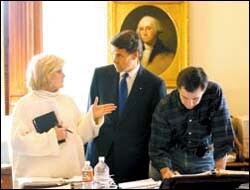
Texas Gov. Rick Perry meets with members of his staff Feb. 9 to polish his State of the State Address, which he delivered Feb. 11. In the speech, Mr. Perry outlined a plan to protect K-12 aid by reducing state mandates. |
Just last week, however, the state’s independent Legislative Budget Board suggested that each state agency come up with a plan to cut its budget 12.5 percent in the next two-year budget cycle. Under those conditions, K-12 education would have to lop $2.8 billion from its current spending level of $29.5 billion.
Mr. Perry, though, in his Feb. 11 speech to the legislature, laid out a blueprint that he says could soften the blow to schools.
For example, he proposed eliminating a host of state mandates, which, in turn, would reduce district spending by an estimated $500 million.
“School districts across this state are diverting precious dollars away from the classroom to pay consultants for audits, to pay for higher utility costs than necessary, and to meet the mandates placed upon them by the state,” the governor said.
Mr. Perry, who was elected to a full, four-year term in November after succeeding President Bush as governor in late 2000, added that districts are required to produce reports on their pest-management systems, recycling programs, and efforts to reduce paperwork.
The oversight of those programs should be left up to the districts themselves, he said. “Local educators and local citizens know what’s best when it comes to the education of their children,” he said.
Karen Soehnge, the associate executive director of government relations for the Texas Association of School Administrators, points out that the legislature has placed new demands on districts without adding funds to help them meet those requirements.
“Local schools had to pick up the costs,” she said. “We believe that there is no doubt that even if just a few of the mandates were repealed, schools could save money.”
But Wayne Pierce, the executive director of the Equity Center, a school funding advocacy group in Austin, doubts the governor’s savings projections.
He agrees that reducing state mandates would certainly free some money for schools. But he added, “This is just a way of the state saying that schools have half a billion dollars when they really don’t.”
Too Optimistic?
In addition, Mr. Perry wants to shift funding from the state’s Telecommunications Infrastructure Fund to the state education department, which would then use the additional funds to raise per-student technology allotments from $30 to $35 without having to tap in to already strained K-12 education funding.
Mr. Perry was optimistic that school aid could be protected, and even increased, without creating new taxes for Texans.
“Texas families don’t want, don’t need, and don’t deserve new taxes,” Mr. Perry said. “Slowdowns in the economy are usually temporary. Tax hikes usually are not.”
While it is conceivable that the state could take care of its budget deficit through cuts in spending, it is not necessarily advisable, said Mr. Pierce.
He also questioned the idea that schools would be spared under Gov. Perry’s proposals. “There have been lots of promises that there will be no cuts to education,” Mr. Pierce said.
The governor also reiterated in his speech that the state needs to solve problems with its school finance system, including its reliance on tax revenue from wealthy districts to help support less affluent ones. (“Texas Bills Would Scrap Finance System,” Feb. 12, 2003.)
Mr. Pierce argued, though, that “we shouldn’t be worrying about taking care of the wealthiest until we’ve taken care of those who are operating on a lot less already.”
Without providing details, the governor also introduced an initiative to reimburse teachers for classroom supplies, a science initiative that he said would increase pay to “expert” science teachers, and a high school completion initiative that would identify students at risk for dropping out of school.



