Opinion
Law & Courts Opinion

Why the Court’s Ruling Against Mandatory Union Dues Is a Good Thing

By Neal McCluskey — June 27, 2018 4 min read
Plaintiff Mark Janus, center, sits with Illinois Gov. Bruce Rauner, left, and Liberty Justice Center founder and chairman John Tillman inside the U.S. Supreme Court as the decision in Janus v AFSCME is delivered. The Illinois-based Liberty Justice Center has been representing Janus in his years-long challenge to union fees.
  • Save to favorites
  • Print

The role of unions in education is highly contentious, eliciting intense emotions both for and against them. To many, unions are the first, most powerful force for protecting and advancing teachers’ interests. To others, they are the most firmly planted, towering obstacles to reforms ranging from value-added assessments to school choice. But today’s Janus v. American Federation of State, County, and Municipal Employees Council 31 ruling should not be viewed through a lens of what is good or bad for unions, but whether justice has been served. And in the U.S. Supreme Court’s finding that public employees cannot be forced to pay agency fees as a condition of government employment, it has been.

The entire idea of constitutional government, which gives specific powers to government and protects rights remaining with the people is, essentially, to declare that ends cannot justify means. You may want a specific outcome, you may even think it is crucial, but the government cannot exceed its delegated power or trample individual rights to get that outcome. Today’s ruling adheres to that foundation, basically saying that no matter how important you think collective bargaining is for balancing the power between employer and employees, obtaining good wages, or amplifying teachers’ voices, those ends cannot trump an individual’s basic right not to pay for speech he or she finds unacceptable.

As Justice Alito writes in the court’s decision, “prominent members of the founding generation condemned laws requiring public employees to affirm or support beliefs with which they disagreed.” He notes that, “Jefferson denounced compelled support for such beliefs as ‘sinful and tyrannical.’”

But what of freeloading? The dissenting employee gets the benefit of the union-bargained contract without paying for the service.

This argument does not pass principled muster, as it essentially declares that one should be forced to pay for a contract even if one dislikes—maybe even hates—its terms. It’s akin to being forced to pay for a restaurant and having no choice about the meal on the grounds that, well, you’re getting fed aren’t you? “But I’m a vegetarian,” you might say, “and can’t even eat this turkey sandwich.”

The decision uses a different analogy, summarizing the petitioner’s argument that, “he is not a free rider on a bus headed for a destination that he wishes to reach but is more like a person shanghaied for an unwanted voyage.”

Of course, avoiding freeloading cannot justify crushing fundamental rights, even if the person whose rights are being abrogated happens to love the union-bargained contract. As the court states, “the First Amendment does not permit the government to compel a person to pay for another party’s speech just because the government thinks that the speech furthers the interest of the person who does not want to pay.”

It is also impossible to accept that payment earmarked for collective bargaining is not paying for political speech, though the nature of the compelled speech should be irrelevant as a matter of principle. Collective bargaining with a public school district is a political exercise because it involves negotiations with a government entity—yes, they are “government schools”—and efforts to influence what government does are inherently political. Add to this the fact that money is fungible: Dollars forced from agency-fee payers free up voluntary dues for everything from lobbying state capitals to organizing PR campaigns. The notion that forced fees are somehow hermetically sealed off from politics is illusory.

So we should be cheered by today’s ruling. But not, crucially, because it weakens unions. Even if the unions may often stand against reforms you like, there is nothing inherently wrong with members of any profession working collectively for their shared good. Indeed, it is the right of all people to do so. Such action can be an important counterbalance against powerful forces, be they school districts or big corporations. What is crucial is that such collective action be voluntary, and that is what today’s ruling does. It declares force unacceptable.

Perhaps this will even be good for the union movement, despite weakening unions in the short run. Even if they lose many members and significant revenue, they will almost certainly remain for many in the media and government the voices of millions of teachers—and that is where their real power lies. And perhaps the freeing of once-captive funders will incentivize them to work a little harder to convince teachers to join by moderating dues, decreasing some political advocacy that may seem tangential to the functioning of schools, or making teachers feel more heard.

That said, how the unions respond to the Janus ruling, or its effects on the political prospects for education reforms, are ultimately irrelevant to the reason that we should welcome this decision: By protecting basic individual rights, justice was served.

Events

This content is provided by our sponsor. It is not written by and does not necessarily reflect the views of Education Week's editorial staff.
Sponsor
Artificial Intelligence Webinar
Managing AI in Schools: Practical Strategies for Districts
How should districts govern AI in schools? Learn practical strategies for policies, safety, transparency, and responsible adoption.
Content provided by Lightspeed Systems
This content is provided by our sponsor. It is not written by and does not necessarily reflect the views of Education Week's editorial staff.
Sponsor
Artificial Intelligence Webinar
AI in Schools: What 1,000 Districts Reveal About Readiness and Risk
Move beyond “ban vs. embrace” with real-world AI data and practical guidance for a balanced, responsible district policy.
Content provided by Securly
This content is provided by our sponsor. It is not written by and does not necessarily reflect the views of Education Week's editorial staff.
Sponsor
Recruitment & Retention Webinar
K-12 Lens 2026: What New Staffing Data Reveals About District Operations
Explore national survey findings and hear how districts are navigating staffing changes that affect daily operations, workload, and planning.
Content provided by Frontline Education

EdWeek Top School Jobs

Teacher Jobs
Search over ten thousand teaching jobs nationwide — elementary, middle, high school and more.
View Jobs
Principal Jobs
Find hundreds of jobs for principals, assistant principals, and other school leadership roles.
View Jobs
Administrator Jobs
Over a thousand district-level jobs: superintendents, directors, more.
View Jobs
Support Staff Jobs
Search thousands of jobs, from paraprofessionals to counselors and more.
View Jobs

Read Next

Law & Courts Appeals Court Revives Lawsuit Over 1st Grader’s Black Lives Matter Drawing
A court revived a 1st grader 's claim she was punished for giving a drawing to a Black classmate.
4 min read
Seen is the drawing made by Viejo Elementary School first-grader B.B. that was entered into evidence. B.B. gave the drawing to her classmate, M.C., who is African American. M.C. thanked B.B.
Pictured is a drawing by a 1st grader in California and given to a Black classmate that is at the center of a First Amendment legal challenge over the student's alleged punishment.
U.S. Court of Appeals for the 9th Circuit
Law & Courts Supreme Court’s Gender Identity Ruling Leaves Schools Seeking Clarity
Advocates say they would welcome more from the Supreme Court on gender-notification policies.
7 min read
The Supreme Court is photographed, Friday, Feb. 27, 2026, in Washington.
The Supreme Court is photographed, Friday, Feb. 27, 2026, in Washington. The high court recently ruled that California policies that sometimes limit or discourage schools from disclosing information to parents about children’s gender transitions and expressions at school likely violate parents’ constitutional rights
Rahmat Gul/AP
Law & Courts Supreme Court Backs Parents in School Gender Disclosure Fight
The Supreme Court restored an injunction blocking California policies on student gender transitions
8 min read
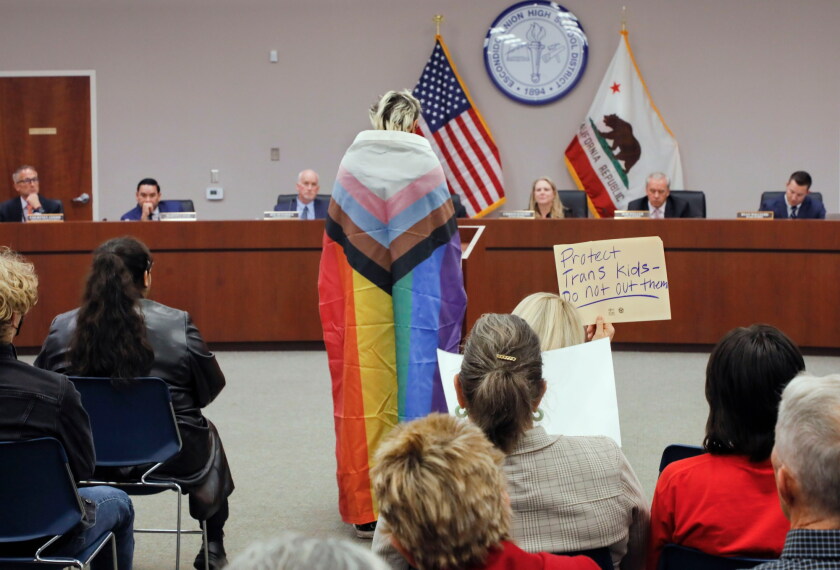
Teacher’s aide Amelia Mester, wrapped in a Pride flag, urges Escondido Union High School District not to have employees notify parents if they believe a student may be transgender in November 2025. A policy on the issue in the city’s elementary school district is the subject of a federal class-action lawsuit in which a judge just sided against the district.
Teacher’s aide Amelia Mester, wrapped in a Pride flag, urges Escondido Union High School District not to have employees notify parents if they believe a student may be transgender at a meeting in November 2025. Two parents and two teachers from the district sued in 2023, challenging California state guidance concerning student gender transitions and parental notification. The U.S. Supreme Court has now reinstated a lower-court decision overturning those state policies.
Charlie Neuman for The San Diego Union-Tribune/TNS
Law & Courts Appeals Court Allows Louisiana Ten Commandments Displays to Proceed
The court said it was premature to rule on the constitutionality of La. Ten Commandments displays.
3 min read
Students work under Ten Commandments and Bill of Rights posters on display in a classroom at Lehman High School in Kyle, Texas, Thursday, Oct. 16, 2025.
Students work under Ten Commandments and Bill of Rights posters on display in a classroom at Lehman High School in Kyle, Texas, Oct. 16, 2025. A federal appeals court has lifted a lower-court injunction blocking a Louisiana law that requires Ten Commandments displays, clearing the way for the law to take effect.
Eric Gay/AP