Opinion
Federal Opinion

Federal Education Reform Has Largely Failed. Unfortunately, We Still Need It

Only a partnership between the federal government and the states has the power to address our greatest educational challenges
By Jack Jennings — June 07, 2024 4 min read
Red, Blue, and Purple colors over a fine line etching of the Capitol building. Republicans and Democrats, Partisan Politicians.
  • Save to favorites
  • Print

From 2001 to 2015, the country was focused as never before on the improvement of public elementary and secondary education, using a federal law, the No Child Left Behind Act of 2001, as the guide. In 2015, NCLB was replaced by a statute, the Every Student Succeeds Act, that reverted to more traditional state control of education.

These reforms largely failed, but the problems calling for national action persist. As a longtime observer of the ways in which federal power can amp up state and local education improvement efforts, I’m persuaded that we need a new partnership now. This joint state-federal program must address the severest challenges facing American schools, challenges that are all too evident in recent results from the National Assessment of Educational Progress.

In 2022, student test scores declined in both reading and mathematics compared with 2019. Students experiencing the greatest difficulties were from Latino and African American families, some other minority-group families, and families with low incomes. In releasing the scores, U.S. Secretary of Education Miguel Cardona said the results constituted “an urgent call to action.”

“Let’s be very clear here,” he explained. “The data prior to the pandemic did not reflect an education system that was on the right track. The pandemic simply made it worse. It took poor performance and dropped it down even further.”

Action needs to come from both the federal government and the states. The truth is that while the states have responsibility for education under our political system, alone they can’t make the changes we need. That was implicitly recognized by Presidents Bill Clinton and George W. Bush, former state governors, who were leaders in the movement that resulted in NCLB. They balanced state and federal roles as they sought to improve education.

NCLB’s drafters, though, chose an unworkable way to gain this improvement. They placed on educators’ shoulders the full responsibility to raise student test scores and used penalties as the means to prod them. When Bush campaigned for NCLB, he put forward the notion that the proposed law would make socioeconomic status irrelevant for school success. It didn’t.

More than 50 years earlier, in 1966, researcher James Coleman concluded from his extensive work that a student’s socioeconomic status—as determined by parents’ income, jobs, and educational attainment—was by far the most important indicator of a student’s success in school. Students from families high on the socioeconomic scale gain the knowledge and skills to do well in school while those from families low on the scale often miss out. His findings have withstood all attacks against them through the NCLB era and beyond.

The problems calling for national action persist.

To counter the socioeconomic disadvantage, schools should make it possible for every student to succeed. The Chicago public schools, for instance, offer students summer programs, after-school programs, and individualized instruction by teachers assisted by specialized coaches. Substantial increases in student achievement have resulted—at a substantial cost.

As essential as it is to offer these programs, America’s roughly 13,300 school districts differ greatly on whether they will do so, reflecting their various levels of financial support and the proportions of their students needing extra services to succeed. State governments should assert their constitutional responsibility to ensure that districts provide meaningful educational opportunities for all their students.

The potency of socioeconomic status, however, is so great that its effects cannot be offset solely by school-based activities, no matter how good they are. A major reason is tax and economic policies that have contributed to rising inequality. The aim of these critical policies should be job creation and higher wages.

President Joe Biden and Congress expanded the Child Tax Credit Program to provide direct, monthly cash payments to more families. That helped to reduce the number of children living in poverty by 50 percent. That outcome, which stabilizes families, should lead over time to higher student achievement. Efforts to make the program permanent are currently stalled in the Senate.
See Also

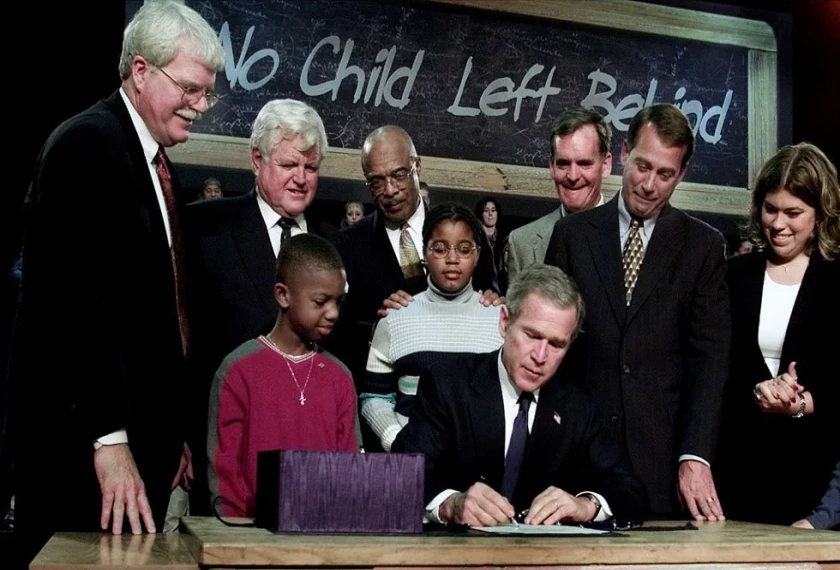
President George W. Bush signs the No Child Left Behind Act at Hamilton High School in Hamilton, Ohio, on Jan. 8, 2002. The NCLB law updated the Elementary and Secondary Education Act and significantly ratcheted up the federal role in education.
Ron Edmonds/AP-File
Every Student Succeeds Act Explainer No Child Left Behind: An Overview
Alyson Klein, April 10, 2015
12 min read

The teacher crisis is another realm where high-level policy changes are needed. Uncertified, undercertified, and emergency/temporary licensed teachers are increasingly employed in American classrooms, especially those with enrollments of children from low-income families. “The current state of the teaching profession is at or near its lowest levels in 50 years,” concluded a 2022 analysis from the Annenberg Center at Brown University.

Lower pay for teachers than for other college graduates, little respect, fewer education school graduates, and accountability programs are among the reasons for this sad state of affairs. Remedies, such as attracting more higher-scoring college students to teaching, need collective consideration. The whole system from recruitment to retirement must be integrated and upgraded.

As the persons most responsible for public education in each state, governors should convene the appropriate parties to find solutions. Only the governor has the stature to undertake and solve such a complicated and political task. It was a governors summit convened by President George H.W. Bush that laid the groundwork for NCLB.

This new partnership must provide leadership and funding to schools instead of demanding more accountability. Extra help for students needing that assistance, building coalitions to advocate fairer tax and economic policies, and finding ways to create and retain a well-educated and trained teaching force should be the outcomes.

We have learned a great deal from earlier efforts to improve education. Now, we have to have the courage and persistence to make the changes that will ensure a good education for all students.

A version of this article appeared in the July 17, 2024 edition of Education Week as NCLB and ESSA Were Both Failures. What Comes Next?

Events

This content is provided by our sponsor. It is not written by and does not necessarily reflect the views of Education Week's editorial staff.
Sponsor
Special Education Webinar
Bridging the Math Gap: What’s New in Dyscalculia Identification, Instruction & State Action
Discover the latest dyscalculia research insights, state-level policy trends, and classroom strategies to make math more accessible for all.
Content provided by TouchMath
This content is provided by our sponsor. It is not written by and does not necessarily reflect the views of Education Week's editorial staff.
Sponsor
School Climate & Safety Webinar
Belonging as a Leadership Strategy for Today’s Schools
Belonging isn’t a slogan—it’s a leadership strategy. Learn what research shows actually works to improve attendance, culture, and learning.
Content provided by Harmony Academy
This content is provided by our sponsor. It is not written by and does not necessarily reflect the views of Education Week's editorial staff.
Sponsor
School & District Management Webinar
Too Many Initiatives, Not Enough Alignment: A Change Management Playbook for Leaders
Learn how leadership teams can increase alignment and evaluate every program, practice, and purchase against a clear strategic plan.
Content provided by Otus

EdWeek Top School Jobs

Teacher Jobs
Search over ten thousand teaching jobs nationwide — elementary, middle, high school and more.
View Jobs
Principal Jobs
Find hundreds of jobs for principals, assistant principals, and other school leadership roles.
View Jobs
Administrator Jobs
Over a thousand district-level jobs: superintendents, directors, more.
View Jobs
Support Staff Jobs
Search thousands of jobs, from paraprofessionals to counselors and more.
View Jobs

Read Next

Federal Trump Talks Up AI in State of the Union, But Not Much Else About Education
The president didn't mention two of his cornerstone education policies from the past year.
4 min read
President Donald Trump enters to deliver the State of the Union address to a joint session of Congress in the House chamber at the U.S. Capitol in Washington, Tuesday, Feb. 24, 2026.
President Donald Trump enters to deliver the State of the Union address to a joint session of Congress in the House chamber at the U.S. Capitol in Washington, Tuesday, Feb. 24, 2026. The president devoted little time in the speech to discussing his education policies.
Kenny Holston/The New York Times via AP, Pool
Federal Education Department Will Send More of Its Programs to Other Agencies
Education grants for school safety, community schools, and family engagement will shift to Health and Human Services.
4 min read
Various school representatives and parent liaisons attend a family and community engagement think tank discussion at Lowery Conference Center on March 13, 2024 in Denver. One of the goals of the meeting was to discuss how schools can better integrate new students and families into the district. Denver Public Schools has six community hubs across the district that have serviced 3,000 new students since October 2023. Each community hub has different resources for families and students catering to what the community needs.
A program that helps state education departments and schools improve family engagement policies is among those the Trump administration will transfer from the U.S. Department of Education to the U.S. Department of Health and Human Services. In this photo, school representatives and parent liaisons attend a family and community engagement discussion on March 13, 2024, in Denver to discuss how schools can better integrate new students and families into the district.
Rebecca Slezak For Education Week
Federal New Trump Admin. Guidance Says Teachers Can Pray With Students
The president said the guidance for public schools would ensure "total protection" for school prayer.
3 min read
MADISON, AL - MARCH 29: Bob Jones High School football players touch the people near them during a prayer after morning workouts and before the rest of the school day on March 29, 2024, in Madison, AL. Head football coach Kelvis White and his brother follow in the footsteps of their father, who was also a football coach. As sports in the United States deals with polarization, Coach White and Bob Jones High School form a classic tale of team, unity, and brotherhood. (Photo by Jahi Chikwendiu/The Washington Post via Getty Images)
Football players at Bob Jones High School in Madison, Ala., pray after morning workouts before the rest of the school day on March 29, 2024. New guidance from the U.S. Department of Education says students and educators can pray at school, as long as the prayer isn't school-sponsored and disruptive to school and classroom activities, and students aren't coerced to participate.
Jahi Chikwendiu/Washington Post via Getty Images
Federal Ed. Dept. Paid Civil Rights Staffers Up to $38 Million as It Tried to Lay Them Off
A report from Congress' watchdog looks into the Trump Admin.'s efforts to downsize the Education Department.
5 min read
Commuters walk past the headquarters of the U.S. Department of Eduction, which were ordered closed for the day for what officials described as security reasons amid large-scale layoffs, on March 12, 2025, in Washington.
The U.S. Department of Education spent up to $38 million last year to pay civil rights staffers who remained on administrative leave while the agency tried to lay them off.
Mark Schiefelbein/AP
