Opinion
Federal Letter to the Editor

AASA Chief Endorses Student Success Act

August 26, 2013 1 min read
  • Save to favorites
  • Print

To the Editor:

In his Commentary “Rokita: Rethinking ESEA With the Student Success Act” (edweek.org, June 28, 2013), U.S. Rep. Todd Rokita, R-Ind., rightly points out that the proposed Student Success Act would reduce the level of federal intrusion and restore educational decisionmaking to states and local officials. This approach provides the foundation for innovation in curriculum, instruction, assessment, and accountability.

All across the country, districts have different needs. The innovations needed to help low-income students, English-language learners, and other high-need students graduate from high school and become college-ready depend on changes that fit the students, staff, and families in their respective communities.

Under the Student Success Act, states would be free to choose approaches that fit their circumstances. Similarly, 40 states and the District of Columbia have been granted waivers from the No Child Left Behind Act allowing them to keep their current systems, modify them, or build better systems because the waivers mean they are free to innovate. School improvement occurs when teachers, principals, superintendents, and parents are encouraged to continuously search for better approaches to increase learning.

As a former superintendent of schools, I know firsthand the positive impact generated by bringing these people together for a common goal.

The Student Success Act is not perfect. That’s why we welcome the opportunity to work with our education policymakers in the U.S. Senate to make improvements. We will look to the Senate bill and any related conference reports to strengthen language to ensure that all public schools—including charters—are treated equitably, to restore maintenance-of-effort language, and to eliminate and avoid proposals aimed at Title I funding portability.

We thank our elected officials for taking a courageous stand. For the first time in more than a decade, we have a bill that would address the problems associated with relying on a single test score, using achievement tests for accountability, and using zero-tolerance accountability instead of recognizing levels of success.

Daniel A. Domenech

Executive Director

AASA, The School Superintendents Association

Alexandria, Va.

Related Tags:

A version of this article appeared in the August 28, 2013 edition of Education Week as AASA Chief Endorses Student Success Act

Events

This content is provided by our sponsor. It is not written by and does not necessarily reflect the views of Education Week's editorial staff.
Sponsor
Artificial Intelligence Webinar
Managing AI in Schools: Practical Strategies for Districts
How should districts govern AI in schools? Learn practical strategies for policies, safety, transparency, and responsible adoption.
Content provided by Lightspeed Systems
This content is provided by our sponsor. It is not written by and does not necessarily reflect the views of Education Week's editorial staff.
Sponsor
Reading & Literacy Webinar
Two Jobs, One Classroom: Strengthening Decoding While Teaching Grade-Level Text
Discover practical, research-informed practices that drive real reading growth without sacrificing grade-level learning.
Content provided by EPS Learning
Jobs Virtual Career Fair for Teachers and K-12 Staff
Find teaching jobs and K-12 education jubs at the EdWeek Top School Jobs virtual career fair.

EdWeek Top School Jobs

Teacher Jobs
Search over ten thousand teaching jobs nationwide — elementary, middle, high school and more.
View Jobs
Principal Jobs
Find hundreds of jobs for principals, assistant principals, and other school leadership roles.
View Jobs
Administrator Jobs
Over a thousand district-level jobs: superintendents, directors, more.
View Jobs
Support Staff Jobs
Search thousands of jobs, from paraprofessionals to counselors and more.
View Jobs

Read Next

Federal Will the Ed. Dept. Act on Recommendations to Overhaul Its Research Arm?
An adviser's report called for more coherence and sped-up research awards at the Institute of Education Sciences.
6 min read
The U.S. Department of Education building is pictured on Oct. 24, 2025, in Washington, D.C.
The U.S. Department of Education building in Washington is pictured on Oct. 24, 2025. A new report from a department adviser calls for major overhauls to the agency's research arm to facilitate timely research and easier-to-use guides for educators and state leaders.
Maansi Srivastava for Education Week
Federal Trump Talks Up AI in State of the Union, But Not Much Else About Education
The president didn't mention two of his cornerstone education policies from the past year.
4 min read
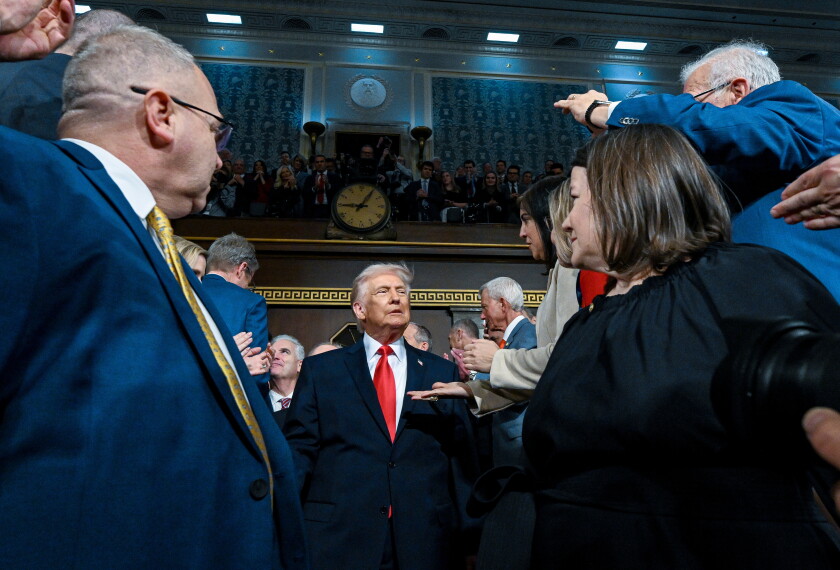
President Donald Trump enters to deliver the State of the Union address to a joint session of Congress in the House chamber at the U.S. Capitol in Washington, Tuesday, Feb. 24, 2026.
President Donald Trump enters to deliver the State of the Union address to a joint session of Congress in the House chamber at the U.S. Capitol in Washington, Tuesday, Feb. 24, 2026. The president devoted little time in the speech to discussing his education policies.
Kenny Holston/The New York Times via AP, Pool
Federal Education Department Will Send More of Its Programs to Other Agencies
Education grants for school safety, community schools, and family engagement will shift to Health and Human Services.
4 min read
Various school representatives and parent liaisons attend a family and community engagement think tank discussion at Lowery Conference Center on March 13, 2024 in Denver. One of the goals of the meeting was to discuss how schools can better integrate new students and families into the district. Denver Public Schools has six community hubs across the district that have serviced 3,000 new students since October 2023. Each community hub has different resources for families and students catering to what the community needs.
A program that helps state education departments and schools improve family engagement policies is among those the Trump administration will transfer from the U.S. Department of Education to the U.S. Department of Health and Human Services. In this photo, school representatives and parent liaisons attend a family and community engagement discussion on March 13, 2024, in Denver to discuss how schools can better integrate new students and families into the district.
Rebecca Slezak For Education Week
Federal New Trump Admin. Guidance Says Teachers Can Pray With Students
The president said the guidance for public schools would ensure "total protection" for school prayer.
3 min read
MADISON, AL - MARCH 29: Bob Jones High School football players touch the people near them during a prayer after morning workouts and before the rest of the school day on March 29, 2024, in Madison, AL. Head football coach Kelvis White and his brother follow in the footsteps of their father, who was also a football coach. As sports in the United States deals with polarization, Coach White and Bob Jones High School form a classic tale of team, unity, and brotherhood. (Photo by Jahi Chikwendiu/The Washington Post via Getty Images)
Football players at Bob Jones High School in Madison, Ala., pray after morning workouts before the rest of the school day on March 29, 2024. New guidance from the U.S. Department of Education says students and educators can pray at school, as long as the prayer isn't school-sponsored and disruptive to school and classroom activities, and students aren't coerced to participate.
Jahi Chikwendiu/Washington Post via Getty Images