
Federal

No ‘Gender Ideology': Ed. Dept.'s New Focus for Mental Health Grants It Yanked

The Trump administration is preparing to award grants under two programs focused on bolstering mental health services in schools
By Brooke Schultz — July 16, 2025 | Updated: July 16, 2025 5 min read
Amelia, 16, sits for a portrait in a park near her home in Illinois on Friday, March 24, 2023. “We are so strong and we go through so, so much," says the teenage girl who loves to sing and wants to be a surgeon. Amelia has also faced bullying, toxic friendships, and menacing threats from a boy at school who said she “deserved to be raped."
  • Save to favorites
  • Print

Updated: This story ws updated to add comments from the Education Department.

The U.S. Department of Education is setting new priorities for roughly $1 billion in school mental health funding after the agency abruptly told former grant recipients their awards would end because they reflected Biden administration policies.

The department, which is expected to publish the proposed priorities in the Federal Register on Thursday, will prioritize recruitment and retention incentives to increase the ranks of credentialed school psychologists and the “respecialization” of people who work in related fields so they can more quickly be certified as school psychologists.

The Education Department said in the document outlining the proposed priorities that it will also prohibit “the use of program funds for promoting or endorsing gender ideology, political activism, racial stereotyping, or hostile environments for students of particular races.”

See Also

Guests listen as President Joe Biden speaks during an event to celebrate the passage of the "Bipartisan Safer Communities Act," a law meant to reduce gun violence, on the South Lawn of the White House, July 11, 2022, in Washington.
Guests listen as then-President Joe Biden speaks during an event to celebrate the passage of the "Bipartisan Safer Communities Act," a law meant to reduce gun violence, on the South Lawn of the White House on July 11, 2022, in Washington. The U.S. Department of Education on April 29 told grantees that had received money to train and hire more mental health professionals in schools that it wouldn't renew their grants.
Evan Vucci/AP
Federal Trump Ends $1 Billion in Mental Health Grants for Schools
Brooke Schultz, April 30, 2025
5 min read

The new priorities come after the department in April notified recipients who received multiyear awards under two grants—the School-Based Mental Health Services Grant Program and the Mental Health Service Professional Demonstration Grant Program—that the funding would end at the conclusion of their current budget period; recipients said at the time that was Dec. 31.

In its message to recipients, the Education Department said it planned to “re-envision and re-compete” the grants based on its new priorities—“merit, fairness, and excellence in education.”

The discontinuation of the funds prompted 16 Democratic state officials to file a lawsuit in federal court earlier this month, arguing that the department’s decision will cause staff layoffs, dry up scholarships for college students who want to be mental health professionals in K-12 schools, and worsen outcomes for hundreds of thousands of students.

The Education Department will accept comments on the proposed priorities, grant requirements, and definitions for 30 days after the July 17 publication in the Federal Register.

What the new priorities say

The two grant programs received a bipartisan infusion of federal funding in recent years after 19 students and two teachers lost their lives in a school shooting in Uvalde, Texas. The Trump administration is now proposing that both will prioritize recruitment and retention of school-based mental health professionals, particularly in high-need schools.

Grants awarded during the previous cycle supported 260 recipients in 49 states, helping them prepare more than 14,000 mental health professionals to work in K-12 schools, the Biden administration said at the time.

Madi Biedermann, a spokesperson for the department, said the agency will use fiscal year 2025 and 2026 funds allocated in the Bipartisan Safer Communities Act for the new awards. The department declined to answer how much funding was left after the previous grant period.

“The Trump administration will review applications based on detailed plans to address the unique mental health needs of a community and pathways to getting high-quality mental health professionals in K-12 schools,” Biedermann said.

See Also

Audience members listen as President Joe Biden speaks during an event to celebrate the passage of the "Bipartisan Safer Communities Act," a law meant to reduce gun violence, on the South Lawn of the White House, July 11, 2022, in Washington, D.C.
Audience members listen as then-President Joe Biden speaks during an event to celebrate the passage of the Bipartisan Safer Communities Act on the South Lawn of the White House on July 11, 2022. The legislation provided funding for two school mental health grants that the Trump administration terminated in late April. Sixteen states are now suing to restore the funding.
Evan Vucci/AP

The School-Based Mental Health Services Grant Program proposals ask state education offices and districts to propose plans to recruit and retain credentialed school psychologists in high-need districts, which it defines as having a ratio of more than 500 students to one school psychologist; high rates of violence, poverty, substance use, suicide, trafficking, or other “adverse childhood experiences"; experience with a traumatic event since the start of the school year; and previous receipt of a Project School Emergency Response grant from the Education Department.

States and districts are also asked to propose plans to grow the numbers of school psychologists who provide intensive mental health services and early intervention and to build capacity to continue the services beyond the grant period.

States can also propose respecialization plans, which would help professionals who have a degree in related fields—such as special education, clinical psychology, or community counseling—obtain a license or certification as a school psychologist.

The Mental Health Service Professional Demonstration Grant Program proposal is largely similar, asking applicants to propose projects designed to train and place school psychology graduate candidates in high-need districts to complete their degrees or increase the ranks of school-based staff who provide intensive services.

Where Trump admin. priorities differ from the Biden administration

The Trump administration’s proposed priorities for both grant programs zero in on a shortage of school psychologists, whereas the Biden administration focused on boosting the ranks of school counselors and social workers, too.

The Biden administration’s priorities for both grant programs, finalized in 2022, also emphasized having school-based mental health providers come from diverse backgrounds, including from the communities of the students they’d be serving. The Mental Health Service Professional Demonstration Grant also prioritized applicants proposing partnerships with historically Black colleges and universities, tribal colleges and universities, and minority-serving institutions.

In terminating the current grant cycle, an Education Department spokesperson said the Biden administration had “deeply flawed priorities” that caused grant recipients to “implement race-based actions like recruiting quotas in ways that have nothing to do with mental health and could hurt the very students the grants are supposed to help.”

But former department staff and other mental health advocates chafed at the depiction. The Biden administration defined “diversity” expansively and built a focus on diversifying the pipeline of mental health professionals into the grant competition, due to research showing that students can do better when they see professionals—educators and mental health specialists—who reflect their community, a former Education Department official said at the time of the grant terminations.

Advocates also argued that the grants were already supporting the training, hiring, and retention of staff and that it was unwise to terminate work that was in progress.

Events

This content is provided by our sponsor. It is not written by and does not necessarily reflect the views of Education Week's editorial staff.
Sponsor
Artificial Intelligence Webinar
Managing AI in Schools: Practical Strategies for Districts
How should districts govern AI in schools? Learn practical strategies for policies, safety, transparency, as well as responsible adoption.
Content provided by Lightspeed Systems
This content is provided by our sponsor. It is not written by and does not necessarily reflect the views of Education Week's editorial staff.
Sponsor
Reading & Literacy Webinar
Unlocking Success for Struggling Adolescent Readers
The Science of Reading transformed K-3 literacy. Now it's time to extend that focus to students in grades 6 through 12.
Content provided by STARI
Jobs Virtual Career Fair for Teachers and K-12 Staff
Find teaching jobs and K-12 education jubs at the EdWeek Top School Jobs virtual career fair.

EdWeek Top School Jobs

Teacher Jobs
Search over ten thousand teaching jobs nationwide — elementary, middle, high school and more.
View Jobs
Principal Jobs
Find hundreds of jobs for principals, assistant principals, and other school leadership roles.
View Jobs
Administrator Jobs
Over a thousand district-level jobs: superintendents, directors, more.
View Jobs
Support Staff Jobs
Search thousands of jobs, from paraprofessionals to counselors and more.
View Jobs

Read Next

Federal Will the Ed. Dept. Act on Recommendations to Overhaul Its Research Arm?
An adviser's report called for more coherence and sped-up research awards at the Institute of Education Sciences.
6 min read
The U.S. Department of Education building is pictured on Oct. 24, 2025, in Washington, D.C.
The U.S. Department of Education building in Washington is pictured on Oct. 24, 2025. A new report from a department adviser calls for major overhauls to the agency's research arm to facilitate timely research and easier-to-use guides for educators and state leaders.
Maansi Srivastava for Education Week
Federal Trump Talks Up AI in State of the Union, But Not Much Else About Education
The president didn't mention two of his cornerstone education policies from the past year.
4 min read
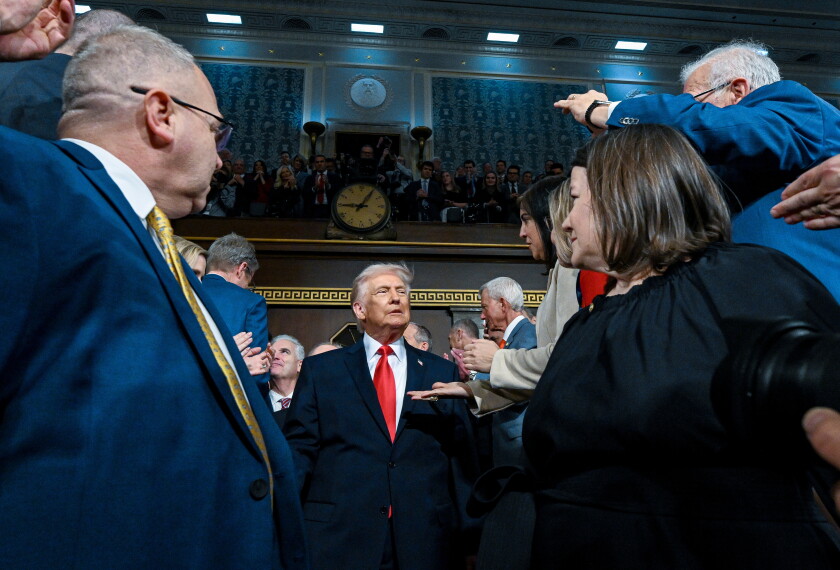
President Donald Trump enters to deliver the State of the Union address to a joint session of Congress in the House chamber at the U.S. Capitol in Washington, Tuesday, Feb. 24, 2026.
President Donald Trump enters to deliver the State of the Union address to a joint session of Congress in the House chamber at the U.S. Capitol in Washington, Tuesday, Feb. 24, 2026. The president devoted little time in the speech to discussing his education policies.
Kenny Holston/The New York Times via AP, Pool
Federal Education Department Will Send More of Its Programs to Other Agencies
Education grants for school safety, community schools, and family engagement will shift to Health and Human Services.
4 min read
Various school representatives and parent liaisons attend a family and community engagement think tank discussion at Lowery Conference Center on March 13, 2024 in Denver. One of the goals of the meeting was to discuss how schools can better integrate new students and families into the district. Denver Public Schools has six community hubs across the district that have serviced 3,000 new students since October 2023. Each community hub has different resources for families and students catering to what the community needs.
A program that helps state education departments and schools improve family engagement policies is among those the Trump administration will transfer from the U.S. Department of Education to the U.S. Department of Health and Human Services. In this photo, school representatives and parent liaisons attend a family and community engagement discussion on March 13, 2024, in Denver to discuss how schools can better integrate new students and families into the district.
Rebecca Slezak For Education Week
Federal New Trump Admin. Guidance Says Teachers Can Pray With Students
The president said the guidance for public schools would ensure "total protection" for school prayer.
3 min read
MADISON, AL - MARCH 29: Bob Jones High School football players touch the people near them during a prayer after morning workouts and before the rest of the school day on March 29, 2024, in Madison, AL. Head football coach Kelvis White and his brother follow in the footsteps of their father, who was also a football coach. As sports in the United States deals with polarization, Coach White and Bob Jones High School form a classic tale of team, unity, and brotherhood. (Photo by Jahi Chikwendiu/The Washington Post via Getty Images)
Football players at Bob Jones High School in Madison, Ala., pray after morning workouts before the rest of the school day on March 29, 2024. New guidance from the U.S. Department of Education says students and educators can pray at school, as long as the prayer isn't school-sponsored and disruptive to school and classroom activities, and students aren't coerced to participate.
Jahi Chikwendiu/Washington Post via Getty Images
