Law & Courts

Mo. Lawmakers Vote to Let Teachers Refriend Facebook

By Dave Helling, Steve Kraske & Mara Rose Williams — September 26, 2011 4 min read
  • Save to favorites
  • Print

———

Missouri lawmakers passed and sent to the governor Friday a bill designed to refriend Facebook and other electronic media for thousands of Missouri’s teachers and students.

Not everyone, however, has decided to “like” it—including Gov. Jay Nixon, who wants to hear what teachers and school boards think.

The Missouri House overwhelmingly passed a repeal of an earlier law barring most private electronic contact between teachers and students, including exchanges on social media websites such as Facebook.

But the new bill does more than just repeal the so-called Facebook law. It also requires local school districts to adopt their own policies by next March, “to prevent improper communications between staff members and students.”

Opponents said that part of the bill would simply allow dozens of Missouri school districts to illegally block electronic interactions between teachers and students.

“We are going to ask the governor to veto the legislation,” said Gary Brunk, executive director of the American Civil Liberties Union of Kansas and Western Missouri. “It could be a nightmare ... these local districts could be all over the place, including (enacting) some things we really don’t like at all.”

But supporters of the repeal said the bill allows districts to tailor policies that best fit the needs of students, teachers, and parents.

“We don’t tell local school districts how to do it at all,” said state Rep. Chris Kelly, a Columbia Democrat, adding the district-by-district approach would help administrators quickly learn the best ways to keep an eye on electronic communications.

Missouri lawmakers—worried about potentially predatory web discussions—approved the original Facebook law last spring as part of a broader measure addressing inappropriate behavior between teachers and students.

That measure prohibited private electronic contact between teachers and students on social media sites, which sponsor state Sen. Jane Cunningham, a St. Louis County Republican, called “a pathway to sexual misconduct.”

But the new law brought complaints from hundreds of teachers and some students. A lawsuit was filed and a judge blocked the law this summer, leading to the repeal debate in the September special legislative session.

Nixon would not indicate Friday whether he will sign the repeal bill. Some lawmakers worry the measure is unconstitutional because it goes beyond the governor’s original request for lawmakers to use the special session to simply repeal the Facebook law.

“We need to interact with some local school boards and some individual teachers to see what their thoughts are,” Nixon told reporters at a news conference. “It appears that they’ve (lawmakers) gone in a broader focus than what my intent was when we brought folks to town.”

While Nixon and others expressed concerns about the Facebook fix, others said they were happy lawmakers were closer to clarifying social media rules that will allow teachers and students to use what’s become an important educational tool.

Mark Enderle, superintendent of the Fort Osage School District, said he supports a district-by-district approach. He opposed the initial, more restrictive proposal.

“It was trying to legislate a solution to a problem that did not exist,” Enderle said. “Social media is how students and teachers communicate ... To deny them access to that tool is a disservice to the student and the staff.”

Student publications teacher Patricia Smith, for example, appreciates the value of text messaging her students. She said not being able to use new technology to communicate with pupils would make her job much tougher.

“I was so upset (by the initial proposal), that I was willing to break the law and I told my principal and superintendent just that,” said Smith, who has taught high school for 13 years. “They were telling me I couldn’t talk to my kids,” she added, her voice cracking with emotion.

Carrie Cox, 17, and editor of the school newspaper, said most students thought the original law was ridiculous.

“It makes me happy that they edited the law to make it more flexible,” she said. “I feel our district will work with us to develop a policy.”

Enderle said district officials, along with parents, already have began discussing what an appropriate policy might look like.

“I’m sure it will be something simple, like communicate on all social media with students and parents being appropriate and professional,” he said.

Andrea Flinders, president of the Kansas City Federation of Teachers, said the repeal bill—if it’s signed into law—will provide clarity for her members.

“Teachers aren’t trying to do anything wrong,” Flinders said. “The sooner the district comes up with the policy, the better off we’re going to be.”

Some districts, Flinders noted already block Facebook on classroom computers — in part because it can be a distraction during the school day.

Meanwhile, several lawmakers said they were embarrassed they caused an uproar among teachers and school administrators. The House measure passed 139-2 on Friday. The Senate passed it earlier by a 33-0 vote.

“When we make errors we need to fix them, and that’s what we’re doing here today,” Kelly said.

Related Tags:

Copyright (c) 2011, The Kansas City Star, Kansas City, Mo. Distributed by McClatchy-Tribune Information Services.

Events

This content is provided by our sponsor. It is not written by and does not necessarily reflect the views of Education Week's editorial staff.
Sponsor
School & District Management Webinar
Too Many Initiatives, Not Enough Alignment: A Change Management Playbook for Leaders
Learn how leadership teams can increase alignment and evaluate every program, practice, and purchase against a clear strategic plan.
Content provided by Otus
This content is provided by our sponsor. It is not written by and does not necessarily reflect the views of Education Week's editorial staff.
Sponsor
Artificial Intelligence Webinar
Beyond Teacher Tools: Exploring AI for Student Success
Teacher AI tools only show assigned work. See how TrekAi's student-facing approach reveals authentic learning needs and drives real success.
Content provided by TrekAi
This content is provided by our sponsor. It is not written by and does not necessarily reflect the views of Education Week's editorial staff.
Sponsor
College & Workforce Readiness Webinar
Building for the Future: Igniting Middle Schoolers’ Interest in Skilled Trades & Future-Ready Skills
Ignite middle schoolers’ interest in skilled trades with hands-on learning and real-world projects that build future-ready skills.
Content provided by Project Lead The Way

EdWeek Top School Jobs

Teacher Jobs
Search over ten thousand teaching jobs nationwide — elementary, middle, high school and more.
View Jobs
Principal Jobs
Find hundreds of jobs for principals, assistant principals, and other school leadership roles.
View Jobs
Administrator Jobs
Over a thousand district-level jobs: superintendents, directors, more.
View Jobs
Support Staff Jobs
Search thousands of jobs, from paraprofessionals to counselors and more.
View Jobs

Read Next

Law & Courts Supreme Court Backs Parents in School Gender Disclosure Fight
The Supreme Court restored an injunction blocking California policies on student gender transitions
8 min read
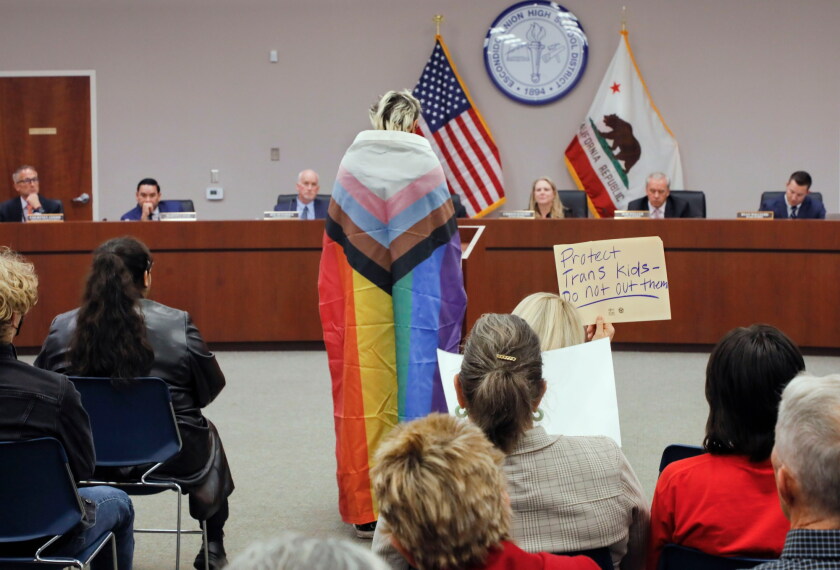
Teacher’s aide Amelia Mester, wrapped in a Pride flag, urges Escondido Union High School District not to have employees notify parents if they believe a student may be transgender in November 2025. A policy on the issue in the city’s elementary school district is the subject of a federal class-action lawsuit in which a judge just sided against the district.
Teacher’s aide Amelia Mester, wrapped in a Pride flag, urges Escondido Union High School District not to have employees notify parents if they believe a student may be transgender at a meeting in November 2025. Two parents and two teachers from the district sued in 2023, challenging California state guidance concerning student gender transitions and parental notification. The U.S. Supreme Court has now reinstated a lower-court decision overturning those state policies.
Charlie Neuman for The San Diego Union-Tribune/TNS
Law & Courts Appeals Court Allows Louisiana Ten Commandments Displays to Proceed
The court said it was premature to rule on the constitutionality of La. Ten Commandments displays.
3 min read
Students work under Ten Commandments and Bill of Rights posters on display in a classroom at Lehman High School in Kyle, Texas, Thursday, Oct. 16, 2025.
Students work under Ten Commandments and Bill of Rights posters on display in a classroom at Lehman High School in Kyle, Texas, Oct. 16, 2025. A federal appeals court has lifted a lower-court injunction blocking a Louisiana law that requires Ten Commandments displays, clearing the way for the law to take effect.
Eric Gay/AP
Law & Courts Social Media Companies Face Legal Reckoning Over Mental Health Harms to Children
Some of the biggest players from Meta to TikTok are getting a chance to make their case in courtrooms around the country.
6 min read
Social Media Kids Trial 26050035983057
Meta CEO Mark Zuckerberg leaves court after testifying in a landmark trial over whether social media platforms deliberately addict and harm children, on Feb. 18, 2026, in Los Angeles.
AP Photo/Damian Dovarganes
Law & Courts Supreme Court Strikes Trump Tariffs in Case Brought by Educational Toy Companies
Two educational toy companies were among the leading challengers to the president's tariff policies
3 min read
Members of the Supreme Court sit for a new group portrait following the addition of Associate Justice Ketanji Brown Jackson, at the Supreme Court building in Washington, Oct. 7, 2022. Bottom row, from left, Associate Justice Sonia Sotomayor, Associate Justice Clarence Thomas, Chief Justice of the United States John Roberts, Associate Justice Samuel Alito, and Associate Justice Elena Kagan. Top row, from left, Associate Justice Amy Coney Barrett, Associate Justice Neil Gorsuch, Associate Justice Brett Kavanaugh, and Associate Justice Ketanji Brown Jackson.
Members of the U.S. Supreme Court sit for a new group portrait following the addition of Justice Ketanji Brown Jackson, at the court building in Washington, Oct. 7, 2022. On Feb. 20, 2026, the court ruled 6-3 to strike down President Donald Trump's broad tariff policies, ruling that they were not authorized by the federal statute that he cited for them.
J. Scott Applewhite/AP