Special Report
Federal

Key Democrats Question Parts of Obama Budget

By Alyson Klein — June 03, 2009 4 min read
  • Save to favorites
  • Print

Includes updates and/or revisions.

Two key Democrats in Congress have expressed skepticism about the Obama administration’s proposal to shift $1 billion out of Title I grants for districts into the separate Title I school improvement program in the fiscal 2010 federal budget.

In separate hearings last week, Sen. Tom Harkin of Iowa and Rep. David R. Obey of Wisconsin told U.S. Secretary of Education Arne Duncan that they were worried about the long-term impact of reducing the annual funding level for the federal Title I district-grant program, which helps disadvantaged students.

In its fiscal 2010 budget proposal, the administration justified the change by pointing to a $10 billion increase that the Title I grant program for districts received in the American Recovery and Reinvestment Act, the stimulus measure that includes up to $100 billion for education, spread out over fiscal years 2009 and 2010.

But Sen. Harkin, who chairs the Senate Appropriations subcommittee that deals with education, said he was worried that reducing the level of the Title I grants program could make it harder to maintain the program’s funding after the one-time economic-stimulus money funding goes away.

“For this year and next year, things are fine,” he told the education secretary at the June 3 hearing. “You can say, well, this is OK because we have all this money in the [stimulus program]. But the problem with that is, you cut the base. If you cut the base this year, you have to make all that up” in fiscal 2011.

And, at a hearing later that same day, Rep. Obey expressed concern that the proposal could lessen the impact of the Title I money in the stimulus package because districts would have to use that money to “backfill” the difference between their 2009 and 2010 allocations.

Secretary Duncan, who was testifying before Rep. Obey’s Appropriations subcommittee on the administration’s budget proposal for education, said he’s committed to the Title I program, although he did not give specific numbers for future funding.

“We hope to resume our initial commitment to funding” the Title I district grants, Mr. Duncan said. But, he added, “in the short term, we need increased funding for school turnaround efforts.”

Another Obama administration proposal appeared to be a tough sell with some congressional Democrats: the increase proposed for the Teacher Incentive Fund, or TIF, which awards grants for pay-for-performance programs. (“Obama Budget Choices Scrutinized,” May 20, 2009.)

The president is seeking to boost funding for TIF to $487.3 million in fiscal 2010, up from $97 million in the current budget year, which ends Sept. 30. That major hike would come on top of $200 million for TIF in the stimulus law.

“I’m concerned, quite frankly, about the direction some of your budget decisions would take us,” Rep. Obey said to Secretary Duncan. “You propose a large increase for the Teacher Incentive Fund … even though the Department [of Education] has yet to complete any rigorous evaluation effort [of the program], which began four years ago.”

TIF Safeguards?

Sen. Patty Murray, D-Wash., had brought up similar concerns during the Senate hearing, asking Mr. Duncan whether he could point to any studies that demonstrate TIF’s effectiveness. The education secretary talked about his positive experience with a TIF grant when he headed the Chicago school system. He said the grants only went to schools where 75 percent of teachers said they wanted them.

But Sen. Murray didn’t sound assuaged. While she said the program’s purpose “sounds good when [Mr. Duncan] says it,” she wants to make sure there are safeguards to make sure that the money isn’t used for programs that give out “subjective rewards” to educators.

Secretary Duncan said the grants wouldn’t go to schools that “pit teachers against each other” and said he’d work with Sen. Murray on his plan for the program.

Both Sen. Harkin and Rep. Obey also questioned the administration’s proposal to shift the Pell Grant program for college students to the mandatory side of the budget ledger from the discretionary side.

During the House hearing, Rep. Lucille Roybal-Allard, D-Calif., complained about a proposed cut to the Education Technology State Grants, which were financed at $270 million for fiscal 2009, but are slated for just $100 million under the Obama budget proposal. Rep. Roybal-Allard didn’t seem to think that including $650 million for the program in the stimulus package made up for the discrepancy.

Mr. Duncan also encountered some pushback on the administration’s proposal to zero out the $66.5 million Even Start family-literacy program.

In response, Secretary Duncan reiterated the Obama administration’s commitment to funding early-childhood programs and pointed to national studies that have questioned the effectiveness of the Even Start program.
A version of this article appeared in the June 10, 2009 edition of Education Week as Harkin Skeptical on Title I Grant Shift

Events

This content is provided by our sponsor. It is not written by and does not necessarily reflect the views of Education Week's editorial staff.
Sponsor
Artificial Intelligence Webinar
AI in Schools: What 1,000 Districts Reveal About Readiness and Risk
Move beyond “ban vs. embrace” with real-world AI data and practical guidance for a balanced, responsible district policy.
Content provided by Securly
This content is provided by our sponsor. It is not written by and does not necessarily reflect the views of Education Week's editorial staff.
Sponsor
Recruitment & Retention Webinar
K-12 Lens 2026: What New Staffing Data Reveals About District Operations
Explore national survey findings and hear how districts are navigating staffing changes that affect daily operations, workload, and planning.
Content provided by Frontline Education
Education Funding Webinar Congress Approved Next Year’s Federal School Funding. What’s Next?
Congress passed the budget, but uncertainty remains. Experts explain what districts should expect from federal education policy next.

EdWeek Top School Jobs

Teacher Jobs
Search over ten thousand teaching jobs nationwide — elementary, middle, high school and more.
View Jobs
Principal Jobs
Find hundreds of jobs for principals, assistant principals, and other school leadership roles.
View Jobs
Administrator Jobs
Over a thousand district-level jobs: superintendents, directors, more.
View Jobs
Support Staff Jobs
Search thousands of jobs, from paraprofessionals to counselors and more.
View Jobs

Read Next

Federal Ed. Dept. Wants to Revamp Assistance Program It Calls 'Duplicative,' 'Confusing'
The department's Comprehensive Centers have already been through a year of shakeups.
3 min read
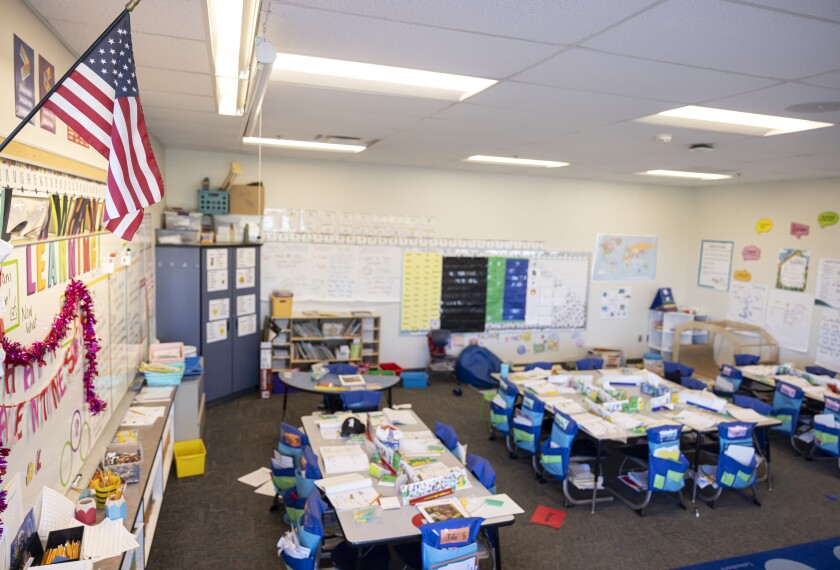
A first grade classroom at a school in Colorado Springs, on Feb. 12, 2026.
A 1st grade classroom at a school in Colorado Springs, Colo., on Feb. 12, 2026. The U.S. Department of Education released a proposal to rework a decades-old program charged with helping states and school districts problem-solve and deploy new initiatives, calling the current structure “duplicative” and “confusing.”
Kevin Mohatt for Education Week
Federal Will the Ed. Dept. Act on Recommendations to Overhaul Its Research Arm?
An adviser's report called for more coherence and sped-up research awards at the Institute of Education Sciences.
6 min read
The U.S. Department of Education building is pictured on Oct. 24, 2025, in Washington, D.C.
The U.S. Department of Education building in Washington is pictured on Oct. 24, 2025. A new report from a department adviser calls for major overhauls to the agency's research arm to facilitate timely research and easier-to-use guides for educators and state leaders.
Maansi Srivastava for Education Week
Federal Trump Talks Up AI in State of the Union, But Not Much Else About Education
The president didn't mention two of his cornerstone education policies from the past year.
4 min read
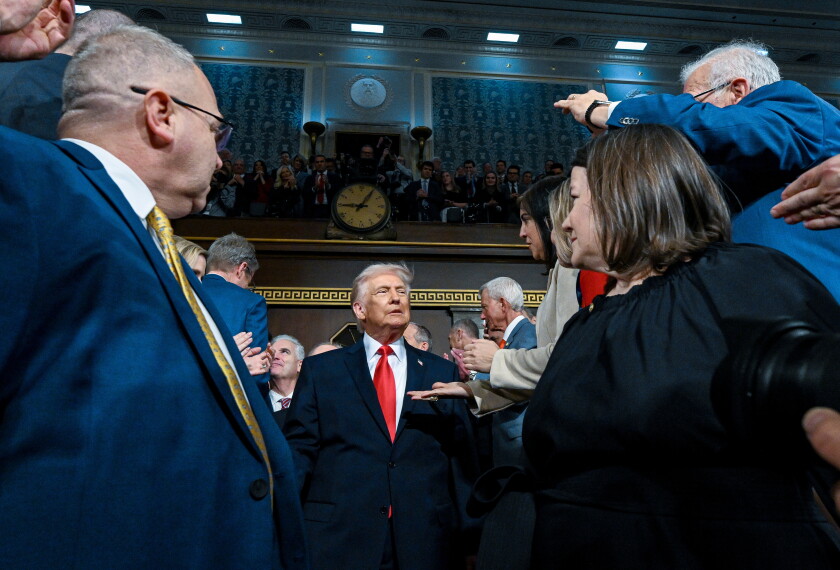
President Donald Trump enters to deliver the State of the Union address to a joint session of Congress in the House chamber at the U.S. Capitol in Washington, Tuesday, Feb. 24, 2026.
President Donald Trump enters to deliver the State of the Union address to a joint session of Congress in the House chamber at the U.S. Capitol in Washington, Tuesday, Feb. 24, 2026. The president devoted little time in the speech to discussing his education policies.
Kenny Holston/The New York Times via AP, Pool
Federal Education Department Will Send More of Its Programs to Other Agencies
Education grants for school safety, community schools, and family engagement will shift to Health and Human Services.
4 min read
Various school representatives and parent liaisons attend a family and community engagement think tank discussion at Lowery Conference Center on March 13, 2024 in Denver. One of the goals of the meeting was to discuss how schools can better integrate new students and families into the district. Denver Public Schools has six community hubs across the district that have serviced 3,000 new students since October 2023. Each community hub has different resources for families and students catering to what the community needs.
A program that helps state education departments and schools improve family engagement policies is among those the Trump administration will transfer from the U.S. Department of Education to the U.S. Department of Health and Human Services. In this photo, school representatives and parent liaisons attend a family and community engagement discussion on March 13, 2024, in Denver to discuss how schools can better integrate new students and families into the district.
Rebecca Slezak For Education Week