Law & Courts

Kentucky’s New Dropout Law Could Face Legal Challenges

By Valarie Honeycutt Spears, Lexington Herald-Leader — July 20, 2015 2 min read
  • Save to favorites
  • Print

Kentucky’s new law that raises the school dropout age from 16 to 18 could be in for both a legal challenge and revision from the 2016 General Assembly.

The idea behind the law, which went into effect July 1, is to increase the percentage of high school graduates and better prepare students for careers or college.

But some dropouts who are close to earning a GED, or general equivalency diploma, would be required to go back to high school and could not take the GED exam until after they turn 18. They would be considered truant if they do not return to school.

Some lawmakers are getting complaints about that unintended consequence.

“We may have to address this in the 2016 session,” said state Sen. Tom Buford, R-Nicholasville.

There is no doubt that getting a high school diploma will result in students becoming better citizens, said Buford. But he said the law has caused problems for some students and parents.

One of the issues, said Buford, is “how do we provide care for young women with children?”

The story of one young mother, Alexis Barnett, 17, of Lexington, was featured in Sunday’s Herald-Leader.

“We need to provide day care if we force them to attend. We did not address this in the bill,” Buford said.

Rep. Derrick Graham, D-Frankfort, who is House Education Committee chairman, said he had heard similar concerns and that he would talk to General Assembly leaders and the bill’s sponsors to see if anything can be done to deal with unintended consequences.

The bill’s sponsor, Sen. David Givens, R-Greensburg, said he had not received complaints. “Certainly we are open to taking a look at addressing issues that may exist,” he said. “However, the phased-in approach that we took with the original legislation should have provided ample time for both school districts and students to be aware that this is happening.”

There are advocates for children who are considering litigation regarding the law, said Rebecca Ballard DiLoreto, director of litigation for the Children’s Law Center.

Kentucky puts children in juvenile detention centers for offenses such as truancy. They are housed with those faced with prosecution in adult court on serious felony crimes, she said.

“The school district is not necessarily providing any additional support for these kids. That is our concern,” said DiLoreto.

Any change in the law next year is not going to come in time for dropouts required to attend school this fall, she said.

Terry Brooks, executive director of Kentucky Youth Advocates, said he doesn’t think there was ever an intent to punish teens who had dropped out before the law was passed, but who have not yet turned 18.

“The K-12 community and state leaders do have a real opportunity — and obligation — to become imaginative in working with young people who have dropped out before the law or those now in the throes of making a bad dropping-out decision,” he said.

The state could focus on alternative and technology/trade programs “to draw in — rather than suppress — vulnerable kids,” he said. “In a lot of ways, this issue is a pivot point. Are we only going to comply with the law? In which case, young people may pay unintended prices. Or is it about a commitment to the spirit of the law, in which case innovative options will flourish, giving vulnerable youth a track to a productive future.”

Copyright (c) 2015 Lexington Herald-Leader, Kentucky. Distributed by McClatchy-Tribune Information Services.

Events

This content is provided by our sponsor. It is not written by and does not necessarily reflect the views of Education Week's editorial staff.
Sponsor
Artificial Intelligence Webinar
Managing AI in Schools: Practical Strategies for Districts
How should districts govern AI in schools? Learn practical strategies for policies, safety, transparency, and responsible adoption.
Content provided by Lightspeed Systems
This content is provided by our sponsor. It is not written by and does not necessarily reflect the views of Education Week's editorial staff.
Sponsor
Reading & Literacy Webinar
Two Jobs, One Classroom: Strengthening Decoding While Teaching Grade-Level Text
Discover practical, research-informed practices that drive real reading growth without sacrificing grade-level learning.
Content provided by EPS Learning
Jobs Virtual Career Fair for Teachers and K-12 Staff
Find teaching jobs and K-12 education jubs at the EdWeek Top School Jobs virtual career fair.

EdWeek Top School Jobs

Teacher Jobs
Search over ten thousand teaching jobs nationwide — elementary, middle, high school and more.
View Jobs
Principal Jobs
Find hundreds of jobs for principals, assistant principals, and other school leadership roles.
View Jobs
Administrator Jobs
Over a thousand district-level jobs: superintendents, directors, more.
View Jobs
Support Staff Jobs
Search thousands of jobs, from paraprofessionals to counselors and more.
View Jobs

Read Next

Law & Courts Supreme Court’s Gender Identity Ruling Leaves Schools Seeking Clarity
Advocates say they would welcome more from the Supreme Court on gender-notification policies.
7 min read
The Supreme Court is photographed, Friday, Feb. 27, 2026, in Washington.
The Supreme Court is photographed, Friday, Feb. 27, 2026, in Washington. The high court recently ruled that California policies that sometimes limit or discourage schools from disclosing information to parents about children’s gender transitions and expressions at school likely violate parents’ constitutional rights
Rahmat Gul/AP
Law & Courts Supreme Court Backs Parents in School Gender Disclosure Fight
The Supreme Court restored an injunction blocking California policies on student gender transitions
8 min read
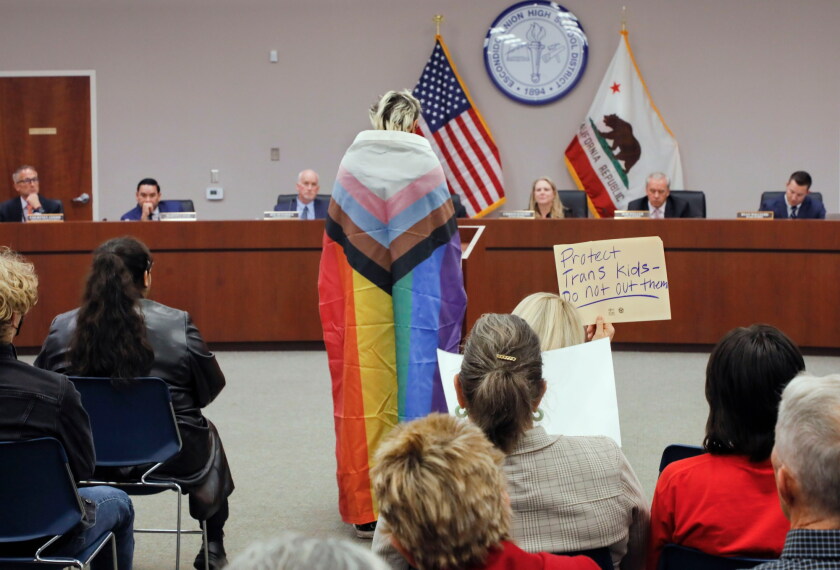
Teacher’s aide Amelia Mester, wrapped in a Pride flag, urges Escondido Union High School District not to have employees notify parents if they believe a student may be transgender in November 2025. A policy on the issue in the city’s elementary school district is the subject of a federal class-action lawsuit in which a judge just sided against the district.
Teacher’s aide Amelia Mester, wrapped in a Pride flag, urges Escondido Union High School District not to have employees notify parents if they believe a student may be transgender at a meeting in November 2025. Two parents and two teachers from the district sued in 2023, challenging California state guidance concerning student gender transitions and parental notification. The U.S. Supreme Court has now reinstated a lower-court decision overturning those state policies.
Charlie Neuman for The San Diego Union-Tribune/TNS
Law & Courts Appeals Court Allows Louisiana Ten Commandments Displays to Proceed
The court said it was premature to rule on the constitutionality of La. Ten Commandments displays.
3 min read
Students work under Ten Commandments and Bill of Rights posters on display in a classroom at Lehman High School in Kyle, Texas, Thursday, Oct. 16, 2025.
Students work under Ten Commandments and Bill of Rights posters on display in a classroom at Lehman High School in Kyle, Texas, Oct. 16, 2025. A federal appeals court has lifted a lower-court injunction blocking a Louisiana law that requires Ten Commandments displays, clearing the way for the law to take effect.
Eric Gay/AP
Law & Courts Supreme Court Strikes Trump Tariffs in Case Brought by Educational Toy Companies
Two educational toy companies were among the leading challengers to the president's tariff policies
3 min read
Members of the Supreme Court sit for a new group portrait following the addition of Associate Justice Ketanji Brown Jackson, at the Supreme Court building in Washington, Oct. 7, 2022. Bottom row, from left, Associate Justice Sonia Sotomayor, Associate Justice Clarence Thomas, Chief Justice of the United States John Roberts, Associate Justice Samuel Alito, and Associate Justice Elena Kagan. Top row, from left, Associate Justice Amy Coney Barrett, Associate Justice Neil Gorsuch, Associate Justice Brett Kavanaugh, and Associate Justice Ketanji Brown Jackson.
Members of the U.S. Supreme Court sit for a new group portrait following the addition of Justice Ketanji Brown Jackson, at the court building in Washington, Oct. 7, 2022. On Feb. 20, 2026, the court ruled 6-3 to strike down President Donald Trump's broad tariff policies, ruling that they were not authorized by the federal statute that he cited for them.
J. Scott Applewhite/AP
