
In a relatively quiet election year at the state level, the high-profile governor running for re-election in New Jersey will attempt to defend and build on the big changes he initiated in the areas of teacher tenure and state control of struggling districts. And in Virginia, where the incumbent is term-limited, the governor’s contest could determine the future of major K-12 policy changes enacted this year.
The two states are the only ones with gubernatorial and legislative elections next fall, although in Virginia, only the House of Delegates has seats up for grabs. (By contrast, 2014 will bring 36 gubernatorial races, and all but four states will hold state legislative elections next year.)
New Jersey Gov. Chris Christie, a Republican, has already tried to steal the thunder of his presumptive Democratic opponent, state Sen. Barbara Buono, on education.
In Virginia, meanwhile, school finance and differentiated diplomas have emerged as early issues for Republican candidate Kenneth T. Cuccinelli II, the state attorney general, and Democrat Terry McAuliffe, a former chairman of the Democratic National Committee, who are vying to succeed Republican Gov. Robert F. McDonnell.
Garden State Showdown
During his first term as New Jersey governor, Mr. Christie has pushed significant changes to teacher tenure through a legislature controlled by Democrats, and clashed vociferously with teachers’ unions, some of his most prominent foes in the state.
He and Commissioner of Education Christopher Cerf—who was appointed by Mr. Christie in 2011 and confirmed by the state Senate last year—also received approval for a waiver of provisions of the federal No Child Left Behind Act. That flexibility expands the state’s authority over low-performing schools. The state can close schools that don’t respond to the turnaround plans specified in the approved waiver.
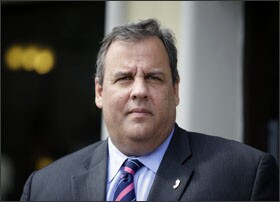
A campaign spokesman for Mr. Christie, Kevin Roberts, stressed the bipartisan agreements the governor has crafted with lawmakers and his work with the Newark teachers’ union to create a merit-pay system in that district.
He said Mr. Christie’s preferred approach is not top-down control but “hands-on, ground-level reform,” in contrast to what he characterized as the approach of past Democratic administrations.

“The calling card here has been one of engagement, across the board,” Mr. Roberts said. He denied that Mr. Christie’s policy moves, which rely on Regional Achievement Centers to monitor low-performing schools and potentially revamp their curricula and learning-time requirements, amount to “full-blown takeovers” of districts.
New Jersey has a 20-year history of taking over troubled districts under its then-groundbreaking state-takeover law, but the results have been controversial.
In Gov. Christie’s first television campaign ad, released May 1, he says he has provided “the most education funding ever” to schools, and has provided merit pay “to reward New Jersey’s best teachers.”
Mr. Roberts said the governor plans to increase education funding if re-elected, while also seeking to end last-in, first-out teacher-layoff policies.
The Christie administration also plans to continue a push for tax-credit-supported scholarships, a form of tuition vouchers, although Mr. Roberts stressed they would be available only in a handful of low-performing districts with high levels of poverty.
“We do think there is a bipartisan appetite for this sort of program,” the spokesman said. An analysis of the Christie campaign’s May 1 ad by PolitiFact New Jersey, a news fact-checking organization, said that while its claim about record K-12 funding was true, the ad left out the fact that Mr. Christie had previously made deep cuts to state public school aid of nearly $1 billion. The state supreme court ruled in 2011 that the cuts violated state law.
The governor’s proposed fiscal 2014 budget contains $9.7 billion for K-12 education, a $97.3 million increase from fiscal 2013.
The analysis also said the ad failed to mention that teacher merit pay applied only in Newark.
Clash Over Finance
Mr. Christie’s boasts about K-12 finance are a sham, contends Ms. Buono, who says that as Senate majority leader she took a prime role in fighting his previous cuts in state aid to districts.
She also says that about 60 percent of districts are receiving less money in the governor’s budget than they did in fiscal 2010. She cites research from the Newark-based Education Law Center, which opposes many of Mr. Christie’s policies and pushes for equitable K-12 funding.
Sen. Buono has also criticized the Christie administration for “bungling” the state’s Race to the Top application in 2010, and has highlighted her role in investigating the failed bid for a federal grant.
A paperwork error in the state’s application may have cost the state its attempt to land $400 million, and led Mr. Christie to fire then-Commissioner Bret Schundler later that year.
Ms. Buono also opposes the governor’s tax-credit-scholarship plan.
The Democrat has a significant history of her own when it comes to education funding. She was a co-author of the 2008 law that significantly increased state education spending—the law that the New Jersey Supreme Court in its 2011 ruling said Mr. Christie violated.
A spokesman for the senator, David Turner, said that she is also concerned about the nature of Mr. Christie’s efforts to increase the state’s role in struggling schools, given the problems similar undertakings in New Jersey have encountered previously.
“The most critical piece of the effort to reform public schools is local input and having local communities be a part of that effort,” Mr. Turner said.
Old Dominion Outlook
In the Virginia governor’s race, neither candidate has raised K-12 as a major issue so far, although it could easily become one.
Citing his belief that “not every child dreams of going to college,” Mr. Cuccinelli, the Republican, says he wants more “high-tech trade” and vocational high schools. The idea is reminiscent of the successful push this year in neighboring North Carolina by Gov. Pat McCrory, a Republican, to have differentiated diplomas.
Mr. Cuccinelli also wants parents to be able to remove their children from failing schools, and last year supported legislation to provide tax-credit scholarships to private schools for low-income students. (Mr. McDonnell ultimately signed that legislation.)
Mr. McAuliffe, the Democrat, has criticized the state for a decline in per-student spending on K-12 even as enrollment has increased. A report from the Virginia Senate education committee said per-pupil funding fell by 8.6 percent from fiscal 2009 to fiscal 2013, while enrollment grew by 2.7 percent from academic years 2007-08 to 2012-13, according to the state education department.
Gov. McDonnell broke ground on new K-12 policies this year, such as a law that creates an “opportunity education district” through which the state can assume control of struggling schools, said Robert Pianta, the dean of the Curry School of Education at the University of Virginia. Another new law mandates the grading of schools according to an A-F system. But it’s unclear whether either candidate will pursue other K-12 initiatives, such as giving the state the authority to approve new charter schools. Only a handful of schools are now eligible for the state-run district.
“I just don’t know what the appetite will be for increasing the flow of failing schools into the [state-run] district,” Mr. Pianta said.
Given the importance of public education to Virginia’s economy, and given that both candidates focus heavily on economics and jobs in their campaigns, “they’ve paid very, very little attention” to education, Mr. Pianta said.


