Law & Courts

Justices Decline Request To Add Parents to Pledge Of Allegiance Case

By Caroline Hendrie — February 04, 2004 3 min read
  • Save to favorites
  • Print

The U.S. Supreme Court last week turned down a request by an atheist father to have two like-minded parents added to his case challenging a California school district’s policy of reciting the Pledge of Allegiance.

Michael A. Newdow had hoped that adding the couple would settle questions about his own legal standing to wage his court battle against the pledge, which he believes violates the U.S. Constitution because of its reference to “one nation under God.”

In a ruling that touched off a political furor, the federal appeals court in San Francisco held in 2002 that classroom recitations of the pledge effectively endorse monotheism and thus violate parents’ rights to send their children to schools free from religious indoctrination.

The Elk Grove Unified School District, where Dr. Newdow’s daughter attends 4th grade, argues that Dr. Newdow lacks standing because of questions related to a custody battle between him and the girl’s mother, a Christian who does not object to the pledge.

In agreeing to take up the district’s appeal, the high court said it would specifically consider the question of Dr. Newdow’s legal standing, as well as whether Elk Grove’s policy of requiring teacher-led recitations of the pledge violates the First Amendment’s prohibition of government-established religion (“Pledge Case to Go Before High Court,” Oct. 22, 2003.) The court is set to hear oral arguments in Elk Grove Unified School District v. Newdow (Case No. 02-1624) on March 24. Dr. Newdow, a physician who also has a law degree, plans to represent himself.

Dr. Newdow’s Dec. 30 motion to add parties to the case featured a statement from an atheist couple with a child in the Elk Grove schools who said they were “in total agreement” with him about the pledge.

“To have that religious indoctrination—or any religious indoctrination—performed by public school employees in the public school setting is directly contrary to our wishes in guiding our child’s religious upbringing,” said the couple, who were identified in court papers by the pseudonyms Jan and Pat Doe.

Describing the couple as “happily married,” Dr. Newdow argued that allowing them to join the case would render the custody issue moot, “and the court would be able to attend to the extremely important Establishment Clause issues without the needless dilution of its limited and valuable resources.”

In his motion, Dr. Newdow pointed to other cases in which the high court agreed to add parties to resolve questions of standing, including a school desegregation case in which students were added to replace those who were graduating.

But court papers filed by the Bush administration, which is supporting the 55,000-student Elk Grove district in the dispute, countered that the justices cannot add parties to give a case proper legal footing if such standing did not exist in the first place, as it did in the desegregation case.

The high court denied Dr. Newdow’s motion without comment on Jan. 26.

Youth Death Penalty

Meanwhile, the justices agreed last week to consider the question of whether the death penalty should be abolished for juvenile offenders.

In Roper v. Simmons (No. 03-633), the high court agreed on Jan. 26 to accept the appeal of a ruling last August in which the Missouri Supreme Court overturned a death sentence against Christopher Simmons. Mr. Simmons was a 17-year-old high school student when he murdered a woman in 1993 by throwing her off a bridge after burglarizing her home.

The state high court held in the case that imposing capital punishment on offenders who were under 18 at the time of their crimes violates the Eighth Amendment’s prohibition on cruel and unusual punishments.

Arguing that the U.S. Supreme Court should not consider the state’s appeal, lawyers for Mr. Simmons cited figures suggesting that the number of minors sentenced to death is on the wane, and that the actual execution of juvenile offenders has become rare nationally, except in the state of Texas.

But the state argued in court papers that the Supreme Court’s guidance was needed to settle the important question of how old offenders must be before their crimes may warrant capital punishment, “particularly in an era when the imposition of adult penalties on juvenile offenders has become more common.”

Events

This content is provided by our sponsor. It is not written by and does not necessarily reflect the views of Education Week's editorial staff.
Sponsor
Artificial Intelligence Webinar
AI in Schools: What 1,000 Districts Reveal About Readiness and Risk
Move beyond “ban vs. embrace” with real-world AI data and practical guidance for a balanced, responsible district policy.
Content provided by Securly
This content is provided by our sponsor. It is not written by and does not necessarily reflect the views of Education Week's editorial staff.
Sponsor
Recruitment & Retention Webinar
K-12 Lens 2026: What New Staffing Data Reveals About District Operations
Explore national survey findings and hear how districts are navigating staffing changes that affect daily operations, workload, and planning.
Content provided by Frontline Education
Education Funding Webinar Congress Approved Next Year’s Federal School Funding. What’s Next?
Congress passed the budget, but uncertainty remains. Experts explain what districts should expect from federal education policy next.

EdWeek Top School Jobs

Teacher Jobs
Search over ten thousand teaching jobs nationwide — elementary, middle, high school and more.
View Jobs
Principal Jobs
Find hundreds of jobs for principals, assistant principals, and other school leadership roles.
View Jobs
Administrator Jobs
Over a thousand district-level jobs: superintendents, directors, more.
View Jobs
Support Staff Jobs
Search thousands of jobs, from paraprofessionals to counselors and more.
View Jobs

Read Next

Law & Courts Supreme Court’s Gender Identity Ruling Leaves Schools Seeking Clarity
Advocates say they would welcome more from the Supreme Court on gender-notification policies.
7 min read
The Supreme Court is photographed, Friday, Feb. 27, 2026, in Washington.
The Supreme Court is photographed, Friday, Feb. 27, 2026, in Washington. The high court recently ruled that California policies that sometimes limit or discourage schools from disclosing information to parents about children’s gender transitions and expressions at school likely violate parents’ constitutional rights
Rahmat Gul/AP
Law & Courts Supreme Court Backs Parents in School Gender Disclosure Fight
The Supreme Court restored an injunction blocking California policies on student gender transitions
8 min read
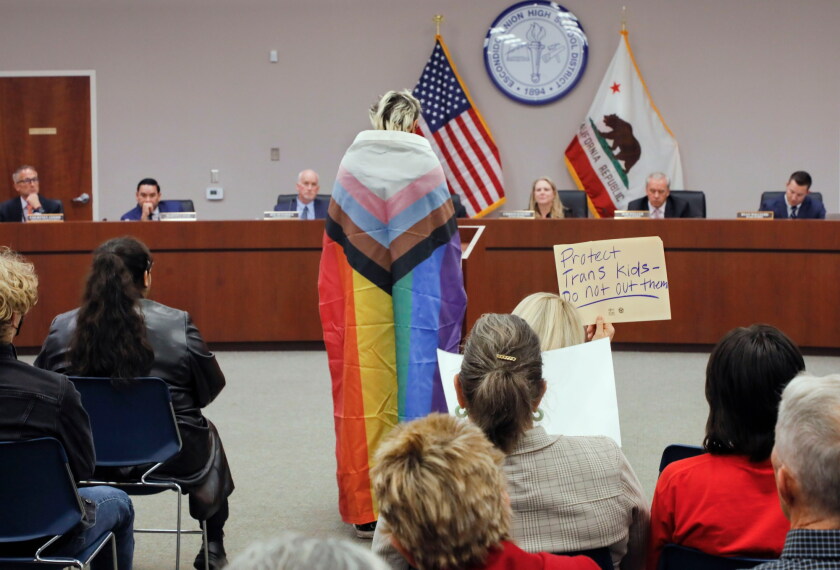
Teacher’s aide Amelia Mester, wrapped in a Pride flag, urges Escondido Union High School District not to have employees notify parents if they believe a student may be transgender in November 2025. A policy on the issue in the city’s elementary school district is the subject of a federal class-action lawsuit in which a judge just sided against the district.
Teacher’s aide Amelia Mester, wrapped in a Pride flag, urges Escondido Union High School District not to have employees notify parents if they believe a student may be transgender at a meeting in November 2025. Two parents and two teachers from the district sued in 2023, challenging California state guidance concerning student gender transitions and parental notification. The U.S. Supreme Court has now reinstated a lower-court decision overturning those state policies.
Charlie Neuman for The San Diego Union-Tribune/TNS
Law & Courts Appeals Court Allows Louisiana Ten Commandments Displays to Proceed
The court said it was premature to rule on the constitutionality of La. Ten Commandments displays.
3 min read
Students work under Ten Commandments and Bill of Rights posters on display in a classroom at Lehman High School in Kyle, Texas, Thursday, Oct. 16, 2025.
Students work under Ten Commandments and Bill of Rights posters on display in a classroom at Lehman High School in Kyle, Texas, Oct. 16, 2025. A federal appeals court has lifted a lower-court injunction blocking a Louisiana law that requires Ten Commandments displays, clearing the way for the law to take effect.
Eric Gay/AP
Law & Courts Social Media Companies Face Legal Reckoning Over Mental Health Harms to Children
Some of the biggest players from Meta to TikTok are getting a chance to make their case in courtrooms around the country.
6 min read
Social Media Kids Trial 26050035983057
Meta CEO Mark Zuckerberg leaves court after testifying in a landmark trial over whether social media platforms deliberately addict and harm children, on Feb. 18, 2026, in Los Angeles.
AP Photo/Damian Dovarganes
