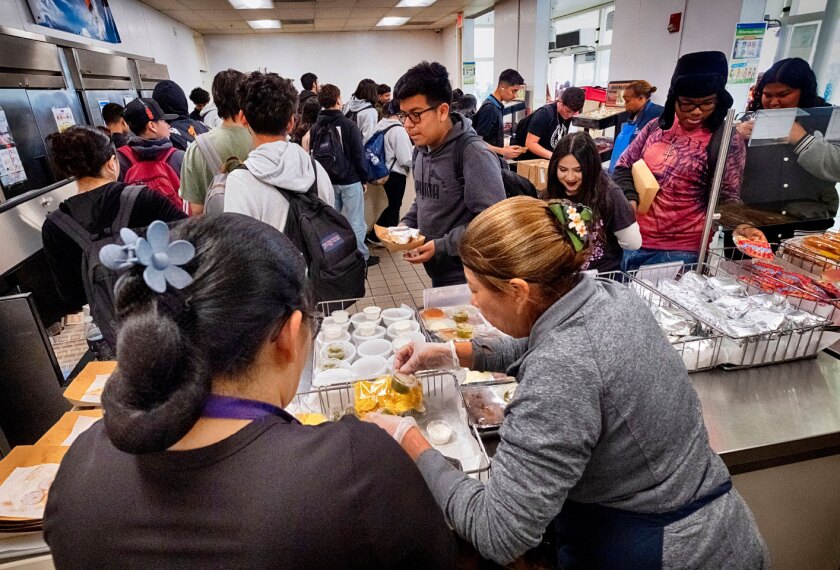
Free school meals for millions of students could be at risk if President-elect Donald Trump takes aim at a rule that allows public schools to serve them universally, a move that many of his political allies support.
While Trump hasn’t introduced any concrete policies around school meals, some of the conservative groups and politicians who supported his campaign favor restrictions on the community eligibility provision. That federal rule allows schools to provide federally subsidized free lunches and breakfasts to all students without requiring income verification from their families. Individual schools or clusters of schools are eligible to offer free meals for all under CEP if at least 25 percent of their student population automatically qualifies for free lunches through participation in social safety net programs like Medicaid or federal food assistance.
About 20 million children—around 40 percent of the nation’s public school students—attend schools that have adopted the community eligibility provision, which was first introduced in the Healthy Hunger-Free Kids Act, a 2010 child nutrition bill championed by former first lady Michelle Obama.
But that number could decline or plummet if new regulations or legislation changes the program’s rules—or eliminates it entirely. That’s what has anti-hunger advocates most concerned.
“Our message is: We can’t go backwards,” said Alexis Bylander, the interim director of child nutrition programs and policy at the Food Research and Action Center, which advocates for increased access to free school meals.
More than half of the 100,000 public schools that participate in the National School Lunch Program now provide universal free school meals, either through community eligibility or through state law. Eight states have passed laws providing state-level funding for universal free meals in recent years, drawing on momentum that swelled during the COVID-19 pandemic, Bylander said.
How Trump’s administration could reduce access to free school meals
Conservative policymakers and activists who want to shrink the role of federal government have floated various changes to the community eligibility provision. They contend that a program designed to help children in poverty has expanded beyond its original scope by serving large numbers of students whose families don’t need the financial help.
Republicans in Congress have pushed to raise the minimum threshold of eligible students necessary for a school to participate, which was lowered from 40 percent to 25 percent under a Biden administration rule finalized in September 2023.
A budget proposed by the Republican Study Committee in March called for eliminating CEP entirely. Project 2025, a 900-page policy agenda spearheaded by the Heritage Foundation, a conservative think thank, also calls for eliminating CEP. Trump sought to distance himself from Project 2025 during the campaign, but has since tapped one of its coauthors to lead the White House office of management and budget.
“Federal school meals should be focused on children in need, and any efforts to expand student eligibility for federal school meals to include all K–12 students should be soundly rejected,” Project 2025 says. “Such expansion would allow an inefficient, wasteful program to grow, magnifying the amount of wasted taxpayer resources.”
It would take an act of Congress to eliminate CEP. In the interim, Project 2025 proposes that the U.S. Department of Agriculture in Trump’s second term issue a new regulation that says only individual schools or entire districts can qualify for community eligibility. Current rules allow a subset of schools within a district to cluster together. That means a school with few automatically qualifying students could combine with a high-poverty school, averaging their data to reach the eligibility threshold.
The Trump administration could also affect community eligibility by setting new restrictions on the safety net programs that allow students to automatically qualify for free meals, like the Supplemental Nutrition Assistance Program, commonly known as food stamps. Trump has recently proposed major budget cuts for such programs at the start of his second term.
Brooke Rollins, the president-elect’s choice for agriculture secretary, has not stated a public position on community eligibility.
Advocates call to protect free school meals
Congress is supposed to reauthorize the Healthy Hunger-Free Kids Act every five years, but it has not done so since the bill originally passed in 2010, said Mara Fleishman, CEO of Chef Ann Foundation, an organization that works with districts to serve scratch-made meals in their cafeterias. Any legislative change to school nutrition programs would require Congress to do something it hasn’t done for years, she said.
But action may be more likely now since Republicans will soon control the Senate, the House of Representatives, and the White House, advocates said.
“I don’t know how real of a possibility [new legislation] is, but any restrictions to CEP is cause for real concern,” said Meghan Maroney, campaign manager for federal child nutrition programs at the Center for Science in the Public Interest. “It would hurt both families and schools that participate.”
School meal programs often operate with very little margin in their operating budgets, which are typically separate from other district spending. Allowing schools to serve free meals to all students eliminates a huge administrative burden for programs that are already stretched thin, said Diane Pratt-Heavner, the spokesperson for the School Nutrition Association, which represents school food directors.
Members have reported getting students through the lunch line more quickly without the need to scan lunch cards linked to meal accounts, giving students more time to eat during already short meal periods, she said. And the ability to qualify a cluster of schools allows districts to ensure that all schools in an attendance zone can qualify, reducing the chances that families will have students in schools with different meal policies, Pratt-Heavner said.
Community eligibility “eliminates stigma of eating school meals, eliminates student lunch debt, eliminates paperwork, and it allows staff to really focus on serving students,” she said.
Supporters argue that school meals are a key source of nutrition for students from low-income households. Researchers have also found benefits linked to universal free meals related to academic achievement, student engagement, and school discipline rates.
Eroding progress toward universal free meals would be particularly troubling after a presidential campaign focused on inflation and the cost of groceries, Bylander said.
“Free school meals for all are such a great way of increasing families’ budgets because it can take care of meals for their kids during the school day and allow families to have more money for meals at home,” she said. “To take that away from them would really increase hardship.”