Law & Courts

High Court to Hear College Religious Group’s Case

By Mark Walsh — December 11, 2009 3 min read
  • Save to favorites
  • Print

The U.S. Supreme Court has agreed to review whether public schools and universities may deny official recognition to student religious groups that limit membership to those who share their core beliefs.

The case, which the justices accepted for review Dec. 7, involves a dispute between the University of California’s Hastings College of Law, in San Francisco, and the law school’s chapter of the Christian Legal Society. The Springfield, Va.-based society promotes a Christian perspective among lawyers and law students.

The same issues have come up in K-12 public schools, as administrators have sought to require such groups to adhere to nondiscrimination policies.

The Hastings dispute arose after the law school refused to recognize the CLS chapter because the group refused to agree to the school’s nondiscrimination policy regarding religion and sexual orientation, according to court papers in Christian Legal Society v. Martinez (Case No. 08-1371).

The CLS chapter says that its members must affirm the national organization’s “statement of faith,” which involves “a shared devotion to Jesus Christ.” The statement also says that “unrepentant participation in or advocacy of a sexually immoral lifestyle is inconsistent” with the group’s beliefs.

The denial of recognition meant the CLS chapter did not have access to meeting space, communications channels such as announcements in law school newsletters and e-mails to students, and the opportunity to apply for funding from student-activity fees.

The chapter sued the law school in federal court, alleging violations of its rights of free speech, expressive association, free exercise of religion, and equal protection of the law.

“We think it’s a common-sense proposition that religious groups should be able to choose that their members and leaders will agree with their religious viewpoints,” said Kimberlee Wood Colby, a lawyer with the Center for Law and Religious Freedom, the society’s legal arm. The society has some 90 student chapters at universities across the country, most at law schools.

Precollegiate Case

A federal district court upheld the law school’s actions in 2006. In March of this year, a three-judge panel of the U.S. Court of Appeals for the 9th Circuit, in San Francisco, unanimously affirmed the lower court in a short opinion that cited another recent 9th Circuit decision that had addressed the issue in a precollegiate context.

In that case, Truth v. Kent School District, the 9th Circuit upheld a Washington state school district’s decision to deny recognition to a student religious club that limited its officer positions and voting membership to Christian believers. (At the prodding of school administrators, the club agreed to allow any student to attend its meetings.)

The appellate court said the school district’s application of its nondiscrimination policy did not violate the club’s First Amendment free-speech rights. The court in that case also held that the school’s actions did not violate the federal Equal Access Act, which requires secondary schools that receive federal money to treat all noncurricular clubs on an equal basis. The act does not apply to colleges and universities.

In June, the Supreme Court declined without comment to hear the Truth club’s appeal of that ruling.

In the Hastings law school case, the Christian Legal Society chapter argues that the 9th Circuit’s rulings conflict with decisions by at least two other federal circuit courts on the rights of student religious groups to restrict their membership and still enjoy recognition by public schools and colleges.One of those was a 1996 decision by the U.S. Court of Appeals for the 2nd Circuit, in New York City, that the Roslyn Union Free School District in New York state violated a high school Bible club’s rights under the Equal Access Act when the district refused to recognize the club as long as it barred nonbelievers from its leadership positions.

The Hastings law school filed a brief arguing that its case made a poor vehicle for deciding some of the issues surrounding student religious clubs in public education.

The high court, in decisions going back nearly three decades, has been generally supportive of the rights of student religious groups. The justices have ruled that a school district violated the Equal Access Act by denying recognition to a student Bible club, and they have held that a college violated the First Amendment free-speech rights of a religious club by conditioning access to college meeting space on the club’s not engaging in religious worship or teaching.

The current case, Christian Legal Society v. Martinez, will be argued sometime in the spring, with a decision likely by late June.

A version of this article appeared in the December 16, 2009 edition of Education Week as High Court Takes Case on College Religious Groups

Events

This content is provided by our sponsor. It is not written by and does not necessarily reflect the views of Education Week's editorial staff.
Sponsor
Artificial Intelligence Webinar
Managing AI in Schools: Practical Strategies for Districts
How should districts govern AI in schools? Learn practical strategies for policies, safety, transparency, and responsible adoption.
Content provided by Lightspeed Systems
This content is provided by our sponsor. It is not written by and does not necessarily reflect the views of Education Week's editorial staff.
Sponsor
Artificial Intelligence Webinar
AI in Schools: What 1,000 Districts Reveal About Readiness and Risk
Move beyond “ban vs. embrace” with real-world AI data and practical guidance for a balanced, responsible district policy.
Content provided by Securly
This content is provided by our sponsor. It is not written by and does not necessarily reflect the views of Education Week's editorial staff.
Sponsor
Recruitment & Retention Webinar
K-12 Lens 2026: What New Staffing Data Reveals About District Operations
Explore national survey findings and hear how districts are navigating staffing changes that affect daily operations, workload, and planning.
Content provided by Frontline Education

EdWeek Top School Jobs

Teacher Jobs
Search over ten thousand teaching jobs nationwide — elementary, middle, high school and more.
View Jobs
Principal Jobs
Find hundreds of jobs for principals, assistant principals, and other school leadership roles.
View Jobs
Administrator Jobs
Over a thousand district-level jobs: superintendents, directors, more.
View Jobs
Support Staff Jobs
Search thousands of jobs, from paraprofessionals to counselors and more.
View Jobs

Read Next

Law & Courts Supreme Court’s Gender Identity Ruling Leaves Schools Seeking Clarity
Advocates say they would welcome more from the Supreme Court on gender-notification policies.
7 min read
The Supreme Court is photographed, Friday, Feb. 27, 2026, in Washington.
The Supreme Court is photographed, Friday, Feb. 27, 2026, in Washington. The high court recently ruled that California policies that sometimes limit or discourage schools from disclosing information to parents about children’s gender transitions and expressions at school likely violate parents’ constitutional rights
Rahmat Gul/AP
Law & Courts Supreme Court Backs Parents in School Gender Disclosure Fight
The Supreme Court restored an injunction blocking California policies on student gender transitions
8 min read
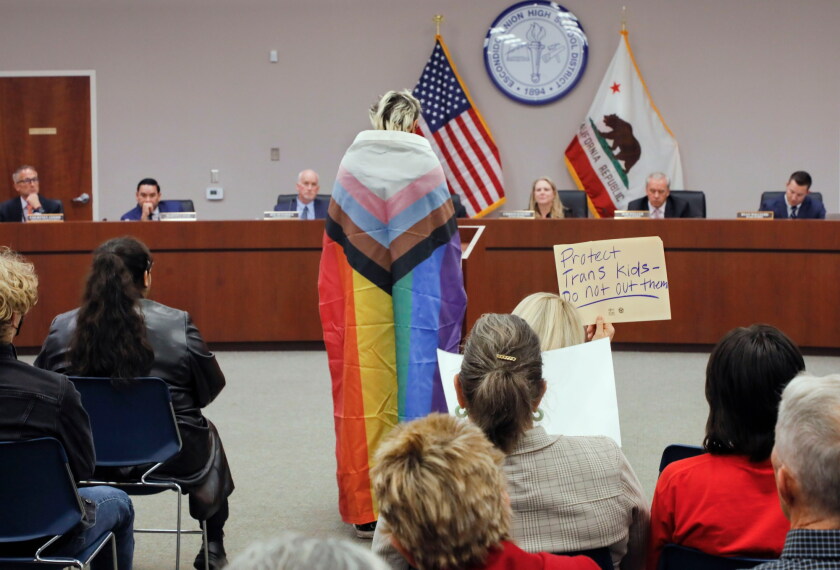
Teacher’s aide Amelia Mester, wrapped in a Pride flag, urges Escondido Union High School District not to have employees notify parents if they believe a student may be transgender in November 2025. A policy on the issue in the city’s elementary school district is the subject of a federal class-action lawsuit in which a judge just sided against the district.
Teacher’s aide Amelia Mester, wrapped in a Pride flag, urges Escondido Union High School District not to have employees notify parents if they believe a student may be transgender at a meeting in November 2025. Two parents and two teachers from the district sued in 2023, challenging California state guidance concerning student gender transitions and parental notification. The U.S. Supreme Court has now reinstated a lower-court decision overturning those state policies.
Charlie Neuman for The San Diego Union-Tribune/TNS
Law & Courts Appeals Court Allows Louisiana Ten Commandments Displays to Proceed
The court said it was premature to rule on the constitutionality of La. Ten Commandments displays.
3 min read
Students work under Ten Commandments and Bill of Rights posters on display in a classroom at Lehman High School in Kyle, Texas, Thursday, Oct. 16, 2025.
Students work under Ten Commandments and Bill of Rights posters on display in a classroom at Lehman High School in Kyle, Texas, Oct. 16, 2025. A federal appeals court has lifted a lower-court injunction blocking a Louisiana law that requires Ten Commandments displays, clearing the way for the law to take effect.
Eric Gay/AP
Law & Courts Social Media Companies Face Legal Reckoning Over Mental Health Harms to Children
Some of the biggest players from Meta to TikTok are getting a chance to make their case in courtrooms around the country.
6 min read
Social Media Kids Trial 26050035983057
Meta CEO Mark Zuckerberg leaves court after testifying in a landmark trial over whether social media platforms deliberately addict and harm children, on Feb. 18, 2026, in Los Angeles.
AP Photo/Damian Dovarganes
