Law & Courts

High Court Declines To Hear Appeal Over Newspaper Ads

By Mark Walsh — June 10, 1998 3 min read
  • Save to favorites
  • Print

The U.S. Supreme Court declined last week to hear the appeal of a Massachusetts father whose ads promoting sexual abstinence among teenagers were rejected by a high school newspaper and yearbook.

The court on June 1 turned away without comment the appeal of Douglas E. Yeo, who had sought to place the advertisements in the student publications of Lexington (Mass.) High School.

The case attracted widespread interest among school boards’ associations and student-journalism groups. The central issue was whether the rejection of the ads by student editors of the publications amounted to government action, since the newspaper and yearbook are officially sponsored by Lexington High.

A federal appeals court ruled that it did not amount to state action, and thus did not represent unconstitutional “viewpoint” discrimination by the government.

The case was sparked by the Lexington school board’s 1992 enactment of a policy to make condoms available at the high school without parental permission. Mr. Yeo, whose three children attended or are currently attending the school, was a leading opponent of the policy.

Out of Place

In the 1993-94 school year, he submitted ads promoting abstinence to the Lexington High yearbook and the student newspaper, The Musket. The yearbook staff rejected the ad because editors believed it was political advocacy and incompatible with the congratulatory tone of other ads.

The Musket editors told Mr. Yeo that they considered his ad a political statement and that they did not accept such ads.

Mr. Yeo sued the Lexington school board and various administrators in federal district court, alleging that the publications’ refusal to print his ad violated his First Amendment right of free speech and his 14th Amendment right of equal protection under the law.

The district court ruled for the school board, holding that there was no state action in the student editors’ decision. A panel of the U.S. Court of Appeals for the 1st Circuit ruled 2-1 for Mr. Yeo, finding that the publications were part of the school curriculum.

But the full 1st Circuit court, based in Boston, set aside that ruling and reheard the case. The court ruled for the school board last December.

“Here, the students’ relationship to the public school officials in the exercise of their editorial judgment was certainly independent,” the appeals court said. “The school officials gained nothing but a lawsuit from the students’ decision, and the officials might themselves, as they told the students, have made a different decision.”

In their appeal to the Supreme Court in Yeo v. Town of Lexington (Case No. 97-1462), Mr. Yeo’s lawyers argued that adult supervision of the publications was so intertwined with the editors’ decisions as to make the rejection of the abstinence ads a government action.

Agency-Fee Case

Separately last week, the high court declined an appeal from two affiliates of the National Education Association over the issue of compulsory arbitration for nonunion members who object to the cost of their service fees for collective bargaining.

The justices rejected without comment the appeal in Anchorage Education Association v. Patterson (No. 97-1454). The action was not a surprise, given the court’s May 26 ruling in a similar labor case that nonunion workers may challenge their so-called agency fees in federal court without first going through an arbitration procedure favored by unions. (“Supreme Court Ruling Is a Defeat for Unions,” June 3, 1998.)

The justices had been holding the agency-fee dispute from Alaska, which presented the same question, pending their ruling in the case of Air Line Pilots Association v. Miller.

Related Tags:

A version of this article appeared in the June 10, 1998 edition of Education Week as High Court Declines To Hear Appeal Over Newspaper Ads

Events

This content is provided by our sponsor. It is not written by and does not necessarily reflect the views of Education Week's editorial staff.
Sponsor
Artificial Intelligence Webinar
Managing AI in Schools: Practical Strategies for Districts
How should districts govern AI in schools? Learn practical strategies for policies, safety, transparency, as well as responsible adoption.
Content provided by Lightspeed Systems
This content is provided by our sponsor. It is not written by and does not necessarily reflect the views of Education Week's editorial staff.
Sponsor
Reading & Literacy Webinar
Unlocking Success for Struggling Adolescent Readers
The Science of Reading transformed K-3 literacy. Now it's time to extend that focus to students in grades 6 through 12.
Content provided by STARI
Jobs Virtual Career Fair for Teachers and K-12 Staff
Find teaching jobs and K-12 education jubs at the EdWeek Top School Jobs virtual career fair.

EdWeek Top School Jobs

Teacher Jobs
Search over ten thousand teaching jobs nationwide — elementary, middle, high school and more.
View Jobs
Principal Jobs
Find hundreds of jobs for principals, assistant principals, and other school leadership roles.
View Jobs
Administrator Jobs
Over a thousand district-level jobs: superintendents, directors, more.
View Jobs
Support Staff Jobs
Search thousands of jobs, from paraprofessionals to counselors and more.
View Jobs

Read Next

Law & Courts Birthright Citizenship Case Raises Stakes for Schools and Undocumented Students
Educators are paying close attention to the case on Trump's birthright citizenship order.
10 min read
President Donald Trump signs an executive order on birthright citizenship in the Oval Office of the White House in Washington, Jan. 20, 2025.
President Donald Trump signs an executive order on birthright citizenship in the Oval Office of the White House on Jan. 20, 2025. The order, now before the U.S. Supreme Court, seeks to limit citizenship for some children born in the United States to immigrant parents without permanent legal status.
Evan Vucci/AP
Law & Courts Appeals Court Revives Lawsuit Over 1st Grader’s Black Lives Matter Drawing
A court revived a 1st grader 's claim she was punished for giving a drawing to a Black classmate.
4 min read
Seen is the drawing made by Viejo Elementary School first-grader B.B. that was entered into evidence. B.B. gave the drawing to her classmate, M.C., who is African American. M.C. thanked B.B.
Pictured is a drawing by a 1st grader in California and given to a Black classmate that is at the center of a First Amendment legal challenge over the student's alleged punishment.
U.S. Court of Appeals for the 9th Circuit
Law & Courts Supreme Court’s Gender Identity Ruling Leaves Schools Seeking Clarity
Advocates say they would welcome more from the Supreme Court on gender-notification policies.
7 min read
The Supreme Court is photographed, Friday, Feb. 27, 2026, in Washington.
The Supreme Court is photographed, Friday, Feb. 27, 2026, in Washington. The high court recently ruled that California policies that sometimes limit or discourage schools from disclosing information to parents about children’s gender transitions and expressions at school likely violate parents’ constitutional rights
Rahmat Gul/AP
Law & Courts Supreme Court Backs Parents in School Gender Disclosure Fight
The Supreme Court restored an injunction blocking California policies on student gender transitions
8 min read
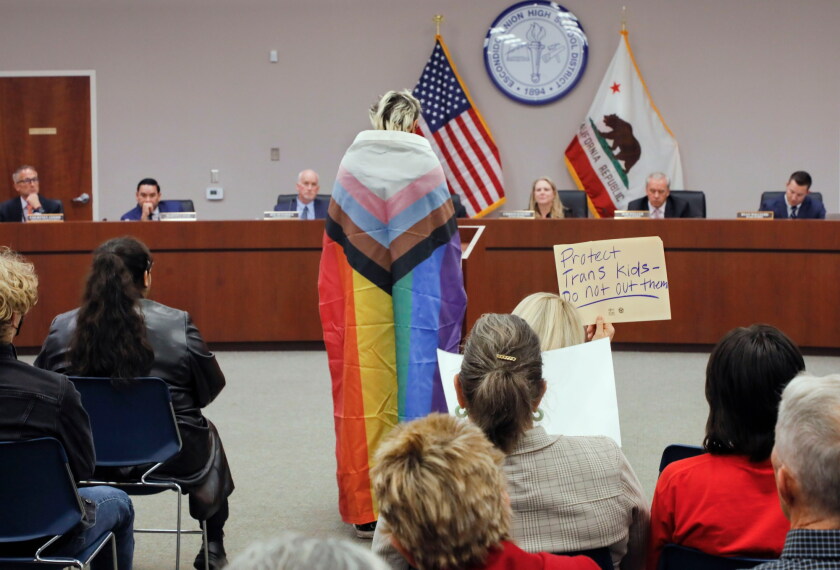
Teacher’s aide Amelia Mester, wrapped in a Pride flag, urges Escondido Union High School District not to have employees notify parents if they believe a student may be transgender in November 2025. A policy on the issue in the city’s elementary school district is the subject of a federal class-action lawsuit in which a judge just sided against the district.
Teacher’s aide Amelia Mester, wrapped in a Pride flag, urges Escondido Union High School District not to have employees notify parents if they believe a student may be transgender at a meeting in November 2025. Two parents and two teachers from the district sued in 2023, challenging California state guidance concerning student gender transitions and parental notification. The U.S. Supreme Court has now reinstated a lower-court decision overturning those state policies.
Charlie Neuman for The San Diego Union-Tribune/TNS