
Blog

Your Education Road Map

Politics K-12

Politics K-12 kept watch on education policy and politics in the nation’s capital and in the states. This blog is no longer being updated, but you can continue to explore these issues on edweek.org by visiting our related topic pages: Federal, States.

Federal

Gingrich Calls for ‘Tripartisanship’ to Improve Schools

By Alyson Klein — September 02, 2008 3 min read
  • Save to favorites
  • Print

President Bush isn’t the only Republican who believes in high academic standards and aggressive accountability. That’s the message that came across at today’s event put on by American Solutions for Winning the Future, a nonprofit organization started by Newt Gingrich, the former speaker of the U.S. House of Representatives. The Education Equality Project and ED in 08 were among the co-sponsors of the event.

Gingrich’s group used the issue of global competitiveness to galvanize support for policies, including alternative pay for teachers and rigorous curricula benchmarked against international standards. For education redesign efforts to succeed, they will have to be championed by Republicans, Democrats, and Independents, Gingrich said.

“If you’re going to get this to scale, it’s going to have to be a tripartisan effort,” Gingrich said. “What we’re going to have here today is some people you’ve probably traditionally thought of as Democrats and some you’ve probably thought of as Republicans.”

Gingrich especially seemed to get a kick out of sharing a stage with the Rev. Al Sharpton, the co-chairman of the Education Equality Project and a 2004 Democratic presidential candidate. Gingrich made sure that the two posed for a photo with the other panelists, including Secretary of Education Margaret Spellings; top McCain education adviser Lisa Graham Keegan; and ED in ‘08’s Roy Romer.

“Most of you didn’t come here so that you could go home and tell your friends how much Al Sharpton impressed you,” Gingrich joked. Sharpton and other members of the Education Equality Project had similar criticisms of unions at last week’s Democratic National Convention.

Sharpton’s speech garnered loud applause from the largely Republican crowd, particularly when he emphasized parental responsibility and took teachers’ unions to task for what he perceived as their failure to embrace accountability.

“You cannot say schools must be improved but that we can not judge the performance of teachers,” he said. “We cannot have any sacred cows in the room when our children are behind in math and science.”

In his speech, ED in ‘08’'s Roy Romer subtly urged the more conservative wing of the Republican party to embrace the idea that, early in the next administration state school chiefs, governors, and the new administration should sit down together to craft high standards. He said that presidential candidates are often afraid of talking about education policy because they’re worried about offending proponents of local control.

And Gov. Tim Pawlenty, who until was last week was widely speculated to be McCain’s veep pick, talked about his own record on education redesign, particularly the need for merit pay, something he has championed in Minnesota.

In her speech, Secretary Spellings said that advocates for federal accountability need to do a better job selling their proposals, particularly to suburban voters.

“We haven’t fully made our case to the American people,” she said, adding that some voters have criticized the law for taking resources away from one school’s “gifted flute program” and steering it towards inner city schools. “People don’t get what’s at stake for this country.”

Part of the problem, she said, is educational policy lingo. When officials used terms such as adequate yearly progress and international benchmarking, “parents don’t know what we’re talking about,” she said.

Keegan, who moderated the panel, didn’t give a speech. But she did emphasize McCain’s and her own support for accountability. “I’m proud to be working for [someone] who backs NCLB and its accountability requirements,” she said. Which sounded pretty Spellings-esque, at least to me.
Related Tags:

A version of this news article first appeared in the Politics K-12 blog.

Events

This content is provided by our sponsor. It is not written by and does not necessarily reflect the views of Education Week's editorial staff.
Sponsor
Artificial Intelligence Webinar
Managing AI in Schools: Practical Strategies for Districts
How should districts govern AI in schools? Learn practical strategies for policies, safety, transparency, as well as responsible adoption.
Content provided by Lightspeed Systems
This content is provided by our sponsor. It is not written by and does not necessarily reflect the views of Education Week's editorial staff.
Sponsor
Reading & Literacy Webinar
Unlocking Success for Struggling Adolescent Readers
The Science of Reading transformed K-3 literacy. Now it's time to extend that focus to students in grades 6 through 12.
Content provided by STARI
Jobs Virtual Career Fair for Teachers and K-12 Staff
Find teaching jobs and K-12 education jubs at the EdWeek Top School Jobs virtual career fair.

EdWeek Top School Jobs

Teacher Jobs
Search over ten thousand teaching jobs nationwide — elementary, middle, high school and more.
View Jobs
Principal Jobs
Find hundreds of jobs for principals, assistant principals, and other school leadership roles.
View Jobs
Administrator Jobs
Over a thousand district-level jobs: superintendents, directors, more.
View Jobs
Support Staff Jobs
Search thousands of jobs, from paraprofessionals to counselors and more.
View Jobs

Read Next

Federal Trump Talks Up AI in State of the Union, But Not Much Else About Education
The president didn't mention two of his cornerstone education policies from the past year.
4 min read
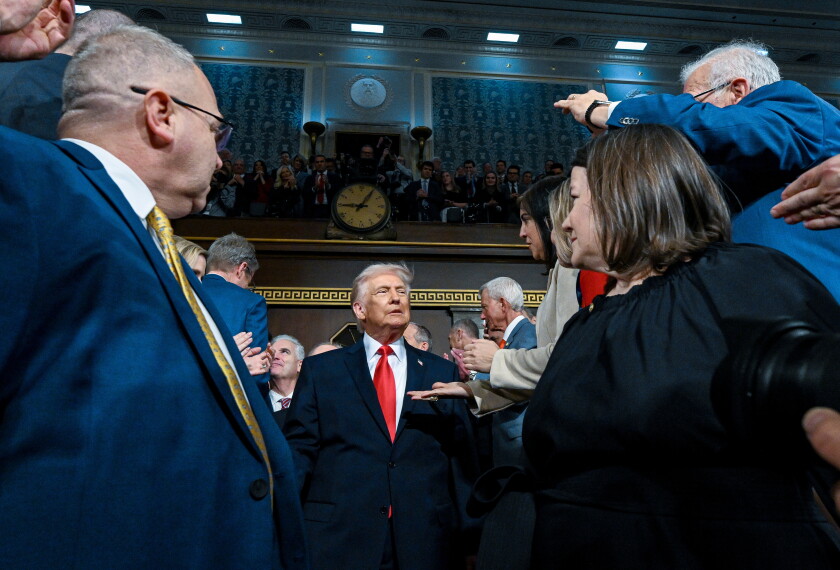
President Donald Trump enters to deliver the State of the Union address to a joint session of Congress in the House chamber at the U.S. Capitol in Washington, Tuesday, Feb. 24, 2026.
President Donald Trump enters to deliver the State of the Union address to a joint session of Congress in the House chamber at the U.S. Capitol in Washington, Tuesday, Feb. 24, 2026. The president devoted little time in the speech to discussing his education policies.
Kenny Holston/The New York Times via AP, Pool
Federal Education Department Will Send More of Its Programs to Other Agencies
Education grants for school safety, community schools, and family engagement will shift to Health and Human Services.
4 min read
Various school representatives and parent liaisons attend a family and community engagement think tank discussion at Lowery Conference Center on March 13, 2024 in Denver. One of the goals of the meeting was to discuss how schools can better integrate new students and families into the district. Denver Public Schools has six community hubs across the district that have serviced 3,000 new students since October 2023. Each community hub has different resources for families and students catering to what the community needs.
A program that helps state education departments and schools improve family engagement policies is among those the Trump administration will transfer from the U.S. Department of Education to the U.S. Department of Health and Human Services. In this photo, school representatives and parent liaisons attend a family and community engagement discussion on March 13, 2024, in Denver to discuss how schools can better integrate new students and families into the district.
Rebecca Slezak For Education Week
Federal New Trump Admin. Guidance Says Teachers Can Pray With Students
The president said the guidance for public schools would ensure "total protection" for school prayer.
3 min read
MADISON, AL - MARCH 29: Bob Jones High School football players touch the people near them during a prayer after morning workouts and before the rest of the school day on March 29, 2024, in Madison, AL. Head football coach Kelvis White and his brother follow in the footsteps of their father, who was also a football coach. As sports in the United States deals with polarization, Coach White and Bob Jones High School form a classic tale of team, unity, and brotherhood. (Photo by Jahi Chikwendiu/The Washington Post via Getty Images)
Football players at Bob Jones High School in Madison, Ala., pray after morning workouts before the rest of the school day on March 29, 2024. New guidance from the U.S. Department of Education says students and educators can pray at school, as long as the prayer isn't school-sponsored and disruptive to school and classroom activities, and students aren't coerced to participate.
Jahi Chikwendiu/Washington Post via Getty Images
Federal Ed. Dept. Paid Civil Rights Staffers Up to $38 Million as It Tried to Lay Them Off
A report from Congress' watchdog looks into the Trump Admin.'s efforts to downsize the Education Department.
5 min read
Commuters walk past the headquarters of the U.S. Department of Eduction, which were ordered closed for the day for what officials described as security reasons amid large-scale layoffs, on March 12, 2025, in Washington.
The U.S. Department of Education spent up to $38 million last year to pay civil rights staffers who remained on administrative leave while the agency tried to lay them off.
Mark Schiefelbein/AP
