Law & Courts

GAO Tracks New Measures to Combat Commercialism

By Rhea R. Borja — October 01, 2004 2 min read
  • Save to favorites
  • Print

Responding to heightened advertising and marketing pressure from the corporate world, 13 states have passed laws over the past four years to curtail commercial activities in schools, according to a report released last week by the federal Government Accountability Office. Those states joined 28 others that had already taken such action before 2000.

Four of the 13 states curtailed or prohibited the sale of sodas and sugary foods in schools; others passed laws to prohibit student participation in market surveys without parental consent or to prevent the dissemination of student data for marketing or market research.

The report “Commercial Activities in Schools,” is available online from the Government Accountability Office. (Requires Adobe’s Acrobat Reader.)

Over the past decade, more businesses have partnered with schools, the report by the congressional investigative agency points out. “In some of these relationships,” it says, “business’ apparent focus is on improving teaching and learning, but in others, the apparent focus is on developing product loyalty and increasing sales.”

The commercial environment in schools has become even more pronounced in recent years, as schools have faced budget cutbacks and as the use of the Internet as a marketing tool has expanded, said Eleanor L. Johnson, the GAO’s assistant director for education issues and a co-author of the report.

See Also

See the accompanying chart,

Chart: Student-Data Disclosure

“The Internet has changed the way advertisers get student information,” she said. “It used to be that … you had to go through schools to get lists on student data. Now, advertisers on the Web simply run contests, and to get the prize, the students just answer [personal] questions.”

Districts ‘Confused’

The report, requested by Democratic Sen. Christopher J. Dodd of Connecticut and Republican Sen. Richard C. Shelby of Alabama, also analyzes how and whether school districts have adopted or amended policies on student data use, as required under the No Child Left Behind Act.

The federal law amended the Protection of Pupil Rights Amendment to require not only a student-data-use policy, but one that includes parental notification and permission.

GAO researchers found that of the 61 school district student-data policies they reviewed for the report, only 19 addressed the commercial use of such information.

“Our concern was that districts seemed to be confused,” Ms. Johnson said.

She added that the districts polled created their policies with input from state school boards, even though the U.S. Department of Education had not issued guidance specifically to state boards on commercial activity in schools.

Consequently, the report recommends that the U.S. Department of Education guide state school boards on how to craft policies that address the release of student data for commercial purposes.
Related Tags:

Events

This content is provided by our sponsor. It is not written by and does not necessarily reflect the views of Education Week's editorial staff.
Sponsor
School Climate & Safety Webinar
Belonging as a Leadership Strategy for Today’s Schools
Belonging isn’t a slogan—it’s a leadership strategy. Learn what research shows actually works to improve attendance, culture, and learning.
Content provided by Harmony Academy
This content is provided by our sponsor. It is not written by and does not necessarily reflect the views of Education Week's editorial staff.
Sponsor
School & District Management Webinar
Too Many Initiatives, Not Enough Alignment: A Change Management Playbook for Leaders
Learn how leadership teams can increase alignment and evaluate every program, practice, and purchase against a clear strategic plan.
Content provided by Otus
This content is provided by our sponsor. It is not written by and does not necessarily reflect the views of Education Week's editorial staff.
Sponsor
Artificial Intelligence Webinar
Beyond Teacher Tools: Exploring AI for Student Success
Teacher AI tools only show assigned work. See how TrekAi's student-facing approach reveals authentic learning needs and drives real success.
Content provided by TrekAi

EdWeek Top School Jobs

Teacher Jobs
Search over ten thousand teaching jobs nationwide — elementary, middle, high school and more.
View Jobs
Principal Jobs
Find hundreds of jobs for principals, assistant principals, and other school leadership roles.
View Jobs
Administrator Jobs
Over a thousand district-level jobs: superintendents, directors, more.
View Jobs
Support Staff Jobs
Search thousands of jobs, from paraprofessionals to counselors and more.
View Jobs

Read Next

Law & Courts Supreme Court Backs Parents in School Gender Disclosure Fight
The Supreme Court restored an injunction blocking California policies on student gender transitions
8 min read
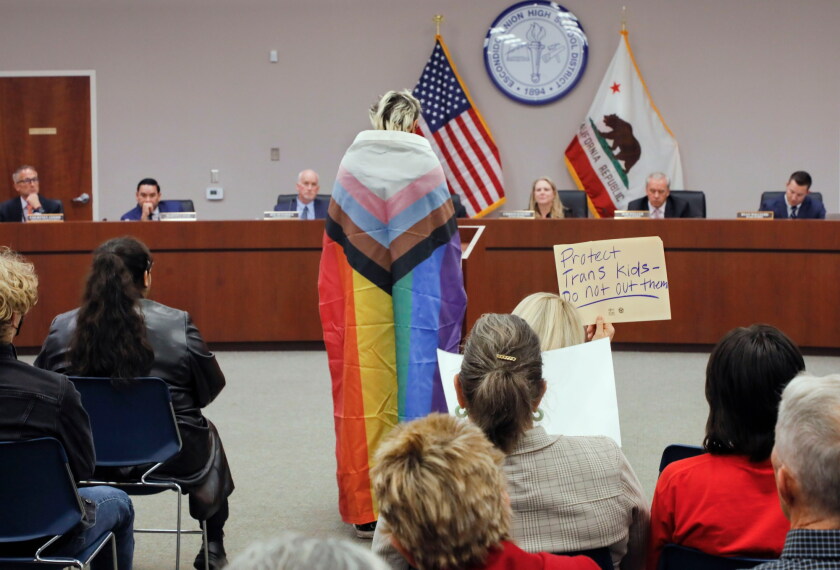
Teacher’s aide Amelia Mester, wrapped in a Pride flag, urges Escondido Union High School District not to have employees notify parents if they believe a student may be transgender in November 2025. A policy on the issue in the city’s elementary school district is the subject of a federal class-action lawsuit in which a judge just sided against the district.
Teacher’s aide Amelia Mester, wrapped in a Pride flag, urges Escondido Union High School District not to have employees notify parents if they believe a student may be transgender at a meeting in November 2025. Two parents and two teachers from the district sued in 2023, challenging California state guidance concerning student gender transitions and parental notification. The U.S. Supreme Court has now reinstated a lower-court decision overturning those state policies.
Charlie Neuman for The San Diego Union-Tribune/TNS
Law & Courts Appeals Court Allows Louisiana Ten Commandments Displays to Proceed
The court said it was premature to rule on the constitutionality of La. Ten Commandments displays.
3 min read
Students work under Ten Commandments and Bill of Rights posters on display in a classroom at Lehman High School in Kyle, Texas, Thursday, Oct. 16, 2025.
Students work under Ten Commandments and Bill of Rights posters on display in a classroom at Lehman High School in Kyle, Texas, Oct. 16, 2025. A federal appeals court has lifted a lower-court injunction blocking a Louisiana law that requires Ten Commandments displays, clearing the way for the law to take effect.
Eric Gay/AP
Law & Courts Social Media Companies Face Legal Reckoning Over Mental Health Harms to Children
Some of the biggest players from Meta to TikTok are getting a chance to make their case in courtrooms around the country.
6 min read
Social Media Kids Trial 26050035983057
Meta CEO Mark Zuckerberg leaves court after testifying in a landmark trial over whether social media platforms deliberately addict and harm children, on Feb. 18, 2026, in Los Angeles.
AP Photo/Damian Dovarganes
Law & Courts Supreme Court Strikes Trump Tariffs in Case Brought by Educational Toy Companies
Two educational toy companies were among the leading challengers to the president's tariff policies
3 min read
Members of the Supreme Court sit for a new group portrait following the addition of Associate Justice Ketanji Brown Jackson, at the Supreme Court building in Washington, Oct. 7, 2022. Bottom row, from left, Associate Justice Sonia Sotomayor, Associate Justice Clarence Thomas, Chief Justice of the United States John Roberts, Associate Justice Samuel Alito, and Associate Justice Elena Kagan. Top row, from left, Associate Justice Amy Coney Barrett, Associate Justice Neil Gorsuch, Associate Justice Brett Kavanaugh, and Associate Justice Ketanji Brown Jackson.
Members of the U.S. Supreme Court sit for a new group portrait following the addition of Justice Ketanji Brown Jackson, at the court building in Washington, Oct. 7, 2022. On Feb. 20, 2026, the court ruled 6-3 to strike down President Donald Trump's broad tariff policies, ruling that they were not authorized by the federal statute that he cited for them.
J. Scott Applewhite/AP
