Law & Courts

Full Appeals Court to Reconsider Ruling That Revived NCLB Suit

By Mark Walsh — May 01, 2008 3 min read
  • Save to favorites
  • Print

Includes updates and/or revisions.

A federal appeals court has agreed to re-examine a ruling by a panel of the court that revived a lawsuit challenging the No Child Left Behind Act for imposing unfunded mandates on states and school districts.

The U.S. Court of Appeals for the 6th Circuit, in Cincinnati, said on May 1 that the entire 14-member court would rehear the case of Pontiac School District v. Spellings.

Bush administration lawyers sought the rehearing on behalf of U.S. Secretary of Education Margaret Spellings after a three-judge panel of the 6th Circuit ruled on Jan. 7 that the states were not on clear notice of their financial obligations when they agreed to accept federal money under the NCLB law. (“Court Ruling in NCLB Suit Fuels Fight Over Costs,” Jan. 16, 2008 and “Spellings Asks 6th Circuit to Reconsider NCLB Ruling,” Feb. 13, 2008.)

The action by the full 6th Circuit has the effect of setting aside the panel’s opinion. No date was set for the rehearing, but one source indicated that oral arguments could take place in September.

The rehearing request had been opposed by the National Education Association, which filed the legal challenge on behalf of nine school districts in Michigan, Texas, and Vermont.

The 6th Circuit court’s action came the same week that a federal district judge dismissed the state of Connecticut’s lawsuit against Secretary Spellings over NCLB funding issues.

U.S. District Judge Mark R. Kravitz of New Haven, Conn., on April 28 rejected the last of the state’s claims in a suit filed in 2005. The judge had dismissed some claims in the suit in 2006.

Judge Kravitz rebuffed Connecticut’s efforts to overturn an administrative decision by Secretary Spellings that turned down the state’s request for greater flexibility in testing students in special education and English-language learners under the NCLB law. The judge said the secretary’s actions were not “arbitrary or capricious” under federal procedural law.

Connecticut filed its lawsuit in August 2005 amid state officials’ growing frustration with the law, which requires annual testing in reading and mathematics in grades 3-8 and once in high school and requires schools and districts to reach achievement benchmarks.

No other state has followed Connecticut’s path, although the NEA suit raises similar questions on NCLB funding issues.

On a key issue in the Connecticut case, Judge Kravitz declined to rule on the state’s arguments that the secretary was enforcing the law in a way that violates the NCLB provision barring the federal government from imposing “unfunded mandates” on the states.

The state failed to make clear during the review of its plan that federal funding would be insufficient to provide testing accommodations for English-language learners or to develop alternative assessments for students with disabilities, Judge Kravitz said.

Conn. Appeal Planned

Connecticut Attorney General Richard Blumenthal, who filed the state’s suit, expressed disappointment with the ruling, but he was eager to press the issues on appeal to the U.S. Court of Appeals for the 2nd Circuit, in New York City.

“My office will immediately take our fight to the 2nd Circuit to protect our children and taxpayers from flawed federal policies that impose mindless, detrimental policies, as well as costs, on states,” Mr. Blumenthal, a Democrat, said in a statement.

Samara Yudof, a spokeswoman for Ms. Spellings, said the decision was a “resounding victory for children and their families.”

William L. Taylor, the chairman of the Citizens’ Commission on Civil Rights, a Washington group that supported Ms. Spellings in the case, said the ruling showed that the courts are not the best arena to remedy conflicts over the NCLB law.

“It’s been almost three years, and Connecticut has lost at every single turn,” Mr. Taylor said. “There is a debate over whether we keep the basic [accountability] principles in this act. But I don’t see these matters getting decided in the courts.”

Events

This content is provided by our sponsor. It is not written by and does not necessarily reflect the views of Education Week's editorial staff.
Sponsor
College & Workforce Readiness Webinar
Building for the Future: Igniting Middle Schoolers’ Interest in Skilled Trades & Future-Ready Skills
Ignite middle schoolers’ interest in skilled trades with hands-on learning and real-world projects that build future-ready skills.
Content provided by Project Lead The Way
This content is provided by our sponsor. It is not written by and does not necessarily reflect the views of Education Week's editorial staff.
Sponsor
Artificial Intelligence Webinar
AI in Schools: What 1,000 Districts Reveal About Readiness and Risk
Move beyond “ban vs. embrace” with real-world AI data and practical guidance for a balanced, responsible district policy.
Content provided by Securly
This content is provided by our sponsor. It is not written by and does not necessarily reflect the views of Education Week's editorial staff.
Sponsor
Recruitment & Retention Webinar
K-12 Lens 2026: What New Staffing Data Reveals About District Operations
Explore national survey findings and hear how districts are navigating staffing changes that affect daily operations, workload, and planning.
Content provided by Frontline Education

EdWeek Top School Jobs

Teacher Jobs
Search over ten thousand teaching jobs nationwide — elementary, middle, high school and more.
View Jobs
Principal Jobs
Find hundreds of jobs for principals, assistant principals, and other school leadership roles.
View Jobs
Administrator Jobs
Over a thousand district-level jobs: superintendents, directors, more.
View Jobs
Support Staff Jobs
Search thousands of jobs, from paraprofessionals to counselors and more.
View Jobs

Read Next

Law & Courts Appeals Court Revives Lawsuit Over 1st Grader’s Black Lives Matter Drawing
A court revived a 1st grader 's claim she was punished for giving a drawing to a Black classmate.
4 min read
Seen is the drawing made by Viejo Elementary School first-grader B.B. that was entered into evidence. B.B. gave the drawing to her classmate, M.C., who is African American. M.C. thanked B.B.
Pictured is a drawing by a 1st grader in California and given to a Black classmate that is at the center of a First Amendment legal challenge over the student's alleged punishment.
U.S. Court of Appeals for the 9th Circuit
Law & Courts Supreme Court’s Gender Identity Ruling Leaves Schools Seeking Clarity
Advocates say they would welcome more from the Supreme Court on gender-notification policies.
7 min read
The Supreme Court is photographed, Friday, Feb. 27, 2026, in Washington.
The Supreme Court is photographed, Friday, Feb. 27, 2026, in Washington. The high court recently ruled that California policies that sometimes limit or discourage schools from disclosing information to parents about children’s gender transitions and expressions at school likely violate parents’ constitutional rights
Rahmat Gul/AP
Law & Courts Supreme Court Backs Parents in School Gender Disclosure Fight
The Supreme Court restored an injunction blocking California policies on student gender transitions
8 min read
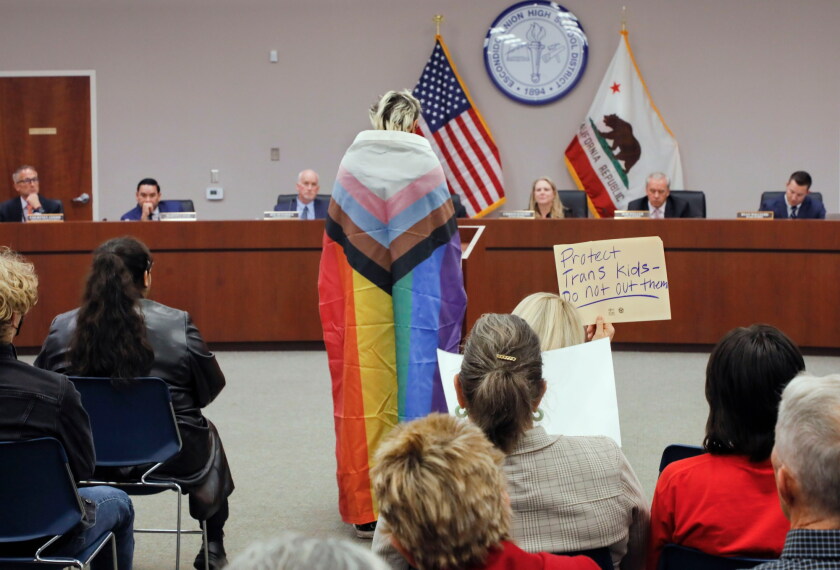
Teacher’s aide Amelia Mester, wrapped in a Pride flag, urges Escondido Union High School District not to have employees notify parents if they believe a student may be transgender in November 2025. A policy on the issue in the city’s elementary school district is the subject of a federal class-action lawsuit in which a judge just sided against the district.
Teacher’s aide Amelia Mester, wrapped in a Pride flag, urges Escondido Union High School District not to have employees notify parents if they believe a student may be transgender at a meeting in November 2025. Two parents and two teachers from the district sued in 2023, challenging California state guidance concerning student gender transitions and parental notification. The U.S. Supreme Court has now reinstated a lower-court decision overturning those state policies.
Charlie Neuman for The San Diego Union-Tribune/TNS
Law & Courts Appeals Court Allows Louisiana Ten Commandments Displays to Proceed
The court said it was premature to rule on the constitutionality of La. Ten Commandments displays.
3 min read
Students work under Ten Commandments and Bill of Rights posters on display in a classroom at Lehman High School in Kyle, Texas, Thursday, Oct. 16, 2025.
Students work under Ten Commandments and Bill of Rights posters on display in a classroom at Lehman High School in Kyle, Texas, Oct. 16, 2025. A federal appeals court has lifted a lower-court injunction blocking a Louisiana law that requires Ten Commandments displays, clearing the way for the law to take effect.
Eric Gay/AP