Federal

Donald Trump Backs Merit Pay, Funds for School Choice

By Alyson Klein — September 13, 2016 2 min read
  • Save to favorites
  • Print

GOP presidential nominee Donald Trump is pledging that, if elected, he’d be the “nation’s biggest cheerleader for school choice” and would offer states the chance to use $20 billion in federal money to create vouchers allowing children in poverty to attend the public, charter, or private school of their choice.

In a speech at a charter school in Cleveland, he also said he’s a supporter of merit pay for teachers—a signature policy of both Presidents Barack Obama and George W. Bush’s administrations—although he did not explain how he hopes to further the cause, other than rhetorically taking aim at tenure.

“There is no policy more in need of urgent change than our government-run education monopoly,” Trump said. “The Democratic Party has trapped millions of African-American and Hispanic youth” in struggling schools.

“We want every inner-city child in America to have the freedom to attend any school,” he said.

Trump said that the $20 billion in federal funds could be combined with more than $100 billion in state and local money to create vouchers of up to $12,000 annually for the nation’s poorest kids.

He did not say where the $20 billion would come from, but it’s possible he was referring to Title I money for disadvantaged students, funded at about $15.5 billion right now. His plan would depend on state and local cooperation: If states and districts decided not to add their own money to the federal financing, the scholarships would be pretty paltry.

Common Theme

Trump’s school choice plan is similar to what 2012 GOP presidential nominee Mitt Romney proposed for K-12 in 2012.

And last year, Sen. Lamar Alexander, R-Tenn., and Rep. Luke Messer, R-Ind., introduced amendments to what became the Every Student Succeeds Act that would have allowed federal money to follow students to the school of their choice, public or private. Those amendments failed to get enough support to pass the House or Senate.

But Messer said in an interview this summer that he thinks the policy could get new life under a potential Trump administration.

On merit pay for teachers, Trump said only that he finds it unfair that “bad ones” sometimes earn “more than the good ones.” Obama also encouraged districts to adopt performance pay, through the Race to the Top competition and the $230 million Teacher Incentive Fund, which Bush started.

Trump’s main rival for the White House, former U.S. Secretary of State Hillary Clinton, hasn’t addressed the issue of merit pay head-on recently, but she has said that she’s not in favor of tying teacher evaluations to test scores, which also was a signature Obama policy.

Trump also hit some of the K-12 themes he’s sounded throughout the campaign, attacking the Common Core State Standards and arguing that the United States spends more on education than most other developed countries for iffy results.

Jeanne Allen, the founder of the Center for Education Reform, which supports school choice, called the idea “pie in the sky,” given the current Washington political dynamic.

But she also noted that Trump did not say the $20 billion for his school choice idea would have to come from the current U.S. Department of Education budget.

But Lily Eskelsen García, president of the National Education Association, said in a statement that “No matter what you call it, vouchers take dollars away from our public schools to fund private schools at taxpayers’ expense with little to no regard for our students.”

Events

This content is provided by our sponsor. It is not written by and does not necessarily reflect the views of Education Week's editorial staff.
Sponsor
Artificial Intelligence Webinar
Managing AI in Schools: Practical Strategies for Districts
How should districts govern AI in schools? Learn practical strategies for policies, safety, transparency, and responsible adoption.
Content provided by Lightspeed Systems
Jobs Virtual Career Fair for Teachers and K-12 Staff
Find teaching jobs and K-12 education jubs at the EdWeek Top School Jobs virtual career fair.
This content is provided by our sponsor. It is not written by and does not necessarily reflect the views of Education Week's editorial staff.
Sponsor
Student Absenteeism Webinar
Turning Attendance Data Into Family Action
This California district cut chronic absenteeism in half. Learn how they used insight and early action to reach families and change outcomes.
Content provided by SchoolStatus

EdWeek Top School Jobs

Teacher Jobs
Search over ten thousand teaching jobs nationwide — elementary, middle, high school and more.
View Jobs
Principal Jobs
Find hundreds of jobs for principals, assistant principals, and other school leadership roles.
View Jobs
Administrator Jobs
Over a thousand district-level jobs: superintendents, directors, more.
View Jobs
Support Staff Jobs
Search thousands of jobs, from paraprofessionals to counselors and more.
View Jobs

Read Next

Federal Ed. Dept. Hangs Banner of Charlie Kirk Alongside MLK Jr., Ben Franklin
It's part of a celebration of the nation's 250th anniversary.
1 min read
New banners of Booker T. Washington, Catharine Beecher and Charlie Kirk hang from the Department of Education, Sunday, March 1, 2026, in Washington.
New banners of Booker T. Washington, Catharine Beecher, and Charlie Kirk hang from the U.S. Department of Education on March 1, 2026, in Washington.
Allison Robbert/AP
Federal Ed. Dept. Wants to Revamp Assistance Program It Calls 'Duplicative,' 'Confusing'
The department's Comprehensive Centers have already been through a year of shakeups.
3 min read
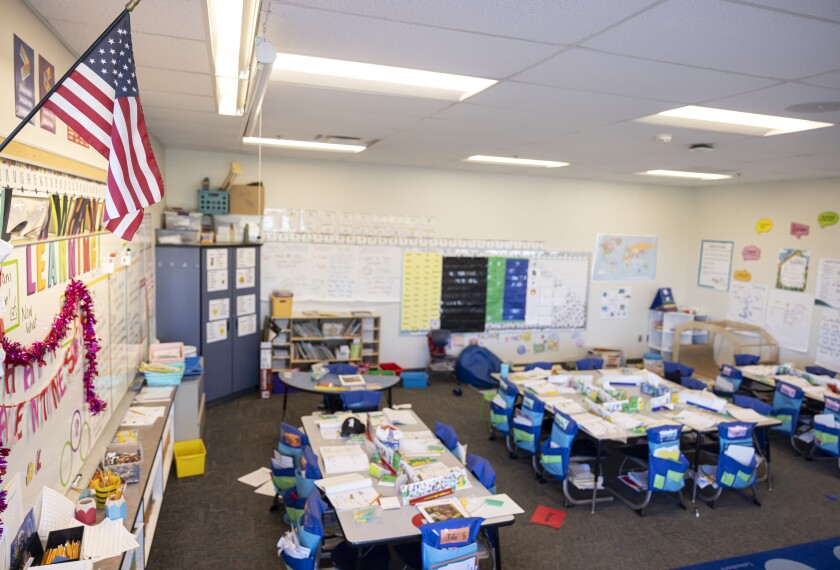
A first grade classroom at a school in Colorado Springs, on Feb. 12, 2026.
A 1st grade classroom at a school in Colorado Springs, Colo., on Feb. 12, 2026. The U.S. Department of Education released a proposal to rework a decades-old program charged with helping states and school districts problem-solve and deploy new initiatives, calling the current structure “duplicative” and “confusing.”
Kevin Mohatt for Education Week
Federal Will the Ed. Dept. Act on Recommendations to Overhaul Its Research Arm?
An adviser's report called for more coherence and sped-up research awards at the Institute of Education Sciences.
6 min read
The U.S. Department of Education building is pictured on Oct. 24, 2025, in Washington, D.C.
The U.S. Department of Education building in Washington is pictured on Oct. 24, 2025. A new report from a department adviser calls for major overhauls to the agency's research arm to facilitate timely research and easier-to-use guides for educators and state leaders.
Maansi Srivastava for Education Week
Federal Trump Talks Up AI in State of the Union, But Not Much Else About Education
The president didn't mention two of his cornerstone education policies from the past year.
4 min read
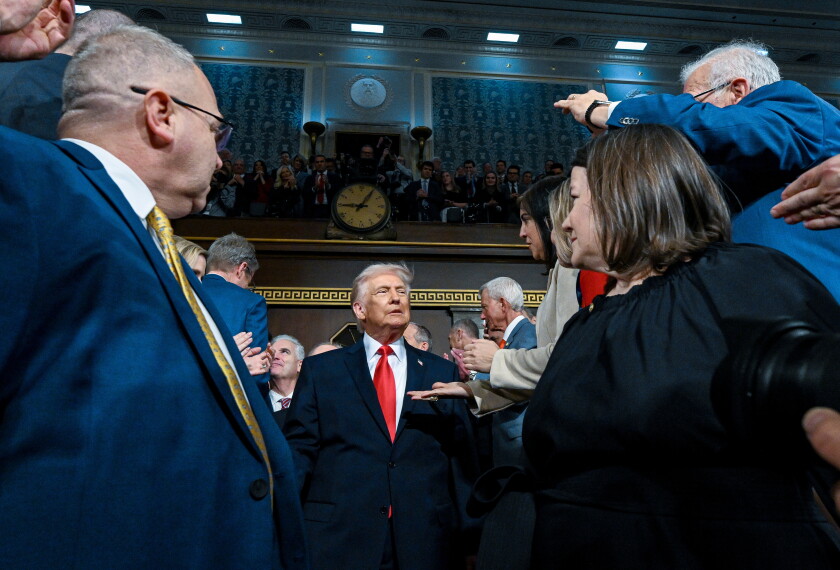
President Donald Trump enters to deliver the State of the Union address to a joint session of Congress in the House chamber at the U.S. Capitol in Washington, Tuesday, Feb. 24, 2026.
President Donald Trump enters to deliver the State of the Union address to a joint session of Congress in the House chamber at the U.S. Capitol in Washington, Tuesday, Feb. 24, 2026. The president devoted little time in the speech to discussing his education policies.
Kenny Holston/The New York Times via AP, Pool