Law & Courts

District’s At-Large Elections Violated Minority Voting Rights, Federal Appeals Court Finds

By Mark Walsh — January 07, 2021 3 min read
Image of people at voting booths.
  • Save to favorites
  • Print

A federal appeals court on Wednesday upheld a trial court’s ruling that at-large school board elections in a New York state school district violate the Voting Rights Act of 1965 because they dilute the voting power of Black and Latino residents.

The decision comes in a case involving the East Ramapo Central School District, which has some 8,800 students and covers large Orthodox and Hasidic Jewish populations that send about 29,000 students to private religious schools.

At the heart of the case are findings that two local rabbis and other leaders in the Orthodox community have long recruited and slated candidates for election to the nine-member East Ramapo school board and that the board often served the interests of the private school community. Although some minority candidates have been slated by the Orthodox leaders and elected, they were not the preferred candidates of minority voters in the district, court papers say.

“The record is replete with evidence that the private-school [community]-run board was chronically unresponsive to public-school concerns,” says the Jan. 6 decision in Clerveaux v. East Ramapo Central School District by a unanimous three-judge panel of the U.S. Court of Appeals for the 2nd Circuit, in New York City.

The resident population of the East Ramapo district is described in court papers as 65.7 percent white, 19.1 percent Black, 10.7 percent Latino, and 3.3 percent Asian.

Minority candidates won seven out of 32 contested board elections from 2005 to 2018, but from 2008 to 2018, the only minority candidates who won did so with the support of the Orthodox organization, court papers say. Thus, according to the voting-rights lawsuit filed by the New York Civil Liberties Union on behalf of the NAACP and other plaintiffs, minority residents were not able to elect their preferred candidates.

In 2014, a state-appointed monitor investigated the board’s activities and found that the “board appears to favor the interests of private schools over public schools.”

For example, the 2nd Circuit panel said, the board closed two public schools over minority opposition and “made a sweetheart deal with a yeshiva to sell it one of the closed schools at a discounted price.”

The board also made accommodations at its meetings for Yiddish-speaking parents but not for Spanish-speaking parents, resulting in New York state issuing a corrective action plan, court papers say.

‘Significant Control’ of Slating Process

The 2nd Circuit court upheld the district court’s reliance on data from the plaintiffs’ voting rights expert over that of the defendants’ expert. The district court concluded that the Black and Latino communities in the school district were politically cohesive and that the white majority votes as a bloc in board elections such that no minority-preferred candidate won a contested election since 2008.

The racially polarized voting in the district elections could not be explained by differences in policy preferences, the district court had ruled. The 2nd Circuit held that voting for private-school friendly policies was a proxy for race in violation of Section 2 of the Voting Rights Act.

“Those policies favorable to the private-school community come at the cost of the public-school community,” the appeals court said. “It defies reality to say that those who vote for private-school-friendly policies would be ignorant that the brunt of these policies is borne by minority children.”

The 2nd Circuit panel said the Orthodox organization’s failure to conduct open calls for candidates, the necessity for inside connections to be slated, the vetting process, and the use of only “safe” or politically or legally expedient minority candidates, all support the finding that minority candidates and residents were denied meaningful access to the slating process.

“These facts underscore the significant control of the white private-school leaders over the slating process, which worked to exclude minority interests and viewpoints from the slate and ultimately the board,” the court said.

The 2nd Circuit upheld the district court’s injunction barring any board elections under the at-large system pending the resolution of the case. In their lawsuit, the plaintiffs’ asked for a single-member district system for election board members, but it is not clear whether that remedy has been ordered or might come after further proceedings.

Events

This content is provided by our sponsor. It is not written by and does not necessarily reflect the views of Education Week's editorial staff.
Sponsor
Artificial Intelligence Webinar
Managing AI in Schools: Practical Strategies for Districts
How should districts govern AI in schools? Learn practical strategies for policies, safety, transparency, as well as responsible adoption.
Content provided by Lightspeed Systems
This content is provided by our sponsor. It is not written by and does not necessarily reflect the views of Education Week's editorial staff.
Sponsor
Reading & Literacy Webinar
Unlocking Success for Struggling Adolescent Readers
The Science of Reading transformed K-3 literacy. Now it's time to extend that focus to students in grades 6 through 12.
Content provided by STARI
Jobs Virtual Career Fair for Teachers and K-12 Staff
Find teaching jobs and K-12 education jubs at the EdWeek Top School Jobs virtual career fair.

EdWeek Top School Jobs

Teacher Jobs
Search over ten thousand teaching jobs nationwide — elementary, middle, high school and more.
View Jobs
Principal Jobs
Find hundreds of jobs for principals, assistant principals, and other school leadership roles.
View Jobs
Administrator Jobs
Over a thousand district-level jobs: superintendents, directors, more.
View Jobs
Support Staff Jobs
Search thousands of jobs, from paraprofessionals to counselors and more.
View Jobs

Read Next

Law & Courts Appeals Court Halts Ruling Letting Teachers Disclose Students' Gender Identity
A federal appeals court has temporarily paused enforcement of the ruling but has not yet decided whether to grant a longer-term stay.
Kristen Taketa, The San Diego Union-Tribune
3 min read
Students carrying pride and transgender flags leave Great Oak High School in Temecula, Calif., on Sept. 22, 2023, after walking out of the school in protest of the Temecula school district policy requiring parents to be notified if their child identifies as transgender.
Anjali Sharif-Paul/The Orange County Register via AP
Law & Courts Schools Can’t Bar Teachers From Telling Parents If Kids Are Transgender, Judge Rules
The injunction bans any public school employee from misleading parents about their child’s gender presentation at school.
Kristen Taketa, The San Diego Union-Tribune
5 min read
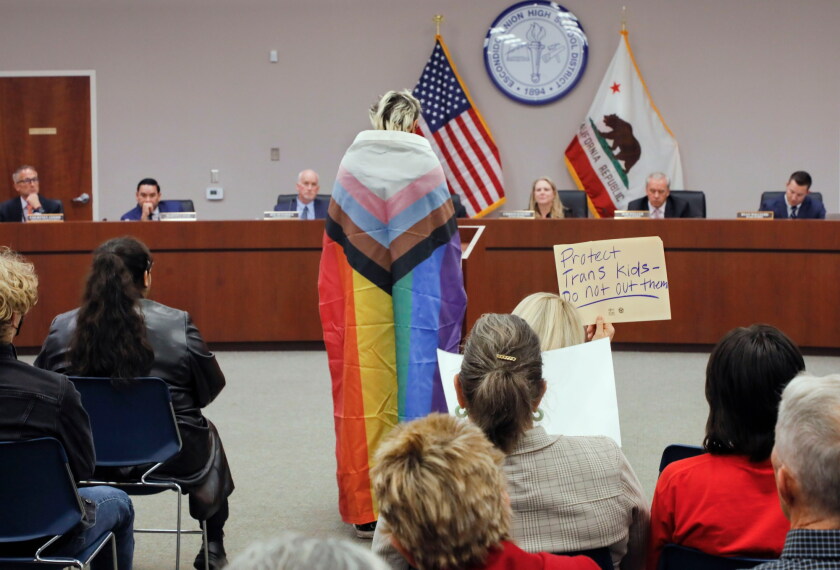
Teacher’s aide Amelia Mester, wrapped in a Pride flag, urges Escondido Union High School District not to have employees notify parents if they believe a student may be transgender in November 2025. A policy on the issue in the city’s elementary school district is the subject of a federal class-action lawsuit in which a judge just sided against the district.
Teacher’s aide Amelia Mester, wrapped in a Pride flag, urges Escondido Union High School District not to have employees notify parents if they believe a student may be transgender. A policy on the issue in the city’s elementary school district is the subject of a federal class-action lawsuit in which a judge just ruled against the district.
Charlie Neuman for The San Diego Union-Tribune/TNS
Law & Courts Federal Appeals Court Upholds 8th Grader's Expulsion Over Gun Comments in Class
Shortly after a nearby mass school shooting, a student allegedly discussed bringing a gun to school.
3 min read
Photo of stone columns.
E+
Law & Courts Trump's Education Policies Spurred 72 Lawsuits in 2025. How Many Is He Winning?
The legal challenges show which policies have had a big impact and how 2026 could go.
5 min read
President Donald Trump holds up an executive order after signing it at an indoor Presidential Inauguration parade event in Washington, Jan. 20, 2025.
President Donald Trump holds up an executive order after signing it at an indoor presidential inauguration parade event in Washington on Jan. 20, 2025. Trump's executive actions prompted legal challenges virtually from the moment he took office, and education-related policies were not immune.
Matt Rourke/AP
