Law & Courts

Court Affirms Rights of Parents To Control Children’s Upbringing

By Mark Walsh — June 14, 2000 3 min read
  • Save to favorites
  • Print

In a ruling with potential ramifications for education, the U.S. Supreme Court last week strongly reaffirmed the constitutional right of parents to make decisions about the upbringing of their children.

The justices were highly splintered on the central issue in the case: Did a Washington state law go too far in granting grandparents and others the right to petition for visits with children against the wishes of a parent? In a 6-3 judgment, the court severely limited the application of the statute. Only four justices, however, signed the main opinion, which called the law “breathtakingly broad.”

But in a flurry of six written opinions in Troxel v. Granville (Case No. 99-138), the justices were in much broader agreement regarding the idea that parents have a fundamental right under the U.S. Constitution to control the upbringing of their children, including their education.

Citing Supreme Court cases dating to the 1920s, Justice Sandra Day O’Connor said in the main opinion that “it cannot now be doubted that the due process clause of the 14th Amendment protects the fundamental right of parents to make decisions concerning the care, custody, and control of their children.”

She cited Meyer v. Nebraska, a 1923 ruling that struck down a Nebraska law barring instruction in foreign languages because it interfered with parents’ right to “control the education of their own,” and Pierce v. Society of Sisters, a 1925 decision that struck down an Oregon law mandating public school attendance and thus precluding enrollment in parochial schools.

At least seven justices expressed strong support for such parental rights. As Justice Anthony M. Kennedy put it, “A custodial parent has a constitutional right to determine, without undue influence from the state, how best to raise, nurture, and educate the child.”

A ‘Strong Rebuke’?

The strong reaffirmation of parental rights is significant, some legal experts said, because the court has had little to say on the subject since its 1972 ruling in Wisconsin v. Yoder, which required the state of Wisconsin to exempt Amish children from compulsory school attendance beyond the 8th grade.

Since then, a growing number of parents, often religious conservatives, have voiced objections to their children’s participation in certain elements of public schooling, such as sex education classes, self-esteem lessons, social science surveys, and compulsory community- service requirements, among others.

In some legal challenges to such practices, lower courts have ruled that parental rights to control their children’s education is outweighed by a school district’s interest in including all students.

The reaffirmation of parental control of a child’s upbringing as a fundamental right “is a strong rebuke to lower federal courts that have sought on their own to reverse Meyer and Pierce,” said Vincent P. McCarthy, a lawyer with the American Center for Law and Justice.

The Virginia Beach, Va.-based legal organization, founded by the religious broadcaster Pat Robertson, has represented parents who object to their children’s mandatory participation in sex education classes.

Julie Underwood, the general counsel of the National School Boards Association, agreed that the Troxel ruling “could be an important case for education.”

“I believe conservative litigators will take this ruling and use it to challenge compulsory education laws, curriculum decisions by school boards, and really any kind of educational requirement,” she said.

But she does not believe that the high court has moved to treat parental rights as deserving of the court’s highest level of constitutional scrutiny. Under so-called strict scrutiny, a government action infringing on a fundamental right must serve a compelling governmental interest, instead of merely being rationally related to a governmental need.

Although Justice O’Connor discussed parental rights as a “fundamental liberty interest,” only Justice Clarence Thomas called for applying strict scrutiny to an infringement of that right.

Justice Antonin Scalia, in a provocative dissenting opinion, raised doubts about whether Meyer, Pierce, and Yoder merited respect as precedents.

While parents’ rights to control their children’s upbringing are inherent in the “unalienable rights” cited in the Declaration of Independence, Justice Scalia said, such rights aren’t mentioned in the Constitution. He said federal judges should avoid trying to define parental rights, or else “we will be ushering in a new regime of judicially prescribed, and federally prescribed, family law.”

Related Tags:

A version of this article appeared in the June 14, 2000 edition of Education Week as Court Affirms Rights of Parents To Control Children’s Upbringing

Events

This content is provided by our sponsor. It is not written by and does not necessarily reflect the views of Education Week's editorial staff.
Sponsor
Special Education Webinar
Hidden Costs of Special Ed Vacancies: Solutions for Your District
When provider vacancies hit, students feel it first. Hear what district leaders are doing to keep IEP-related services on track.
Content provided by Huddle Up
Budget & Finance Webinar Creative Approaches to K-12 Budget Realities
What are districts prioritizing in 2026? New survey data reveals emerging K-12 budgeting trends.
This content is provided by our sponsor. It is not written by and does not necessarily reflect the views of Education Week's editorial staff.
Sponsor
College & Workforce Readiness Webinar
From Coursework to Careers: Expanding Work-Based Learning and Industry Credentials in CTE
Expand work-based learning and industry credentials in CTE to connect classroom learning with real careers and prepare students for future success.
Content provided by Project Lead The Way

EdWeek Top School Jobs

Teacher Jobs
Search over ten thousand teaching jobs nationwide — elementary, middle, high school and more.
View Jobs
Principal Jobs
Find hundreds of jobs for principals, assistant principals, and other school leadership roles.
View Jobs
Administrator Jobs
Over a thousand district-level jobs: superintendents, directors, more.
View Jobs
Support Staff Jobs
Search thousands of jobs, from paraprofessionals to counselors and more.
View Jobs

Read Next

Law & Courts Birthright Citizenship Case Raises Stakes for Schools and Undocumented Students
Educators are paying close attention to the case on Trump's birthright citizenship order.
10 min read
President Donald Trump signs an executive order on birthright citizenship in the Oval Office of the White House in Washington, Jan. 20, 2025.
President Donald Trump signs an executive order on birthright citizenship in the Oval Office of the White House on Jan. 20, 2025. The order, now before the U.S. Supreme Court, seeks to limit citizenship for some children born in the United States to immigrant parents without permanent legal status.
Evan Vucci/AP
Law & Courts Appeals Court Revives Lawsuit Over 1st Grader’s Black Lives Matter Drawing
A court revived a 1st grader 's claim she was punished for giving a drawing to a Black classmate.
4 min read
Seen is the drawing made by Viejo Elementary School first-grader B.B. that was entered into evidence. B.B. gave the drawing to her classmate, M.C., who is African American. M.C. thanked B.B.
Pictured is a drawing by a 1st grader in California and given to a Black classmate that is at the center of a First Amendment legal challenge over the student's alleged punishment.
U.S. Court of Appeals for the 9th Circuit
Law & Courts Supreme Court’s Gender Identity Ruling Leaves Schools Seeking Clarity
Advocates say they would welcome more from the Supreme Court on gender-notification policies.
7 min read
The Supreme Court is photographed, Friday, Feb. 27, 2026, in Washington.
The Supreme Court is photographed, Friday, Feb. 27, 2026, in Washington. The high court recently ruled that California policies that sometimes limit or discourage schools from disclosing information to parents about children’s gender transitions and expressions at school likely violate parents’ constitutional rights
Rahmat Gul/AP
Law & Courts Supreme Court Backs Parents in School Gender Disclosure Fight
The Supreme Court restored an injunction blocking California policies on student gender transitions
8 min read
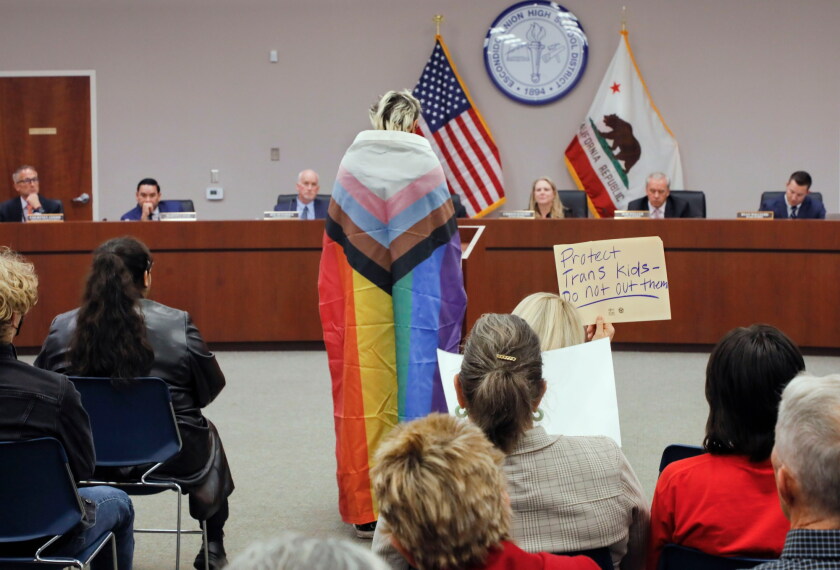
Teacher’s aide Amelia Mester, wrapped in a Pride flag, urges Escondido Union High School District not to have employees notify parents if they believe a student may be transgender in November 2025. A policy on the issue in the city’s elementary school district is the subject of a federal class-action lawsuit in which a judge just sided against the district.
Teacher’s aide Amelia Mester, wrapped in a Pride flag, urges Escondido Union High School District not to have employees notify parents if they believe a student may be transgender at a meeting in November 2025. Two parents and two teachers from the district sued in 2023, challenging California state guidance concerning student gender transitions and parental notification. The U.S. Supreme Court has now reinstated a lower-court decision overturning those state policies.
Charlie Neuman for The San Diego Union-Tribune/TNS