For seven years, the Department of Education and Pennsylvania officials battled over how the state spent $108 million in federal education grants.
But their differences finally faded after an intensive, six-month mediation effort. On Feb. 27, Pennsylvania and federal auditors wiped the state’s slate clean when the state agreed to pay back $2 million and change several administrative procedures.
|
The consensus pact is the product of a striking change in a relationship that, until late last year, was mired in court proceedings throughout the 1990s, federal and state officials acknowledged.
It also marks the first major settlement under a 4-year-old federal effort called the Cooperative Audit Resolution and Oversight Initiative, or CAROI. Education Department officials see CAROI as a way to ease relations with state grantees nationwide.
|
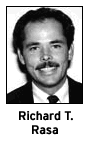
“Our vision is ... that we will be working with all states just as we did with Pennsylvania,” said Richard T. Rasa, the director of state and local assistance for the office of the Education Department’s inspector general.
In Pennsylvania, both sides are predicting that the state education department’s books will not invite further citations in years to come.
“One of the ultimate benefits is these findings shouldn’t occur in the future,” Mr. Rasa said.
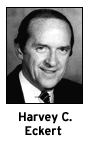
“The [audit findings] that we resolved, we shouldn’t have problems with them in the future,” said Harvey C. Eckert, Pennsylvania’s deputy secretary for comptroller operations. “The resolution was something that both sides agreed with.”
Getting Together
The cooperative-resolution initiative’s goal is to bring together all of the players--lawyers, program directors, auditors, and accountants--to solve problems identified in audits of state financial statements for federal education-grant projects.
In traditional audits, the financial analysts and program directors remain apart, leaving their lawyers to fight over the details before administrative-law judges and federal appellate courts.
Federal law requires states to hire independent accountants for annual audits of their federal grant projects. It also mandates that states oversee the audits conducted for school districts and other recipients of federal education grants. The federal Education Department’s inspector general’s office reviews the audits and takes action when it appears that federal money has been misspent.
Frequently, grantees’ biggest problems revolve around how a state documents the amount of time employees spend working on grant projects and how it pays salaries with those grants, federal officials say. Many states also fail to document their “maintenance of effort,” a requirement in federal education laws to ensure that states keep up their end of the school funding equation. Maintenance-of-effort language is designed to keep states from relying on federal money to offset cuts in state spending.
In three pilot states, the CAROI process yielded resolutions to audit problems less complex than Pennsylvania’s.
In working with Florida in 1996, for example, the federal government created a new, less burdensome way for states to collect time sheets from employees. The cooperative approach also was applied in Washington state and Mississippi.
Now, Florida collects detailed time sheets for only three months a year to calculate the federal share of an employee’s salary. California, North Carolina, and other states are considering adopting the new method, according to Hazel Fiers, the federal department’s director of post-audit operations.
Federal auditors are also using the CAROI model in Puerto Rico to address problems with the commonwealth’s personnel accounting. They also are applying the principles to specific audit findings in California, Illinois, Texas, and the Virgin Islands.
Federal officials hope to integrate the CAROI philosophy into every audit review, Mr. Rasa said, and they hope states will follow their lead when dealing with audits of districts.
Initial Skepticism
While the pilot states had relatively few differences to resolve, Pennsylvania had a mountain of problems, many of which had resisted resolution for almost a decade.
“What happened in the past was each side would dig in, and the only people who were talking to each other were the attorneys,” Mr. Eckert said. “You used so many resources preparing to go to court. It just wasn’t necessary.”
Job-Training Issues
Pennsylvania’s biggest problem centered on one state job-training program. After reviewing an audit of the initiative, a federal appeals court had ruled in 1996 that the state owed $3.1 million to the U.S. government for fiscal 1989 and 1991 for failing to maintain the proper level of state aid for vocational education--a condition of its federal funding.
But that decision was rendered moot when Congress inserted language in the fiscal 1997 education appropriations law forgiving the state’s debt for those years.
Over the past six months, federal officials sorted through documents from the job-training program that the courts never reviewed. They found that the job-training program in question did not conform to the federal law’s definition of vocational education, according to Brent Weston, the federal official who helped resolve the issue.
Because it was then considered unrelated to the federal grant, the state did not have to maintain funding at a particular level to keep receiving federal vocational education money, federal officials decided. The decision settled outstanding audit findings from fiscal years not covered in the 1997 appropriations law.
The six-month mediation in Pennsylvania also settled lesser conflicts over personnel costs and job training for disabled students and resulted in $2 million being returned to federal coffers.
With long-standing issues on the table, Pennsylvania seemed an unlikely candidate for CAROI success.
As federal officials explained the process, “the expression on [state officials’] faces showed their skepticism,” said Phil H. Rosenfelt, an assistant general counsel for the federal Education Department who fought many of the agency’s legal battles against Pennsylvania.
Mr. Eckert acknowledged that he and others doubted mediation would work, but he has since changed his mind.
“If we have a problem, we know who to contact, and it’s a person who we’ve been face to face with,” he said. “There’s a structure to be followed in the future. Hopefully, we won’t get in this situation again.”


