Law & Courts

Clinton’s Call for Racial Harmony Sparks Debate on Education Policy

By David J. Hoff — June 25, 1997 2 min read
  • Save to favorites
  • Print

President Clinton’s call to heal the nation’s racial divisions has highlighted his differences with Republicans over school policy.

In speeches this month, Mr. Clinton and Speaker of the House Newt Gingrich, R-Ga., both called education a key ingredient in leveling the playing field for members of different races.

But they disagreed starkly on what policies to pursue, with both sides reaffirming long-held positions.

“We must create better opportunities for all children to learn by ... giving urban parents the financial opportunity to choose the public, private, or parochial school that’s best for their children,” the House leader said in a speech to the Orphan Foundation here June 18.

Two Views

Instead of school choice, Mr. Clinton’s June 14 speech on race relations focused on improving public schools so the achievement of all children would rise.

“There are no children who, because of their ethnic or racial background, cannot meet the highest academic standards if we set them and measure our students against them, if we give them well-trained teachers and well-equipped classrooms, and if we continue to support reasoned reforms to achieve excellence, like the charter school movement,” the president said in a commencement speech at the University of California, San Diego.

In addition, Mr. Clinton defended college admissions policies that give preferences to minority students. That drew Mr. Gingrich’s ire.

“The president must abandon the misguided belief that our society should ever use discrimination to end discrimination,” Mr. Gingrich and author Ward Connerly, a University of California regent, wrote in the The New York Times the day after Mr. Clinton’s speech. Mr. Connerly, who is black, helped champion the movement to pass a 1996 California referendum to abolish race-based preferences in government programs, including schools.

Upcoming Debates

The war of words will likely lead to legislative battles in coming months.

Even before last week, Republicans, with a few Democrats supporting them, promised to push for a school-voucher-demonstration program in the District of Columbia this year.

A similar attempt last year failed when Democrats in the Senate filibustered against it. The president had opposed the measure.

In his June 18 speech, Mr. Gingrich also endorsed community-redevelopment legislation that requires participating cities to offer school vouchers. (“Black Congressman Backs Private School Voucher Measure,” March 19, 1997.)

His Republican colleagues also unveiled legislation last week to repeal affirmative action programs in response to Mr. Clinton’s defense of them.

Civil rights activists generally take Mr. Clinton’s side in the school choice debate. Still, they aren’t enamored of some other elements of the president’s education agenda.

For example, one of Mr. Clinton’s education goals is to entice 100,000 teachers to become certified by the National Board for Professional Teaching Standards. (“Clinton Gives Top Billing to Education Plan,” Feb. 12, 1997.)

That is a laudable aim, according to William L. Taylor, a noted school desegregation lawyer. But it does nothing to improve the inner-city schools where most minority children are enrolled, he argued.

“There is a crying need in central cities for improved teaching,” said Mr. Taylor, who is a visiting professor at the Stanford University law school in California. “What he has given is a much more diffuse call for teachers.”

Related Tags:

Events

This content is provided by our sponsor. It is not written by and does not necessarily reflect the views of Education Week's editorial staff.
Sponsor
Artificial Intelligence Webinar
Managing AI in Schools: Practical Strategies for Districts
How should districts govern AI in schools? Learn practical strategies for policies, safety, transparency, and responsible adoption.
Content provided by Lightspeed Systems
This content is provided by our sponsor. It is not written by and does not necessarily reflect the views of Education Week's editorial staff.
Sponsor
Student Absenteeism Webinar
Removing Transportation and Attendance Barriers for Homeless Youth
Join us to see how districts around the country are supporting vulnerable students, including those covered under the McKinney–Vento Act.
Content provided by HopSkipDrive
This content is provided by our sponsor. It is not written by and does not necessarily reflect the views of Education Week's editorial staff.
Sponsor
Reading & Literacy Webinar
Two Jobs, One Classroom: Strengthening Decoding While Teaching Grade-Level Text
Discover practical, research-informed practices that drive real reading growth without sacrificing grade-level learning.
Content provided by EPS Learning

EdWeek Top School Jobs

Teacher Jobs
Search over ten thousand teaching jobs nationwide — elementary, middle, high school and more.
View Jobs
Principal Jobs
Find hundreds of jobs for principals, assistant principals, and other school leadership roles.
View Jobs
Administrator Jobs
Over a thousand district-level jobs: superintendents, directors, more.
View Jobs
Support Staff Jobs
Search thousands of jobs, from paraprofessionals to counselors and more.
View Jobs

Read Next

Law & Courts Supreme Court’s Gender Identity Ruling Leaves Schools Seeking Clarity
Advocates say they would welcome more from the Supreme Court on gender-notification policies.
7 min read
The Supreme Court is photographed, Friday, Feb. 27, 2026, in Washington.
The Supreme Court is photographed, Friday, Feb. 27, 2026, in Washington. The high court recently ruled that California policies that sometimes limit or discourage schools from disclosing information to parents about children’s gender transitions and expressions at school likely violate parents’ constitutional rights
Rahmat Gul/AP
Law & Courts Supreme Court Backs Parents in School Gender Disclosure Fight
The Supreme Court restored an injunction blocking California policies on student gender transitions
8 min read
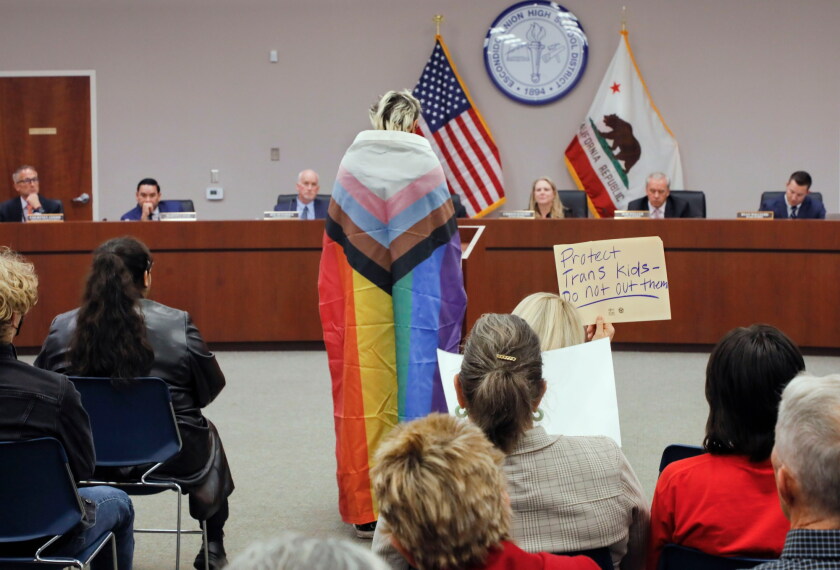
Teacher’s aide Amelia Mester, wrapped in a Pride flag, urges Escondido Union High School District not to have employees notify parents if they believe a student may be transgender in November 2025. A policy on the issue in the city’s elementary school district is the subject of a federal class-action lawsuit in which a judge just sided against the district.
Teacher’s aide Amelia Mester, wrapped in a Pride flag, urges Escondido Union High School District not to have employees notify parents if they believe a student may be transgender at a meeting in November 2025. Two parents and two teachers from the district sued in 2023, challenging California state guidance concerning student gender transitions and parental notification. The U.S. Supreme Court has now reinstated a lower-court decision overturning those state policies.
Charlie Neuman for The San Diego Union-Tribune/TNS
Law & Courts Appeals Court Allows Louisiana Ten Commandments Displays to Proceed
The court said it was premature to rule on the constitutionality of La. Ten Commandments displays.
3 min read
Students work under Ten Commandments and Bill of Rights posters on display in a classroom at Lehman High School in Kyle, Texas, Thursday, Oct. 16, 2025.
Students work under Ten Commandments and Bill of Rights posters on display in a classroom at Lehman High School in Kyle, Texas, Oct. 16, 2025. A federal appeals court has lifted a lower-court injunction blocking a Louisiana law that requires Ten Commandments displays, clearing the way for the law to take effect.
Eric Gay/AP
Law & Courts Supreme Court Strikes Trump Tariffs in Case Brought by Educational Toy Companies
Two educational toy companies were among the leading challengers to the president's tariff policies
3 min read
Members of the Supreme Court sit for a new group portrait following the addition of Associate Justice Ketanji Brown Jackson, at the Supreme Court building in Washington, Oct. 7, 2022. Bottom row, from left, Associate Justice Sonia Sotomayor, Associate Justice Clarence Thomas, Chief Justice of the United States John Roberts, Associate Justice Samuel Alito, and Associate Justice Elena Kagan. Top row, from left, Associate Justice Amy Coney Barrett, Associate Justice Neil Gorsuch, Associate Justice Brett Kavanaugh, and Associate Justice Ketanji Brown Jackson.
Members of the U.S. Supreme Court sit for a new group portrait following the addition of Justice Ketanji Brown Jackson, at the court building in Washington, Oct. 7, 2022. On Feb. 20, 2026, the court ruled 6-3 to strike down President Donald Trump's broad tariff policies, ruling that they were not authorized by the federal statute that he cited for them.
J. Scott Applewhite/AP
