
With summer approaching, school district leaders are gearing up for the programs they’ll run to keep students engaged and learning during the break.
But students’ summer success requires more than just sending them to a school building, experts say. Intentional planning and structure are key.
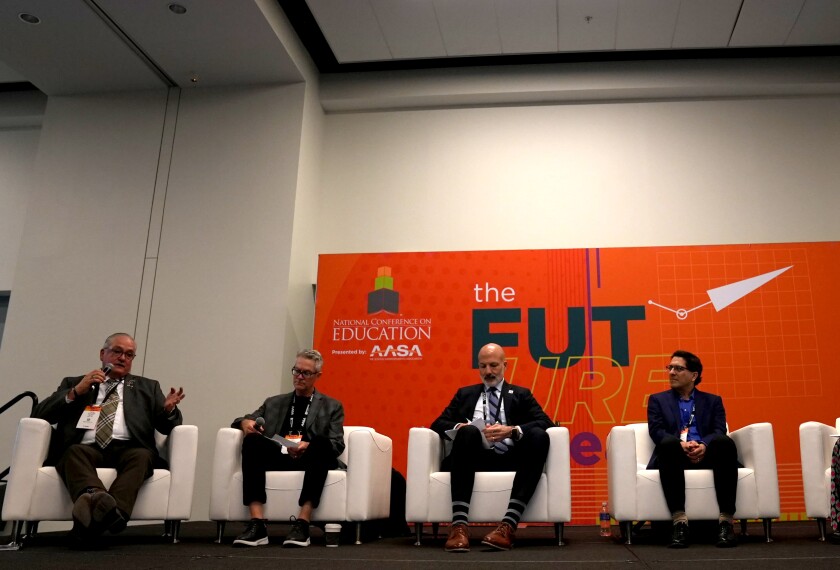
More than 80% of districts offer some kind of summer programming, Ben Master, a senior policy researcher at the RAND Corp., said during a panel discussion at the National Conference on Education in Nashville, Tenn., hosted in February by AASA, The School Superintendents Association. Of those programs, though, only about one-third meet basic standards that researchers use to determine whether a program is effective.
Master was joined by three superintendents who discussed how their districts have started and sustained effective summer programs, navigated challenges, and planned for the future.
Districts should focus on five key areas to get the biggest bang for their buck, Master said, citing RAND research that shows programs incorporating those elements are more likely to have high attendance and lead to improved academic performance.
The areas are: early planning; curriculum aligned to school-year lessons; staff quality; enrichment activities; and program length long enough to produce results, usually at least five weeks.
“Well-designed summer programs can produce meaningful academic and behavioral benefits across a variety of different summer program models and across different student groups,” Master said.
All those factors together can influence students’ attendance, which needs to be above about 60% to have a statistically significant impact on participating students’ achievement, Master said. Attendance can improve if districts help families navigate common barriers—addressing a lack of transportation and ensuring program schedules can accommodate parents’ work schedules.
Students are also far more likely to attend consistently if the program climate is positive, welcoming, and fun, Master said. Researchers have been able to accurately predict a program’s attendance rate based on how welcoming it appears to be for students.
Both Joe Gothard, the superintendent in Madison, Wis., and John Skretta, the Lincoln, Neb., superintendent, said they rely on partnerships with local community centers to sustain their summer offerings.
In Wisconsin, the community centers are generally newer than school buildings and provide more modern amenities for kids, and they are often centrally located so they can serve several school communities, reducing the need to run individual programs at each school.
The Lincoln district has partnered with community organizations to open “community learning centers” across the city, often at its highest-poverty schools, that provide out-of-school-time activities—before and after school, on some holidays, and during longer breaks like summer—that align with the district’s curriculum.
“Historically, when we think about summer programming, there’s this negative self-talk that we do as educators and the limiting proposition has been around, ‘Well, we invited students, but it’s voluntary, so what are we supposed to do?’ and kind of put our hands up,” Skretta said. “Then you just end up in this cycle of not doing great and not captivating students with engaging programming.”
Summer programs can take kids ‘places they’ve never seen before’
The Roma Independent school district in Texas has fewer community organizations to partner with, said Superintendent Carlos Gonzalez. Instead, his rural district, located on the U.S.-Mexico border, focuses on creating a themed, in-house program each year that is designed to expose students—the vast majority of whom come from families in poverty—to different cultures and experiences from around the world, without ever leaving Texas.
One year’s theme was “Adventureland.” Another was “Around the World in 20 Days.” The theme for the upcoming summer is Mardi Gras.
Upon enrolling in the summer program, each child gets a cutout replica of a plane ticket in the mail for their “trip.” The entire program, from hallway decorations to enrichment activities, revolves around the year’s theme.
“A lot of our students, since they’re from a low-socioeconomic background, they don’t have a chance to go on vacation, so we want to make our summer-school programs engaging, where we can ‘take,’ so to speak, these kids to see places that they’ve never seen before,” Gonzalez said.
Each day, the roughly 400 enrolled students participate in about three hours of math and reading instruction, two hours of enrichment activities—science projects, music, art—and one hour of recess and other physical activities.
Throughout the program, students can earn “Gladiator Bucks” (named for the district’s mascot) for good behavior to save up and spend at the end-of-summer store, stocked with prizes ranging from socks to action figures.
Last summer, students’ average attendance was over 90%, well above RAND’s threshold of about 60%.
Every participant in the Roma program receives free breakfast and lunch, a feature that the Lincoln district’s summer program shares. Free meals can entice food-insecure families to participate, Skretta said, and access to nutritious meals sets kids up for success year-round.
“The reality is that summer programming is a fundamental tool for addressing food insecurity and sustaining students as learner-ready throughout the entire calendar year, rather than just during the regular nine-month school year of 175 or 180 student days,” Skretta said.
Partnerships can address barriers to attendance
Transportation can present one challenge as families decide whether to enroll their children in summer programs.
Oftentimes, programs run at odd hours—for half or partial days, for example—and working parents struggle to align their schedules. If schools want to maximize participation, they should both make sure buses can run some routes to pick up and drop off students and strive to schedule programs for the length of the average workday, even if that means partnering with other organizations to staff them, Skretta said.
The Lincoln district provides essentially half-day summer school from 8 a.m. to noon each day. Afterward, the community learning centers the district set up in partnership with outside organizations offer “essentially high-quality child care” for the remainder of the day, Skretta said.
The CLCs, as Skretta called them, offer STEM, arts, and physical activity opportunities that align with the summer school curriculum. CLC directors and school principals work together to tailor those extracurricular experiences to align them with the summer program curriculum and “ensure optimal chances of success,” Skretta said.
Gothard, in Wisconsin, added that similar partnerships can fill child-care gaps families face between the end of the school year and the start of summer school and between the end of summer school and the start of the school year.
“We work with those community partners to make sure there’s a drop-in opportunity for students to be somewhere that’s safe, that’s supportive, where they can have access to food and have access to high-quality staff during those times,” Gothard said.
One community partner runs a summer program in partnership with the Madison district called Pedals and Pixels, in which participating students get a bicycle and ride as a group throughout the summer using the city’s bike lanes, stopping to take photographs in nature. Then, kids write about their photos to work on their literacy skills, Gothard said.
The kids can then keep their bikes, and Gothard has heard from families who have been grateful for a new mode of transportation and a new way to bond as a family.
“We kind of forget how important those aspects of what we do every day are sometimes,” Gothard said.


