School Climate & Safety

Report Finds Suspension Disparities in Ky.

By Darcia Harris Bowman — March 05, 2003 1 min read
  • Save to favorites
  • Print

Kentucky schools suspend students far too often—especially black students, who are booted from school two to 17 times as often as whites in some districts, a report concludes.

The study found that the state’s 176 districts doled out a combined 68,000 suspensions in the 2000-01 school year, up from about 65,500 such punishments the previous year.

The report, “Unintended Consequences: The Impact of ‘Zero Tolerance’ and Other Exclusionary Policies on Kentucky Students,” February 2003, is available from Building Blocks for Youth. (Requires Adobe’s Acrobat Reader.)

The authors did not include the total number of black students suspended in each of those academic years. But they said a review of individual districts showed that African-Americans, more often than whites were the students disciplined under such policies.

“Unintended Consequences: The Impact of ‘Zero Tolerance’ and Other Exclusionary Policies on Kentucky Students” was released late last month by Spalding University’s National Institute on Children, in Louisville, and the Children’s Law Center, in Covington, Ky.

Among other consequences, the report’s authors argue that schools’ widespread use of suspension feeds a growing disparity in school performance between the state’s black and white students.

Zero Tolerance

“Zero-tolerance policies seem to be a backdoor way of getting rid of certain student populations,” said co-author David Richart, the director of the National Institute on Children. “When policies send a message to African-American youth that they are disposable and less valuable, it’s no wonder that Kentucky is struggling with a dramatic achievement gap.”

The authors say their findings are consistent with recent national studies on the impact of zero-tolerance policies.

But Brad Hughes, a spokesman for the Kentucky School Boards Association, said the report’s characterization of the state’s rate of school suspensions as an overuse of zero-tolerance policies was misleading. Only two districts in the state, he said, have true zero- tolerance policies, which call for expulsion—not suspension—for students who commit certain infractions.

“We obviously do believe that in most cases, suspensions are meted our fairly,” Mr. Hughes added, “but if a district sees its African-American 8th graders are being suspended more often than its white 8th graders, they should probably look into it.”
Events

This content is provided by our sponsor. It is not written by and does not necessarily reflect the views of Education Week's editorial staff.
Sponsor
Artificial Intelligence Webinar
Managing AI in Schools: Practical Strategies for Districts
How should districts govern AI in schools? Learn practical strategies for policies, safety, transparency, and responsible adoption.
Content provided by Lightspeed Systems
Jobs Virtual Career Fair for Teachers and K-12 Staff
Find teaching jobs and K-12 education jubs at the EdWeek Top School Jobs virtual career fair.
This content is provided by our sponsor. It is not written by and does not necessarily reflect the views of Education Week's editorial staff.
Sponsor
Student Absenteeism Webinar
Turning Attendance Data Into Family Action
This California district cut chronic absenteeism in half. Learn how they used insight and early action to reach families and change outcomes.
Content provided by SchoolStatus

EdWeek Top School Jobs

Teacher Jobs
Search over ten thousand teaching jobs nationwide — elementary, middle, high school and more.
View Jobs
Principal Jobs
Find hundreds of jobs for principals, assistant principals, and other school leadership roles.
View Jobs
Administrator Jobs
Over a thousand district-level jobs: superintendents, directors, more.
View Jobs
Support Staff Jobs
Search thousands of jobs, from paraprofessionals to counselors and more.
View Jobs

Read Next

School Climate & Safety Schools Flag Safety Incidents As Driverless Cars Enter More Cities
Agencies are examining reports of Waymos illegally passing buses; in another case, one struck a student.
5 min read
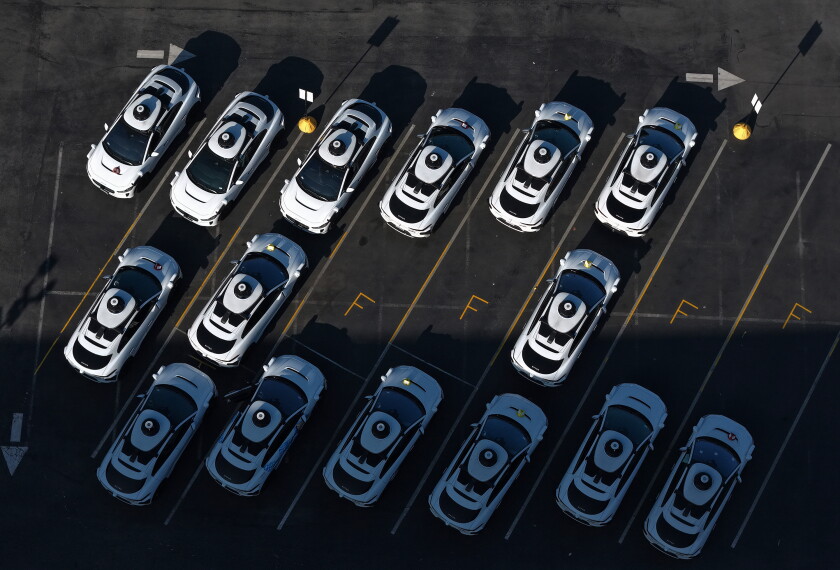
In an aerial view, Waymo robotaxis sit parked at a Waymo facility on Dec. 8, 2025 , in San Francisco . Self-driving taxi company Waymo said it is voluntarily recalling software in its autonomous vehicles after Texas officials documented at least 19 incidents this school year in which the cars illegally passed stopped school buses, including while students were getting on or off.
Waymo self-driving taxis sit parked at a Waymo facility on Dec. 8, 2025, in San Francisco. Federal agencies are investigating after Austin, Texas, schools documented incidents in which the cars illegally passed stopped school buses. In a separate incident, a robotaxi struck a student at low speed as she ran across the street in front of her Santa Monica, Calif., elementary school.
Justin Sullivan/Getty Images via TNS
School Climate & Safety Informal Classroom Discipline Is Hard to Track, Raising Big Equity Concerns
Without adequate support, teachers might resort to these tactics to circumvent prohibitions on suspensions.
5 min read
Image of a student sitting outside of a doorway.
DigitalVision
School Climate & Safety Tracker School Shootings This Year: How Many and Where
Education Week is tracking K-12 school shootings in 2026 with injuries or deaths. See the number of incidents and where they occurred.
3 min read
Sign indicating school zone.
iStock/Getty
School Climate & Safety School Shootings in 2025: The Fewest Incidents and Deaths in 5 Years
The overall number of U.S. school shootings was lower than in any year since 2020.
2 min read
A mother holds her children at the memorial outside Annunciation Catholic Church after Wednesday's shooting, Sunday, Aug. 31, 2025, in Minneapolis.
A mother holds her children at a memorial outside Annunciation Catholic Church following the Aug. 27 shooting at the Minneapolis Catholic school. The shooting, in which two children died and 21 people were injured, was the largest school shooting of 2025, a year during which there were fewer school shootings than in any year since 2020.
Ellen Schmidt/AP
