Opinion
Student Well-Being & Movement Letter to the Editor

Feds Show No Urgency for Mental-Health Resources

April 09, 2019 1 min read
  • Save to favorites
  • Print

To the Editor:

As a recent Education Week article pointed out, student depression is on the rise (“Schools Grapple With Student Depression as Data Show Problem Worsening,” March 14, 2019). While research shows there is an increase in mental illness among teens, I am not aware of any “intentional and strategic” plan to help students in my school district.

The federal, state, and local policymakers may be too late in exploring ways of preventing an epidemic. According to an analysis co-authored by psychologist Jean Twenge that the article references, in 2017, approximately 13.2 percent of teens 12-17 reported symptoms of a major depressive episode within the last year. Despite calls for intensive support for students diagnosed with mental illness, there is still no urgency in federal response to support schools.

Data show that the national average student-to-counselor ratio is one counselor to 482 students, which limits the effective support needed to address students and their needs. Rather than highlighting the issue after a tragedy, there should be greater emphasis on implementing mental-health programs tailored with additional support staff or counselors. In addition, policymakers should collectively collaborate with districts and school leaders to address the growing concerns of mental health and student wellness.

It may be difficult for districts to adopt an immediate plan to help students, but small changes will eventually lead to big shifts.

Simone Garnett

Teacher

Brooklyn, N.Y.

Related Tags:

A version of this article appeared in the April 10, 2019 edition of Education Week as Feds Show No Urgency for Mental-Health Resources

Events

EdWeek Top School Jobs

Teacher Jobs
Search over ten thousand teaching jobs nationwide — elementary, middle, high school and more.
View Jobs
Principal Jobs
Find hundreds of jobs for principals, assistant principals, and other school leadership roles.
View Jobs
Administrator Jobs
Over a thousand district-level jobs: superintendents, directors, more.
View Jobs
Support Staff Jobs
Search thousands of jobs, from paraprofessionals to counselors and more.
View Jobs

Read Next

Student Well-Being & Movement Yes, Computer Science Can Teach Social-Emotional Skills. Here's How
Though seemingly disparate, computer science and student mindfulness can mutually reinforce one another.
2 min read
Education Teacher Appreciation Morale 24126158566435
Students work on computers at A.D. Henderson School in Boca Raton, Fla., on April 16, 2024. Strategies used in computer science can also help teach students social-emotional skills.
Rebecca Blackwell/AP Photo
Student Well-Being & Movement Opinion How We Can End the Chicken-and-Egg Problem at the Heart of Student Misbehavior
As teachers manage classrooms filled with anxiety and impulsivity, this is how leaders can help.
5 min read
A teacher and students try to untangle complex emotional strings.
Chiara Vercesi for Education Week
Student Well-Being & Movement Can AI Help Students Learn Social-Emotional Skills?
Teachers are experimenting with ways to leverage the technology.
5 min read
Empathy02
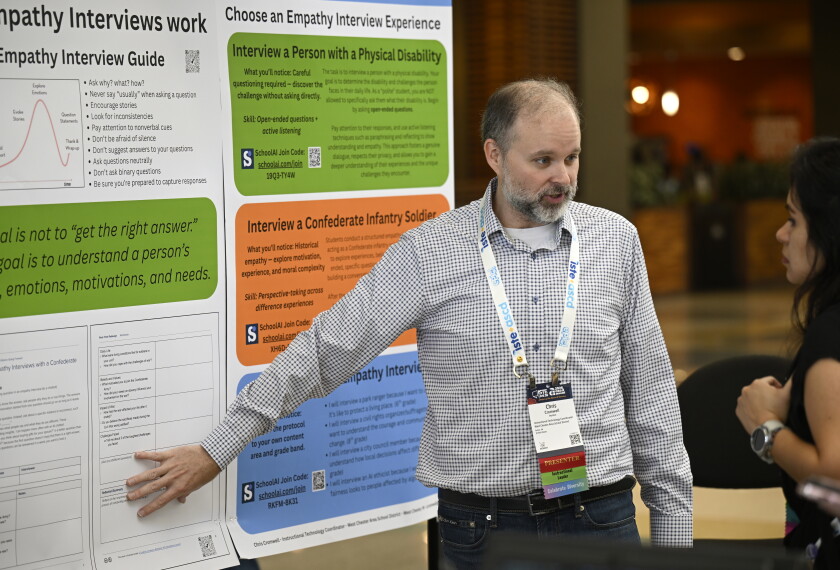
Chris Cromwell, an instructional technology coordinator for the West Chester Area School District in Pennsylvania, speaks to attendees during his presentation at the ISTELive 26 + ASCD Annual Conference in Orlando, Fla., on July 1, 2026. Cromwell is one of a small but growing number of educators using AI to teach students social and emotional skills.
Marvin Joseph/Education Week
Student Well-Being & Movement Q&A Is SEL a Band-Aid Patching Over Schools' Systemic Problems?
Why schools need to take a hard look at how their decisions heighten student stress.
3 min read
Students embrace Sage, a therapy dog, at Valley View Elementary on April 29, 2026, in Columbia Heights, Minn.
Students embrace a therapy dog at an elementary school in Columbia Heights, Minn., on April 29, 2026. Efforts to help kids improve their social and emotional well-being need to be combined with schools taking a hard look at how they are contributing to high levels of student stress, experts say.
Ellen Schmidt/MinnPost via AP