Is there a disconnect between the academic mainstream and a vast number of Americans? No question. Is the disconnect a problem for academics? Without question.
Recently, I searched the term “segregation” in Google Scholar, and it yielded 1.75 million hits. The term “intersectionality” yielded over 32,000 hits.
In 2014, I ran as the Democratic nominee for superintendent of public instruction in Arizona—the state’s highest education office. I spoke with voters daily about the issues facing their schools and ideas for improving them. During the campaign, segregation was not brought up once. Not once. No one mentioned intersectionality. Not a single person. To me, it is evident that even though academics may want to believe they are “speaking truth to power,” few are listening.
Explore the geographic distribution of 2017 RHSU Edu-Scholars concentrations and the political composition of their universities’ faculty.
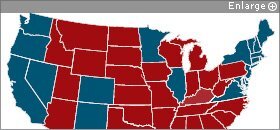
Source: Mitchell Langbert, Anthony J. Quain, and Daniel B. Klein (Econ Journal Watch, 2016); Associated Press
For public-minded academics, meaning those who regularly engage with laypeople (in person) on education issues, this disconnect is a familiar challenge that we navigate routinely. The profession as a whole, however, has lost step with the general public—and with many politicians, for that matter—because too few academics are public-minded.
It’s too convenient and clichéd to write that academics or our ideas are out of touch. The problem is that we have become complacent. We discuss our ideas comfortably to friendly audiences that do not question the applicability of our scholarship to those outside the room. We largely present to our own where too few are encouraged to ask the “so what?” question. In fact, the “so what?” question is often discouraged for fear of offending our colleagues.
For more in this package, please visit:
But when I engage with laypeople—and, yes, politicians are laypeople—their first question about education research is, in fact, “So what?” How does that study impact my students, my schools, my constituents? How does that study matter to my life? To be prepared to engage publicly means being prepared to answer these questions.
I am not arguing that education research is unimportant. Rather, I believe that academics are an essential voice in public and policy discussions. We need to work harder, and more explicitly, though, to connect education research with the general public. We must make the case for its importance outside academia just as ardently as we do within it.
This table lists the top 10 junior scholars who have not yet received tenure, according to the 2017 RHSU Edu-Scholar Public Influence Rankings.

I recognize the institutional barriers to engaging in public scholarship. The academic reward structure lists heavily toward peer-reviewed scholarship. Here, the institutional leadership must have the courage to value public scholarship—or, to go a step further, dedicate at least one faculty position to public scholarship, someone who is promoted based on contributions beyond those in peer-reviewed academic journals, such as crafting legislation or leading a task force.
My overarching concern for those in education policy, however, is that our disconnection with the general public means a disconnection with politicians, too. There is much that academics can do to engage with the public and, in turn, help shape the policy agenda.
We must begin by engaging—in person. It is not enough to post, click send, and walk away.This one-sided communication is not engagement. The strongest factor in educating and influencing the political sphere is personal contact. This is a tall order because academics spend very little time with politicians, and virtually no time with politicians who hold an opposing or critical worldview.
Linda Darling-Hammond, Diane Ravitch, and Gloria Ladson-Billings took the top three spots in the 2017 RHSU Edu-Scholar Public Influence Rankings. Click on the chart below to learn who took the other two spots. (The affiliations cited are drawn from the scholars’ CVs.)

We must have answers. Academic careers are built upon identifying problems. We problematize issues. We create contested spaces. Yet, to be productive in the public sphere, we need to translate this theorization into answers to practical, real-world policy issues. If you don’t have answers to problems facing real people, politicians will stop asking you questions. Often, these answers are not idealized. Rather, they are the result of compromise and dialogue. They are the most actionable plan at the moment, rather than the “scientifically best” option.
Lastly, we need unlikely allies. If your work is so compelling that the legislature or the press needs to hear about it, then someone outside of academia should be willing to make your case. These unlikely allies include community members, business or nonprofit leaders, even politicians from the “other” party. If you cannot convince someone outside of academia (or beyond yourself) to discuss and promote your work, then it’s not of public importance.
Since running for office—and in spite of losing the election—I am still called upon by politicians from both sides of the aisle along with many community groups. My approach to public scholarship is the same as my approach to teaching—to provide frameworks for people to better understand public education and make decisions. As academics, we do this well. It’s time we make it known beyond our own.


