
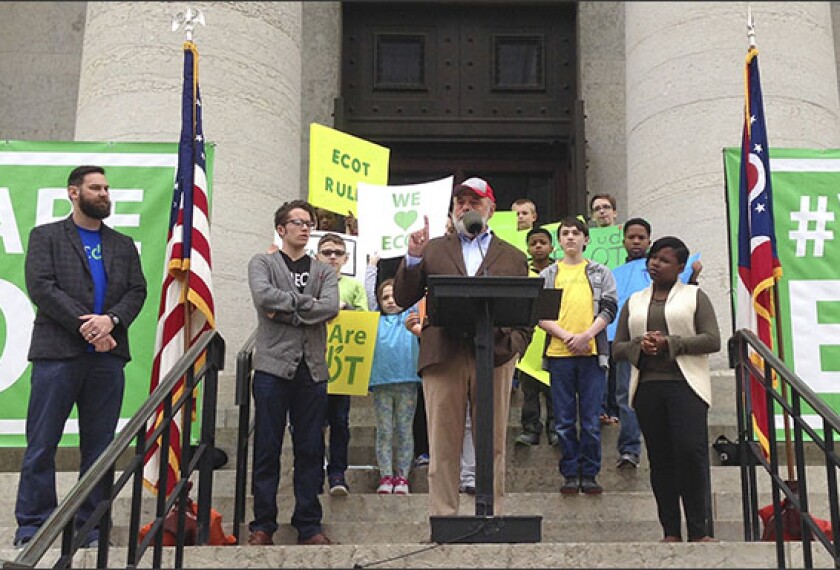
Ohio’s largest full-time online charter school has threatened to shut down in the middle of this school year, saying the state education department’s efforts to recover roughly $80 million in disputed funds are having a “fatal impact” on its ability to continue operating.
At the heart of the dispute are software-login records, which the Ohio education department recently began using to help determine attendance and enrollment—and thus funding—for the state’s e-schools. Through reviews of those records, state officials determined that a total of nine e-schools overstated their full-time enrollment by anywhere from dozens to thousands of students during the 2015-16 school year.
If the Electronic Classroom of Tomorrow closes, hundreds of educators and administrators would likely lose their jobs, and thousands of students—many of whom are struggling academically—would be displaced.
“When a school has 12,000 students spread around the state, the impact of a mid-year closure [would] create logistical nightmares for school districts and families,” said Chad Aldis, the vice president of Ohio policy at the Thomas B. Fordham Institute, which recently released a study taking a critical look at the academic performance of the state’s e-school sector. “It’s important to note, though, that this would be a voluntary closure.”
Some smaller e-schools that were found to have overstated their student enrollment have reached settlement agreements to repay the state education department. Others have shut down or suspended operations.
In recent months, the Ohio education department has withheld more than $10 million from its monthly payments to ECOT, part of its effort to recover more than $60.3 million in per-pupil funding it says the school improperly claimed during the 2015-16 school year.
What will happen to students?
Presumably, the Electronic Classroom of Tomorrow’s estimated 12,000 students, who are from all over Ohio, could return to the traditional schools in their home communities, or seek to enroll in other schools of choice. But ECOT officials argue that many students will either drop out or end up in schools that already failed them.
Will the state get repaid?
As part of its attendance dispute with ECOT, the Ohio Department of Education has already collected more than $10 million from the school, and the department says it’s owed roughly $70 million and counting more. Observers are debating whether ECOT could legally declare bankruptcy. State auditor general Dave Yost has suggested that the school could be ordered to sell its assets and recover money from its vendors, and he’s warned that e-schools and even their board members could be held liable if they don’t make every effort to do so.
Who deals with the administrative headaches?
ECOT officials say their school has enrolled between 300,000 to 500,000 students during its 17 years of operations, and currently employs 800 people. Thousands of school-owned computers and other equipment are currently in the hands of students all across the state. Forcing the school to close mid-year will create huge disruption on all those fronts, officials warn. Either the state or ECOT will have to address those administrative challenges.
In September, state officials told the school it must also repay an additional $19.2 million, based on a review of the school’s 2016-17 student-login records.
And the department says it will begin increasing its monthly withholdings in anticipation that the school won’t be able to document attendance for all the students who it claims are enrolled during the current school year.
Valuable Option or Bad Education?
ECOT has been challenging those actions in court, arguing that state officials have been retroactively applying an unfair standard as part of their efforts to track e-school attendance and enrollment. To date, the school’s lawsuits have been unsuccessful. But the Ohio Supreme Court agreed last month to hear its appeal.
Lawyers for the school have asked the court to either expedite its ruling or issue an injunction preventing the state from withholding any additional money, saying the school will otherwise be forced to close by January.
Many parents remain committed to full-time online charters, describing them as a valuable option for students who have not succeeded in more traditional environments. Education Secretary
But in Ohio and across the country, researchers have consistently found that students in full-time online charters perform significantly worse than their peers in brick-and-mortar schools.
Such troublesome academic results provide the backdrop for mounting concerns over student attendance.
Last year, for example, an Education Week investigation found that just 1 in 4 students at Colorado’s largest full-time online charter used the school’s learning software on a typical day.
Education policy experts generally agree that such findings constitute a red flag. But many are lukewarm about using such data for accountability and funding purposes, as Ohio has done.
“Basing school funding on the amount of time a student is logged in is an imperfect measure at best,” said Aldis of the Fordham Institute. “Its prime redeeming quality is that it’s better than simply funding students who enroll without regard to any consistent engagement.”
Critics of the state’s e-school sector say that such a lack of oversight has been the norm for far too long. The Electronic Classroom of Tomorrow has been a particular target, especially given concerns over the school’s multi-million dollar contracts with for-profit companies owned by the school’s founder, William Lager, a major political donor in the state.
The Ohio Republican Party, for example, recently announced it would return $76,000 in campaign donations from Lager and others affiliated with his school management company.
And state auditor Dave Yost, previously an ECOT supporter, has recently joined those taking a hard line on the school, saying that Lager’s companies should return $12 million it was paid from the school as the result of inflated attendance claims.
“If a school was overfunded, it must not result in a windfall profit for a private company, while the school itself suffers with reduced funding,” Yost wrote in an August letter to the state’s e-schools.
Neither a lawyer nor a spokesperson for the school responded to a request for comment.
Collecting money from vendors is just one of a host of issues raised by the possibility of large e-school closures.
The most immediate concern is what would happen to students.
In their request for emergency court relief, ECOT lawyers argued that in some cases, “students will have no choice but to return to the traditional schools where, for one reason or another…they were originally unable to find success.”
In other cases, the lawyers argued, students may simply drop out altogether.
The school also raised concerns about the logistics of collecting computers and other equipment it has distributed to students, as well as the administrative burden of providing academic records on between 300,000 and 500,000 current and former students to those individuals’ last-known school.
Some E-Schools Shut Down
A few of Ohio’s 13 e-schools have already shut down in the face of attendance and funding disputes with the state education department. Provost Academy, the Marion Digital Academy, Southwest Licking Digital Academy, and the Virtual Community School either closed or suspended operations before the start of the current school year.
Southwest Licking Digital Academy was found to owe the state $140,000, and the Virtual Community School was found to owe $4.2 million. Those debts are still outstanding, according to an education department spokeswoman.
The department has reached settlement agreements related to the 2015-16 attendance reviews with two other e-schools in the state: Massillon Digital Academy ($12,630), and TRECA Digital Academy ($5 million, to be repaid over five years.)
Four e-schools are still awaiting the results of their administrative appeals to the state.
Since the Electronic Classroom of Tomorrow’s administrative appeal of its 2015-16 review was denied in June, the state education department has been withholding roughly $2.5 million—or 1/24 of the $60.3 million the department says it’s owed from the 2015-16 school year from each of its monthly payments to the school.
In addition, the department this month began withholding an additional 18.5 percent of those monthly payments, a practice it says reflects the likelihood that ECOT will be unable to substantiate the full enrollment it is claiming for the current school year.
ECOT has appealed the state’s finding that it overstated its 2016-17 enrollment by more than 2,600 students. If the school loses its appeal, the state education department is expected to seek repayment of an additional $19.2 million.


