

Palm Beach County, Fla.
As soon as Darnell Boursiquot hits the hallways of a Florida middle school, he’s mobbed by starstruck teenagers.
When he steps into a classroom, Sharpie-wielding students line up to ask for autographs on their shoes, phone cases, and body parts.
In the main office, teachers rush over for photos.
But Boursiquot isn’t a politician, pop star, or professional athlete.
He’s a wildly popular online math tutor, whose surprising celebrity has been made possible by an explosion of new online learning models in Florida and across the country.
“Honestly, it’s surreal to actually get to see him in real life,” said Joselyn Espinoza-Guadamuz, an 8th grader at Conniston Middle School.
“I’m used to just seeing him on a screen. When I don’t get something, I just watch his videos, and he makes me understand.”
Boursiquot is one of the public faces of a project called Algebra Nation, which includes a library of web-based instructional videos featuring T-shirt-clad instructors who sprinkle in jokes and dance moves as they explain polynomial expressions. Launched in 2013, the free online-learning platform is now used by every school district in Florida, as well as schools in Alabama, Michigan, Mississippi, New York, and South Carolina.
The program is meant to supplement, not replace, regular classroom teaching. Participating schools receive paper workbooks and online quizzes for students and classroom activities and training for teachers. Researchers at the University of Florida run the program along with a company called Study Edge. They say it’s helped generate big gains in the numbers of students passing the state’s end-of-year math exam.
This year, more than 242,000 students have logged in to Algebra Nation. Boursiquot’s videos have been viewed more than 1 million times this school year alone. He is one of the most popular of Algebra Nation’s five instructors.

The 26-year old immigrant said he’s always had big dreams for himself. But he never imagined this is where his path would lead.
“I still get weirded out by the whole celebrity thing,” said Boursiquot, still smiling after the day’s final selfie.“But it’s phenomenal that these kids are getting this excited about math.”
High Expectations
Part of Boursiquot’s appeal—and his apparent effectiveness helping students learn algebra—is his ability to make failure seem like no big deal.
Born in Haiti, he grew up speaking Haitian Creole and French. As a boy, he dreamed of playing professional soccer.
Along with his two younger brothers, Boursiquot spent his elementary and middle school years at a prestigious Roman Catholic high school in the nation’s capital, Port-au-Prince.
Education has always been a family priority, he said. His dad, who has a degree in accounting, would drill him on multiplication tables. His grandmother, a teacher, would see a 95 on his exams, then ask why he hadn’t scored 100.
By the time he was a teenager, Boursiquot had relocated to Palm Beach County, Fla. He spent his first summer in the United States learning a new language and preparing to attend an American high school. His cram sessions consisted of watching Nickelodeon sitcoms and writing English-language book reports assigned by his aunt.
The adjustment took time. Real schools, Boursiquot discovered, weren’t quite as friendly as those on the popular TV show “Ned’s Declassified School Survival Guide.”
Fortunately, he said, one part of the transition was easy.
“The math I learned in 7th and 8th grade in Haiti essentially carried me through high school,” he said.
Tutoring Career Begins
As a student, Boursiquot said, he was a procrastinator, confident he could succeed without much studying.
Then he met Sue Devick, who taught biology and anatomy at Spanish River High in Palm Beach County.
“She’s the kind of person who wanted you to learn for the sake of learning, not for passing a test,” he said.
Inspired, Boursiquot entered the pre-med program at the University of Florida in Gainesville.
But by his sophomore year, his passion was waning. He switched fields from sports medicine to sports management.
Boursiquot landed an internship with the Orlando Magic. He quickly realized that becoming a front-office executive in the NBA was going to be an even longer, more uncertain grind than the one he’d just left.
By the time he graduated, Boursiquot wasn’t sure what he wanted to do.
Still, he remained upbeat.
He landed a summer job at Algebra Nation.
He found he had a surprising ability to reach young people.
When the summer started, one middle school student said he didn’t bother trying at math because he wasn’t any good at it. But as September neared, the young man told Boursiquot he couldn’t wait for geometry to start.
“He said, ‘I realized I’m not actually bad at math,’ ” Boursiquot recalled. “I thought that was the most amazing thing.”
‘He Just Makes Me Happy’
Five years later, Boursiquot is given a hero’s welcome each time Algebra Nation arranges a visit to classrooms like Jamie Ehlers’ 5th period Algebra 1 class at Polo Park Middle School in Palm Beach County.
All through the school year, Ehlers—popular and much-beloved—was the students’ primary math teacher.
Sometimes, she would ask her students to watch an Algebra Nation video before class, to become familiar with a concept. After school, students frequently turned to their phones and laptops, where they could watch and rewatch the step-by-step explanations of how to solve problems.
Most of the videos are simple. An overhead shot shows a math problem and the instructor’s hands. In the bottom-right corner of the screen, there’s a straight-ahead shot of the instructor, who narrates their problem-solving process.
For each topic, students can choose which one of five Algebra Nation “study experts” they want to watch. The tutors, who make between $45,000 and $80,000 per year, take different approaches. Some make quicker videos, some go more in-depth. Some are funny, some more serious.
As Boursiquot worked the other side of Ehlers’ room, a group of 7th and 8th grade girls huddled at their desks. They said their preference was clear.
They all loved Darnell.
“I’m fan-girling over here,” 8th grader Shayna Thomas confided. “He’s like a math celebrity.”
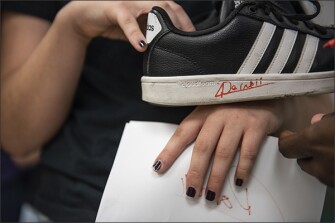
The students said there’s no real secret to Boursiquot’s draw. He explains things patiently. He encourages them to keep trying, without making them feel bad. He’s funny. He’s relatable.
He even has a signature dance move, “dabbing” each time he tells viewers to pause the video and solve a problem on their own.
“He just makes me happy,” said Kenna Wioncek, also in 8th grade.
Reaching Almost 250,000 Students
Diana Snider, the director of secondary math for the Palm Beach County district, takes pains to point out the videos are an “ancillary” part of math instruction in her schools. She generally doesn’t want teachers playing the videos in class and she certainly doesn’t see them as a replacement for live teachers or hands-on math activities.
Boursiquot agreed, describing his primary role as making regular classroom teachers’ lives easier.
He just happens to have a platform that allows him to reach almost 250,000 students, instead of 25.
And his gift just happens to be convincing teenagers that learning algebra is no different from learning anything else.
Getting better takes practice. Sometimes, you have to go out and find other resources that will help. Failure is part of the process.
“Think about the very first time you started doing something you love,” Boursiquot said. “You were not as good then as you are now, but you made a decision to keep doing it.”


