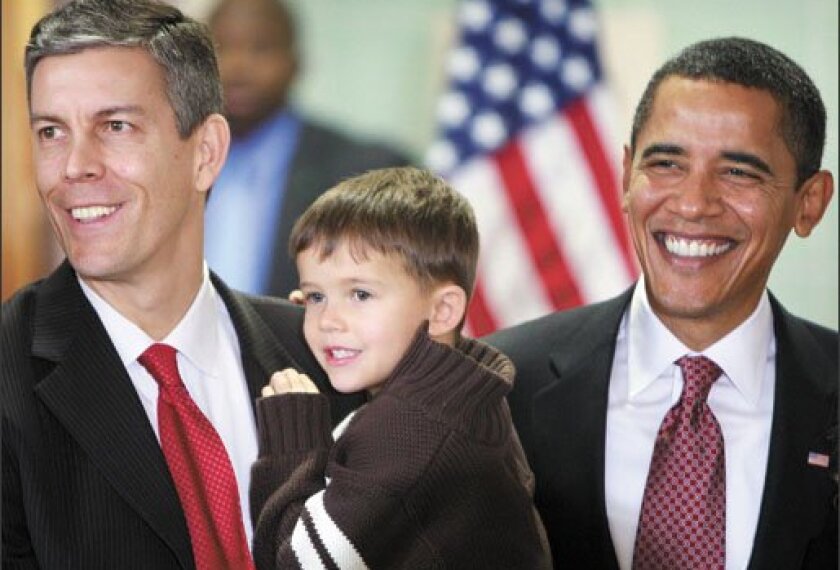
As the man tapped to be the next U.S. secretary of education, Arne Duncan faces a long list of difficult and complex tasks, some of which he has no background in handling.
The current chief executive officer of the Chicago public schools, if confirmed by the Senate, will be the point person for Barack Obama’s expansive K-12 agenda, which includes efforts to recruit large numbers of new teachers and ensure that they are highly qualified to work in the schools that need them the most.
Mr. Duncan will probably lead the new administration’s effort to improve the implementation of the No Child Left Behind Act in the short term, and to work with Congress to rewrite the law, which is overdue for reauthorization.
He will also need to decide how to use temporary executive powers designed to ensure that banks have enough cash to make tuition loans to college students for the 2009-10 school year—a task unrelated to his seven years of experience as the leader of the nation’s third-largest school system. (“In Chicago, Duncan Seen as Collaborator,” this issue.)
But President-elect Obama appears to have confidence that the 44-year-old Chicago native has the management skills and programmatic approach to handle those tasks and lead the 4,200-employee bureaucracy at the federal Department of Education.
“When faced with tough decisions, Arne doesn’t blink,” Mr. Obama said at a Dec. 16 news conference held at Chicago’s Dodge Renaissance Academy, which started during Mr. Duncan’s tenure as the leader of the 408,000-student district with 44,500 employees. “He’s not beholden to any one ideology—and he doesn’t hesitate for one minute to do what needs to be done.”
At the news conference, Mr. Duncan said he believes basic instructional strategies and innovative policies can combine to produce excellent schools.
“While there are no simple answers,” he said, “I know from experience that when you focus on basics, like reading and math, and when you embrace innovative new approaches, and when you create a professional climate to attract great teachers, you can create great schools.”
Variety of Strategies
The favorable response to the selection throughout political and educational circles suggests that Mr. Duncan could be confirmed as secretary shortly after Mr. Obama is inaugurated on Jan. 20.
“There’s a nice combination of start-from-scratch strategies when he needs to, and build-on-the-past when he can,” Kati Haycock, the executive director of the Education Trust, said of Mr. Duncan. Ms. Haycock, whose Washington-based group is an advocate for poor and minority students, has worked on teacher training and other issues in Chicago.
Mr. Duncan appears to be popular now, one skeptic said, because his record includes such a variety of approaches, including experimenting with teacher pay, opening new charter schools, and calling for dramatic funding increases for the 7-year-old NCLB law.
But once he takes office, his decisions may need to go against the interests of one group or another, said Jay P. Greene, the chairman of the department of education reform at the University of Arkansas at Fayetteville.
“The reason he’s so popular is because people are projecting on to him the policies they prefer,” Mr. Greene said. “There’s no way to predict which choices he’s likely to make and where his opposition will come from.”
Since Mr. Obama won the Nov. 4 election, Mr. Duncan had been seen as a natural choice to become the next secretary of education. The two men have worked together closely on education issues, are friends, and often play basketball together.
Bridging Divide?
Mr. Duncan also emerged as a candidate who could bridge the divide between two camps in the Democratic Party on education issues. With his support for charter schools and alternative forms of teacher pay, Mr. Duncan won praise from advocates for aggressive changes to school policies.
The National Education Association—which is among the Democratic-leaning groups wary of such approaches—also endorsed his selection. The 3.2 million-member teachers’ union noted that in 2006, Mr. Duncan called for doubling federal funding for the NCLB law. The nea has sued the federal government, saying that No Child Left Behind is an impermissible unfunded mandate. (“Federal Appeals Court Weighs Union’s Suit Over NCLB,” this issue.)
Linda Darling-Hammond, a Stanford University education professor and the leader of the education policy team for the Obama transition, praised Mr. Duncan as a “very thoughtful and collaborative reformer” who “is deeply steeped in urban education.” Mr. Duncan has been able to bring disparate groups together to support his policies, she added.
Ms. Darling-Hammond was considered a candidate to be education secretary and received significant support in the form of online petitions and high-profile letters to the editor from her colleagues in academia and other educators.
But her role in the transition also has been criticized by advocates for alternative teacher preparation programs. As the CEO of Chicago’s schools since 2001, Mr. Duncan has opened 75 charter schools, and has created new pathways into the profession for teachers. For example, he started the Dodge Renaissance Academy in a building that had been closed because of low student performance. In the new school, teacher-candidates work closely with mentors for one school year as they prepare for their own careers.
Mr. Obama, in his campaign platform, called for expanding such academies, as well as experimenting with new ways of rewarding teachers. He also supports doubling a federal program to start new charter schools.
Mr. Duncan’s support for the No Child Left Behind law also mirrors the president-elect’s.
Throughout the 2008 campaign, Mr. Obama said he agreed with the law’s goal of improving student performance and narrowing the gaps in student achievement between different racial and ethnic groups. But he said the law overemphasizes testing and should reward successful schools rather than identifying unsuccessful ones.
Mr. Duncan voiced a similar qualified endorsement of the law in July, at a congressional hearing featuring urban leaders. (“City Leaders Back Stronger Accountability,” July 30, 2008.)
“The No Child Left Behind Act, with a focus on accountability, was a huge step in the right direction,” he told the House Education and Labor Committee. He also endorsed the way the law holds schools and districts accountable for the performance of students in a variety of racial and demographic groups.
Two years earlier, Mr. Duncan told the House education committee—then under Republican leadership—that the NCLB law was underfunded, and that Congress should double its financial support.
In Chicago, Mr. Duncan won approval for his district to offer tutoring services for schools that haven’t met their achievement goals under the law for four or more consecutive years. Bush administration officials originally rejected the proposal because the district itself hadn’t made adequate yearly progress—the law’s measure for success of a school or district.
Ensuring Cash for Loans
As the education secretary, Mr. Duncan will face tasks that go beyond his experience at the school district level. In recent months, Education Department officials have intervened in credit markets so that banks have enough cash to make student loans for the spring 2009 semester, Secretary of Education Margaret Spellings said in a recent interview.
The next secretary will need to work closely to ensure that capital is available so banks can make loans for the 2009-10 academic year, she said.
“I expect him to get good people around him,” she said of Mr. Duncan. “He’s done that in Chicago, and I expect him to do that in Washington.”
It would be unusual for any candidate to be secretary of education to have expertise in both K-12 and higher education, said Michael D. Casserly, the executive director of the Council of the Great Schools.
“He has the management experience from running a very large organization that’s comparable to the U.S. Department of Education,” said Mr. Casserly, whose Washington-based group represents more than 60 urban districts, including Chicago. “There aren’t very many people who have broad, detailed experience in both sides of the house.”
Staff Writer Alyson Klein contributed to this report.


