Imagine a time, Christopher Whittle says, when a big-city school system like New York City’s would hire a handful of competing companies to run all of its schools.
Teachers would make two or even three times the typical salary of today. Principals would be trained in “principal colleges” that looked a lot like medical or law schools. Students, as they got older, would spend increasing amounts of time learning independently, outside the classroom.
And the federal government would vastly increase what it spends for research and development in education.
The net result of those and other changes: an American education system that could “eradicate failing schools by 2030.”
Pure fantasy? Perhaps, but in the mind of Mr. Whittle, the controversial founder and chief executive officer of Edison Schools Inc., that scenario could be the future of American education.
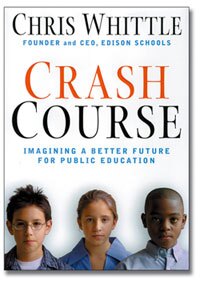
Mr. Whittle puts forth those and other ideas in his ambitious new book, Crash Course: Imagining a Better Future for Public Education, to be published in September by Riverhead Books.
“[The] idea is take the great old house of public education, the very portal of the American dream, and move it dramatically forward—utilizing, as a major new ingredient, the world-class vibrancy and inventiveness of America’s private sector,” he writes.
Crash Course offers a dramatic rethinking of the K-12 education system. The book is also a smooth sales pitch for the private sector from one of the foremost salesmen in the education business.
‘Fresh Horses’
Edison Schools has long faced stiff criticism, much of it driven by misgivings about letting for-profit ventures run public schools.
Founded in 1992, the New York City-based company managed 157 public schools serving more than 70,000 students in 20 states and the District of Columbia as of the 2004-05 school year. A multi-year study of its schools by the RAND Corp., commissioned by Edison but expected to be one of the most independent evaluations of its approach, is due out this fall.
Edison has had a rocky road, especially with its troubled foray as a publicly traded company from 1999-03, when its stock value eventually plummeted, at one point, to less than $1 per share.
Some school systems have canceled their contracts with Edison, citing disappointing academic results. But in the Philadelphia school system, where many Edison-run public schools showed fairly robust academic growth last year, the company has been asked to manage two more schools.
In a recent interview, Mr. Whittle, 58, said of his decision to write Crash Course: “It seemed like a good moment in time to, as I say in the book, pause for ‘fresh horses’ and reflect not so much on where we’ve been but on where we ought to go.”
Thomas Toch, the co-director of the Washington think tank Education Sector, who has been working on a book about Edison, notes that Mr. Whittle has had “some ideas that just flubbed.”
“Not all of Edison’s schools have performed [well],” he said. “But he is exactly the kind of person that public education desperately needs now—people challenging the status quo, challenging assumptions, … and doing it with an immense amount of energy.”
In the book, Mr. Whittle puts forward an array of ideas that he says would transform schooling.
He suggests that schools put a far greater emphasis on students’ independent learning. Even at the elementary level, he says, pupils might spend an hour or two outside class, learning on their own, though perhaps watched over by an older peer. The proportion would gradually increase until high school, when students would spend just one-third of their time in traditional classrooms.
Beyond what he views as the educational benefits of such independent study, Mr. Whittle has another motive: It would reduce school staffing, thereby freeing up money to double or even triple teacher salaries.
“If we want a certain level of talent in our classrooms, we must pay for it,” he writes.
As for principals, he suggests annual salaries that could reach $200,000, including big bonuses based largely on improvements in student achievement.
In the book, Mr. Whittle fast-forwards to 2030 and imagines what the New York City school system might look like.
Humility Required?
The district, like other large urban districts, has hired several companies to run all of its schools. Each company has complete management responsibility for its schools, including curriculum, instruction, and finances. The district maintains some overarching responsibilities, from hiring and monitoring the companies to student assessment. Teachers would remain under a collective-bargaining agreement with the district, though schools would choose their staff members.
“He’s a creative guy,” said Henry Levin, who heads up the National Center for the Study of Privatization at Teachers College, Columbia University. But based on some of Mr. Whittle’s ambitious predictions in the past for Edison, Mr. Levin said, “I think some humility is required on his part. … He’s lost a lot of people’s money.”
Mr. Whittle, formerly the publisher of Esquire magazine, said that he has never claimed the private sector “will always get it right, and the public sector will always get it wrong.” But, he added, “the private sector … has certain built-in advantages that the public sector ought to take advantage of.”


