Drawing on ideas recently laid out by a state “P-20 education” council, Colorado Gov. Bill Ritter Jr. is proposing to expand early-childhood education, provide more counselors in secondary schools, and create a data-collection system that tracks individual students from the time they start preschool until they enter the workforce.
The governor, a Democrat, pointed to Florida as the only other state that has such a system to comprehensively track academic and related information on individual youths over an extended period of time.
But with a tight budget situation, the governor, even with Democrats in control of the legislature, may have trouble getting all his plans enacted. Further complicating matters is a likely legal challenge to the mechanism the governor is using to free up state dollars to help pay for it all.
Colorado Gov. Bill Ritter Jr. is pushing a number of changes to the state’s school system, based on recommendations from the state’s P-20 Education Coordinating Council:
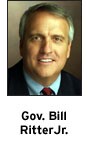
• Establishing a data and accountability system that can provide detailed data on students from preschool through college.
• Expanding access to full-day kindergarten to eventually serve an additional 22,000 children, spending $25 million in the first year.
• Eliminating the waiting list for the state’s preschool program, making 3,000 more children eligible.
• Forming a corps of 70 new middle and high school counselors to work on dropout prevention and college preparation in a state where the ratio of students to counselors is 544-to-1, which officials say is among the nation’s worst.
SOURCE: Office of the Governor, Colorado
The proposals by Gov. Ritter—now finishing his first year in office—will be taken up when the legislature convenes Jan. 9.
“Nobody can say we are doing the best job possible when it comes to preparing our kids for a 21st-century workforce,” the governor said Dec. 5 at the Colorado Statewide Dropout Summit, held at Mountain Range High School in Westminster. In his first State of the State address in January, he said he wanted to cut the state’s dropout rate in half over the next decade.
Sen. Nancy Spence, a Republican who serves on her chamber’s education committee, said she sympathizes with the goal of devoting more resources to early-childhood education, but has fiscal concerns.
“We can say ‘yes’ forever, but when you have to find money in the budget to fund these programs, both [political] parties are going to be at a loss,” she said. “That’s where it gets really controversial.”
‘The Open Question’
Gov. Ritter is proposing to phase in plans for an extra 22,000 children to eventually attend full-day kindergarten. The governor would spend $25 million on that effort in the first year. He also wants to spend $10.5 million to end the waiting list of roughly 3,000 youngsters for the state-funded preschool program, which is aimed at children considered at risk of doing poorly in school.
And he would set aside $5 million next year to send 70 new counselors into middle and high schools. He did not provide any cost estimate for the data-collection system.
On the question of how to pay for the programs, the governor has pointed to recent action by the legislature, at his request, to impose a freeze on local property-tax rates—effectively keeping them from going down. Without the change, school mill levies, in many instances, would otherwise decline under a 1994 school finance law, and Colorado would be obligated to fill the gap from the state education fund. The freeze is expected to free up $114 million next fiscal year for the state fund.
Current state spending for K-12 is $3.7 billion out of an overall budget of about $18 billion. The governor’s plans were welcomed by some major education groups in Colorado, which had an K-12 enrollment of 794,000 as of October 2006, the most recent figure available last week from state officials.
“We are especially pleased to see the emphasis on full-day kindergarten and preschool,” said Beverly Ingle, the president the Colorado Education Association, an affiliate of the National Education Association. “Teachers know how critical it is that children have a strong foundation.”
But Randy DeHoff, a Republican on the state education board, said he’s not sure the governor’s fiscal strategy is realistic.
“The open question is how to pay for it, and he keeps saying, ‘We’re going to use the state education fund that we fixed last year,’ ” Mr. DeHoff said.
The Independence Institute, a free-market think tank in Golden, Colo., was expected last week to file a lawsuit challenging the state freeze on property-tax rates. Mr. DeHoff said a lawsuit, if successful, would undermine the governor’s plan to fund his proposals.
In addition, Sen. Spence said expanding full-day kindergarten would put new burdens on some localities that would need to raise capital funding to house the classes.
Dwight Jones, the state’s new education commissioner, agreed that meeting that need might be a challenge, but added: “The majority of superintendents and board members, they say that’s a nice problem to have.”
Collecting Data
Mr. Ritter’s plans are based on the work of the P-20 Education Coordinating Council, which the governor convened last April to come up with ideas for forging what he called a “seamless education system” from preschool through postsecondary education.
The panel’s data and accountability subcommittee has called for the state to enact legislation creating a “P-20 data system” to help in conducting research, informing public policy, and evaluating the effectiveness of programs, among other goals.
Mr. Jones said the collection of student data is not well coordinated in Colorado.
“Right now, there is no one place that this data is collected,” he said. “It is in a lot of different places, and many times in systems that don’t even talk to each other.”
Jane Urschel, the associate executive director of the Colorado School Boards Association, applauded the governor’s plans, although she conceded that fiscal constraints limit what he can do.
For instance, she said, adding 70 counselors wouldn’t go very far statewide.
“That’s not much,” she said, “but it’s a start, and it’s an acknowledgment that that’s a service [that should] accompany a high school education. … Colorado works under a constitutional tax code that really ties its hands.”


