With voters in Alabama offering a resounding “no” to Gov. Bob Riley’s $1.2 billion tax referendum last week, state leaders are warning of looming spending cuts for education and other government services.
|
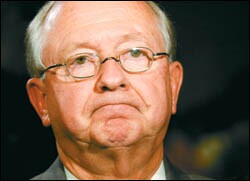
Alabama Superintendent of Education Ed Richardson talks with reporters in Montgomery after voters overwhelmingly defeated a $1.2 billion tax referendum last week. |
Sixty-eight percent of the nearly 1.3 million Alabamians who went to the polls Sept. 9 rejected the referendum, The Birmingham News reported.
The legislature was expected to convene this week in a special session to write a budget for fiscal 2004, which begins Oct. 1. And while some tough budget reductions will be required—an estimated $100 million for K-12 education alone— the Republican governor and other leaders have predicted that the biggest shock will come next year, when far more Draconian cuts will be needed.
As the results became clear last week, Gov. Riley said: “Ladies and gentleman, I have heard what the people of Alabama have said, and they said very clearly tonight, ‘We do want you to be good stewards, but we want a smaller government until you prove to us that you are stewards of our money.’”
Mr. Riley had promoted education as the centerpiece of his plan to transform Alabama with the tax package. (“Ala. Measure Would Raise Taxes and Hopes,” Sept. 3, 2003.)
One of the biggest obstacles the first- term governor faced was a citizenry profoundly distrustful of government. Opponents capitalized on the sentiment, running ads that warned that state legislators couldn’t be trusted to spend the extra money on the programs promised by the governor.
The plan had proposed to institute merit-based college scholarships, extend the school year by five days, and expand the state’s reading initiative, among other measures. It also had sought to impose new accountability demands on schools and state government, including provisions to ensure better financial management by school districts, end tenure for some new school administrators, and streamline the teacher dismissal process.
‘Too Big, Too Fast’?
To pay for his plans, Mr. Riley had called for rewriting the state tax code, and eventually bringing in an extra $1.2 billion annually in state and local taxes. He argued, however, that many lower-income Alabamians would actually owe less in taxes overall. Alabama currently has the lowest combined state and local taxes in the nation.
Larry J. Sabato, the director of the Center for Politics at the University of Virginia, argued that the vote in Alabama—about 2-to-1 against higher taxes—was echoing across the country. “Unfortunately, there is a lesson there,” he said. “I’ve already heard elected officials in several places say, ‘So much for tax increases.’”
Moreover, he added, “they saw a conservative Republican stick his neck out in ‘Nixon goes to China’ fashion and get his head handed to him on a plate.”
But David Azbell, a spokesman for Gov. Riley, said other states should not over-interpret the vote. “I don’t think other states have the level of cynicism [of government] that Alabama has,” Mr. Azbell said. “Alabama is probably the most conservative state in the union, and you couple that staunch conservatism with just almost a resentment of state government. ... That made this very difficult to pass.”
Cynicism may not have been the only factor. Marty Connors, the chairman of the Alabama Republican Party—whose executive committee opposed the referendum—cited another reason.
“It failed because it was too big, too fast,” he said.
"[T]he message from the voters is: Alabama families live within their means, Montgomery must live within its means,” said John Giles, the head of the Christian Coalition of Alabama, which campaigned against the tax plan.
Mr. Riley has projected that the state will have a nearly $700 million shortfall for fiscal 2004. The state budget for the current fiscal year is $17.1 billion.
Cuts Ahead
Ed Richardson, the state schools superintendent, predicted that the state will see cuts to precollegiate education this school year and well into the future. The current state K-12 budget is $3.02 billion.
“About $100 million will have to be cut out of the budget this year,” Mr. Richardson said of the fiscal year that begins next month. “We’re looking at textbooks and teacher supplies.” He added: “We’re looking at about a $300 million cut in K-12 next year.”
Mr. Richardson said that cut would result in layoffs of more than 4,000 teachers and 2,000 support workers. He also said the state would have to trim back its reading initiative, which now reaches 450 schools, to about 120 schools.
Some of the governor’s proposed accountability measures had been welcome news to Mr. Giles of the state chapter of the Christian Coalition, but he wasn’t persuaded that schools needed more money.
“We have blown our [administrative costs] way out of proportion, and are diverting resources away from the children, away from the classroom, and into some jobs program,” he contended.
Gov. Riley, however, and the many education and business leaders who backed his plan, had argued that the tax package’s combination of more accountability and more money, carefully targeted, would have made a big difference to public schools.
To see cuts will be hard for schools, said Mr. Richardson. “I have asked our schools to meet very high academic standards, to improve student achievement,” he said. “You would hope that effort would be rewarded, and instead they’re just being penalized.”


