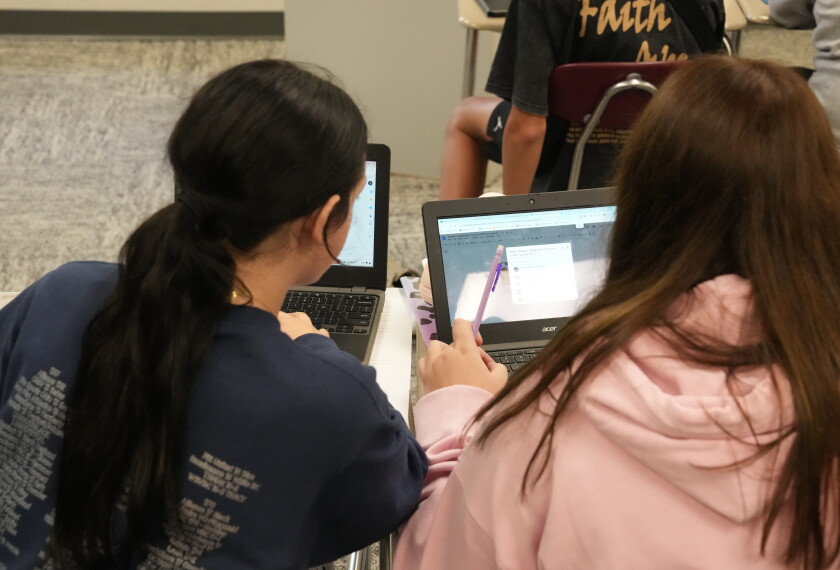
When 200 students sign up for a course, educators normally think of ways to split up the classroom into more manageable sizes. But for the University of Miami Global Academy, an online high school run by the University of Miami, building a class with hundreds of students was all part of the plan when it launched its first “massively open online course,” or MOOC, in November. The six-week, noncredit course—a virtual seminar designed to help high school students prepare for the SAT II subject test in biology—used virtual-conferencing software to allow students to interact with the teacher in real time.
Students from as far away as China signed up for the biweekly sessions, and feedback about the course has been positive, said Craig Wilson, the head of school for the Miami Global Academy, a private, online-only middle and high school that serves 143 students from the United States and 20 other countries.
“We’re still exploring [the MOOC course model],” Mr. Wilson said. “I think that most institutions are still trying to find the best way to apply the massively-open-online-course platform to the audience they serve.”
While not every “massively open online course” is the same, typical formats contain the following elements:

SOURCE: Education Week
MOOCs have been hailed by their evangelists as a revolution in virtual education that will open doors to teachers and curricula not otherwise available to a mass audience. They have garnered so much attention in higher education that the online news site Inside Higher Ed named the approach the top educational technology trend of 2012.
And now, the trend is showing up in K-12 environments such as the Miami Global Academy, although at a much slower rate than the idea has taken off in colleges and universities.
How Much Potential?
Experts advise precollegiate educators to take a cautious approach regarding MOOCs, saying the courses aren’t ready for widespread adoption at the K-12 level.
In contrast with typical online learning in K-12, MOOCs offer free courses and usually don’t give credit for class completion. And enrollment can rise to thousands of students from anywhere in the world.
In the short term, Mr. Wilson said, MOOCs will likely be useful tools for helping students prepare for high-stakes exams. His school is looking into creating another course to prepare students for the Advanced Placement Calculus exam.
Jennifer Taylor, the lead science teacher for Miami Global Academy, served as the instructor for the MOOC. The academy, which charges tuition, did not make any money from the course, since Mr. Wilson said the course was designed to test the viability of the MOOC model and to provide a free resource for students taking the test.
MOOCs aren’t for everyone, Mr. Wilson said.
“Online learning in general tends to be a really good fit for students that are self-motivated. MOOCs allow students to sample the medium,” he said.
Advocates for the movement say MOOCs have the potential to make classes available anywhere in the world. The free, open access that defines the MOOC model allows anyone with an Internet connection to enroll.
Even the large size of a typical MOOC course, which can range from a few dozen students to a few thousand, can be a benefit, experts point out. Virtual discussion boards can connect students from around the world, allowing students who might have never met in a traditional classroom to interact and to share ideas. They also give average students access to high-achieving peers, who could serve as tutors.
But skeptics say a lack of standards for the quality of the courses and the absence of policies about how they should be used reduce the potential for the approach to make substantive changes to K-12 virtual education.
And those especially critical of the model, both in higher education and K-12, point to low course-retention rates—estimated at less than 10 percent—as reason for concern.
“If you’re the head of a high school, and 10 percent of your students pass, you’re going to get fired. There’s no way any administrator would take that risk,” said Fred Singer, the chief executive officer of Echo360, a for-profit course provider for universities. Mr. Singer predicts MOOCs won’t find themselves in every K-12 school in the next five years.
Nevertheless, 2012 was a big year for this online class format. Currently, 2.6 percent of higher education institutions have at least one MOOC and 9.4 percent report they are planning such a course, according to a recent survey from the Babson Survey Research Group at Babson College in Wellesley, Mass.
Coursera, a for-profit online-course provider based in Mountain View, Calif., which only uses the MOOC format for courses, has had elite global institutions, such as Princeton University and the Hebrew University of Jerusalem, rushing to partner with the MOOC provider, though only one of the 33 schools offers course credit for completion of the online lessons.Despite only having been founded in 2012, Coursera has already reached more than 2.5 million students worldwide.
Opinion is divided about how, when, and at what level MOOCs will have an impact on K-12 education.
Some virtual education experts, such as Susan Patrick, the president and chief executive officer of the International Association for K-12 Online Learning, or iNACOL, based in Vienna, Va., believe the model can potentially be applied to the precollegiate curriculum, but that other options might be preferable for K-12 learning in the near future because the impact of MOOCs on learning at the elementary and secondary levels is still to be fully researched.
Even so, Ms. Patrick said, MOOCs signal a shift toward more personalized learning for students, where the emphasis is placed on building competency and mastering skills.
In addition, MOOCs can be used as research tools if they have learning-analytic technology built in that would allow educators to conduct rapid research on a large number of students in different settings.
“There is a lot to learn about student support that we could gather through MOOCs,” Ms. Patrick said.
High School Students’ Needs
Mr. Singer said the MOOC model, while impressive, is not yet a game-changer for K-12 education, since most of the content models currently available are not flexible enough to accommodate different types of learners, which he views as necessary in K-12 education.
Instead, Mr. Singer said, educators should be looking into blended and adaptive learning technologies, which can help teachers customize lesson plans to fit individual students’ needs.
And while MOOCs offer great opportunities for learners, the immediate focus of technology in education should be on the quality of education, he said, not how many students can be taught at once. The often-cited low completion rates for the courses means MOOCs are too risky for K-12 educators to take seriously, he said.
Still, low completion rates for MOOCs are not atypical for any type of course that doesn’t give credit, said Alec Couros, a professor of educational technology and media at the University of Regina in Saskatchewan, Canada. Since some MOOC models exist solely for connecting with fellow learners, and others exist as an extension of traditional courses where credit may be offered, students do not always approach the course with completion in mind, he said.
But for MOOCs to become widespread at the high school level, Mr. Couros said, educators must customize the model toward an optimal learning experience for students, which would require much more interactivity than many MOOC models now provide.
“You can’t just take an existing online course and expect it to work for K-12 students,” said Mr. Couros. “You need to start from scratch and develop courses consistent with the ways that high school students learn.”