
Republican presidential nominee Mitt Romney made his strongest commitment yet to education by promising in this week’s debate with President Barack Obama not to cut federal school funding if elected. But whether he could uphold that pledge while also reining in a mounting federal deficit is an open question.
“I’m not going to cut education funding. I don’t have any plan to cut education funding and—and grants that go to people going to college. ... I’m not planning on making changes there,” Mr. Romney said during the Oct. 3 debate at the University of Denver.
The statement marked the first time in the campaign that Mr. Romney specifically addressed education spending—something he’s been continually attacked on by Mr. Obama’s campaign. “I don’t want to cut our commitment to education,” the GOP nominee said. “I want to make it more effective and efficient.”
Mr. Romney has been hammered by the Obama campaign since the former Massachusetts governor picked as his running mate U.S. Rep. Paul Ryan of Wisconsin, the chairman of the House Budget Committee, who put forth a controversial budget that would cut domestic discretionary funding, which includes education, by 20 percent.
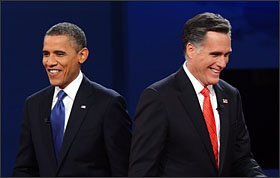
“Governor Romney doesn’t think we need more teachers. I do,” the president said during this week’s debate, the first of three scheduled between the two candidates.
Though Mr. Romney has called the Ryan budget “marvelous,” his education advisers have said that he wouldn’t necessarily adopt the plan wholesale.
Prominent Theme
Education was a prominent theme throughout the 90-minute Denver debate, as both candidates sought to link the quality of American schools to the country’s economic future.
Mr. Romney’s pledge to not cut education funding, though seemingly straightforward, raises many questions.
He didn’t offer specifics on what “education funding” he would protect—whether it would be all, or just some, of the programs in the U.S. Department of Education’s $68.1 billion discretionary budget. He also didn’t explain whether that promise would extend to other programs outside the department, such as Head Start, which is run by the Department of Health and Human Services. The Romney campaign would not provide more specifics this week.
Education has been a second-tier issue throughout the campaign, but it was mentioned frequently in this week’s debate in Denver between President Obama and Mr. Romney. Among the exchanges:
Obama
“We’ve got to improve our education system. And we’ve made enormous progress drawing on ideas both from Democrats and Republicans that are already starting to show gains in some of the toughest-to-deal-with schools.”
“I want to hire another 100,000 new math and science teachers and create 2 million more slots in our community colleges so that people can get trained for the jobs that are out there right now. And I want to make sure that we keep tuition low for our young people.”
“We’ve seen layoffs of hundreds of thousands of teachers over the last several years, and Gov. Romney doesn’t think we need more teachers. I do, because I think that that is the kind of investment where the federal government can help.”
“We use something called Race to the Top. Wasn’t a top-down approach, Governor. What we’ve said is, to states, we’ll give you more money if you initiate reforms. And as a consequence, you had 46 states around the country who have made a real difference.”
“A teacher that I met in Las Vegas, wonderful young lady, who describes to me—she’s got 42 kids in her class. The first two weeks, she’s got them—some of them sitting on the floor until finally they get reassigned. They’re using textbooks that are 10 years old. That is not a recipe for growth; that’s not how America was built.”
Romney
“I’m not going to cut education funding. I don’t have any plan to cut education funding and grants that go to people going to college. I’m planning on continuing to grow, so I’m not planning on making changes there.”
“Massachusetts, our schools are ranked number one of all 50 states. And the key to great schools: great teachers. So I reject the idea that I don’t believe in great teachers or more teachers. Every school district, every state should make that decision on their own.”
“Education is key, particularly [to] the future of our economy. But our training programs right now, we got 47 of them housed in the federal government, reporting to eight different agencies. Overhead is overwhelming.”
“[President Obama] put $90 billion into ... green jobs. ... I’m all in favor of green energy. Ninety billion [dollars] ... that would have hired 2 million teachers.”
“How do we get schools to be more competitive? Let’s grade them. I propose we grade our schools so parents know which schools are succeeding and failing, so they can take their child to ... a school that’s being more successful.”
SOURCE: National Public Radio transcript
And although Mr. Romney said he would not cut college grants, he was not precise about what he was pledging to protect. Earlier this month, however, he said he would hold steady Pell Grant awards for low-income students and allow them to grow with the rate of inflation.
During the debate, Mr. Romney argued strongly that he’s the right candidate to cut government spending. If, as president, he were to hold education harmless while seeking to slash the deficit, he might have to make even bigger cuts elsewhere, and in the face of some in his party who want to eliminate the federal Education Department altogether.
‘A Bright Line’
Some Republicans and other observers seem to agree that Mr. Romney won’t be able to easily backtrack from his debate promise.
John Bailey, a co-founder of Whiteboard Advisors, a consulting firm in Washington, who has advised the Romney campaign on education, put it this way: “I do think he sort of drew a bright line. It’s one the education community is going to hold up as an expectation.”
Michael J. Petrilli, the executive vice president of the Thomas B. Fordham Institute in Washington and a former Education Department official under President George W. Bush, said: “It’s going to be very hard for a President Romney to cut education spending after promising the country on national television that he won’t. ... The education community should be very happy today.”
But prominent Obama backers in the education community don’t believe Mr. Romney’s promise.
“Governor Romney says he supports the Ryan budget, which will necessitate cutting nondefense discretionary funds, including education, by as much as $115 billion,” National Education Association President Dennis Van Roekel said in a statement and in an appearance on the nationally syndicated Bill Press radio show this week. “Then he flip-flops and says he doesn’t support cuts to education. You just can’t have it both ways.”
The Obama campaign criticized Mr. Romney in a similar vein.
In a press call this week after the debate, chief Obama strategist David Axelrod said that on the campaign trail, Mr. Romney has criticized President Obama repeatedly for supporting teachers and their unions.
“Last night, he couldn’t be more enthusiastic about teachers,” Mr. Axelrod said.
Clashing Positions
Mr. Obama’s rhetoric about the effect a Romney presidency would have on education has been strong. During this week’s debate, the president said that the Romney-Ryan ticket would lead to a “gutting” of education. He talked about a teacher in Las Vegas he met who had 42 students using textbooks 10 years old. “That’s not a recipe for growth,” he said.
“This is where budgets matter because budgets reflect choices,” Mr. Obama said. “Governor Romney wants to cut taxes and potentially benefit folks like me and him, and to pay for it, we’re having to initiate significant cuts in federal support for education. That makes a difference.”
While pledging to protect education funding, Mr. Romney seemed to promote a less involved role for the federal Education Department. He also touted his plan to turn federal Title I and special education funding into vouchers. “I want the kids getting federal dollars. ... I want them to go to the school of their choice,” he said. “All federal funds would follow the child.”
He has not explained how such a system would work, especially given that the federal government pays for less than 10 percent of K-12 education, with the rest coming from state and local taxpayers.
The Heritage Foundation’s Lindsey Burke said Mr. Romney’s bigger message is how existing federal dollars are used, rather than the level of education funding.
“To me, it sounded like he’s saying we need a better bang for our buck,” said Ms. Burke, the Will Skillman fellow in education policy at the Washington think tank.
But from a policy perspective, Ms. Burke said, cuts to the Education Department should be in the mix.
“We have been saying over and over the Department of Education desperately needs some fiscal-austerity measures put into place,” she said. “I think overall when we are thinking about what good conservative education policy looks like, we certainly need to look at trimming the size and scope of the federal Education Department.”


