Law & Courts

High Court Declines to Hear Case on Pupil’s Use Of Religious Images

By Andrew Trotter — May 02, 2006 | Corrected: May 09, 2006 2 min read
  • Save to favorites
  • Print

Corrected: A previous version of this story misspelled the name of the judge who wrote the previous decision in the case. He is Guido Calabresi of the U.S. Court of Appeals for the 2nd Circuit.

The U.S. Supreme Court last week declined to review a case in which educators at a New York school restricted religious viewpoints that a student expressed in a class assignment having nothing to do with religion.

The court’s refusal to consider a ruling of the U.S. Court of Appeals for the 2nd Circuit means that public schools in Connecticut, New York, and Vermont, the states covered by the New York City-based appeals court, may not censor a student’s viewpoint on curriculum subjects when it is a response to a school assignment or program, said Mathew D. Staver, the lawyer who represented the student in the case.
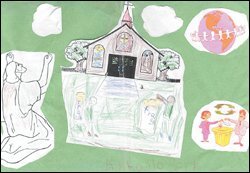
Antonio Peck's poster on the environment includes Jesus and a church, along with children depositing trash. His parents' lawsuit alleged that the school censored the religious images.

At issue is a poster that Antonio Peck, who in the spring of 2000 was a kindergartner at McNamara Elementary School in the 5,900-student Baldwinsville, N.Y., school district, made at home with the help of his mother, JoAnne Peck, for an assignment on recycling. His teacher had directed her students to create posters based on a two-month environmental unit; the posters were to be displayed at a school environmental program to which parents would be invited.

The first version of Antonio’s poster featured cutout pictures of Jesus, the Ten Commandments, and other religious images under the heading “The only way to save our world!”

A substitute poster, which Antonio and his mother made after the teacher asked him to revise it to address material learned in class, showed a recycling symbol and children cleaning up trash, but also depicted Jesus and a church.

For the environmental program, school personnel hung Antonio’s poster with those by other pupils but folded it back so the part showing Jesus could not be seen. The boy’s parents sued, claiming a violation of Antonio’s First Amendment rights to free exercise of religion and free speech, and other violations.

A Religious Perspective

A federal district judge in Syracuse dismissed the suit. But in October 2005, a three-judge panel of the 2nd Circuit court unanimously found merit in the family’s free-speech claim.

“The district court overlooked evidence that, if construed in the light most favorable to the Pecks, suggested that Antonio’s poster was censored not because it was unresponsive to the assignment, and not because [the teacher and school principal] believe that JoAnne Peck rather than Antonio was responsible for the poster’s content, but because it offered a religious perspective on the topic of how to save the environment,” U.S. Circuit Judge Guido Calabresi wrote.

Distinguishing a student’s expression of a “religious viewpoint,” which may be constitutionally protected speech, from a student’s unprotected “religious proselytizing,” can be hard, the judge said.

But whether Antonio’s poster showed a “religious viewpoint,” and whether the school would have similarly censored a poster that depicted a purely secular image that was equally outside the scope of the lessons, were disputed factual questions that should be resolved in a trial, Judge Calabresi wrote.

In its petition to the Supreme Court, the Baldwinsville district argued that the appeals court’s decision “perilously tied the hands of public school educators within its jurisdiction.”

The Supreme Court on April 24 declined without comment to hear the district’s appeal in Baldwinsville School District v. Peck (Case No. 05-899). The case will now return to the district court for further proceedings.

A version of this article appeared in the May 03, 2006 edition of Education Week as High Court Declines to Hear Case On Pupil’s Use of Religious Images

Events

Webinar Supporting Older Struggling Readers: Tips From Research and Practice
Reading problems are widespread among adolescent learners. Find out how to help students with gaps in foundational reading skills.
This content is provided by our sponsor. It is not written by and does not necessarily reflect the views of Education Week's editorial staff.
Sponsor
Reading & Literacy Webinar
Improve Reading Comprehension: Three Tools for Working Memory Challenges
Discover three working memory workarounds to help your students improve reading comprehension and empower them on their reading journey.
Content provided by Solution Tree
Recruitment & Retention Webinar EdRecruiter 2026 Survey Results: How School Districts are Finding and Keeping Talent
Discover the latest K-12 hiring trends from EdWeek’s nationwide survey of job seekers and district HR professionals.

EdWeek Top School Jobs

Teacher Jobs
Search over ten thousand teaching jobs nationwide — elementary, middle, high school and more.
View Jobs
Principal Jobs
Find hundreds of jobs for principals, assistant principals, and other school leadership roles.
View Jobs
Administrator Jobs
Over a thousand district-level jobs: superintendents, directors, more.
View Jobs
Support Staff Jobs
Search thousands of jobs, from paraprofessionals to counselors and more.
View Jobs

Read Next

Law & Courts How One Lawyer Helped Reshape Special Education at the Supreme Court
A documentary follows a lawyer behind major Supreme Court wins for students with disabilities.
9 min read
Roman Martinez, an attorney with Latham & Watkins, is featured in the Bloomberg Law documentary 'Supreme Advocacy.'
Roman Martinez, a Washington lawyer who has played a role in four U.S. Supreme Court cases about the rights of special education students, is featured in the Bloomberg Law documentary "Supreme Advocacy."
via YouTube
Law & Courts Supreme Court Weighs IQ Tests and Other School Records in Key Death Penalty Case
The court weighs the proper role of IQ tests for defendants claiming an intellectual disability.
8 min read
IQ test, paper sheet with test answer on the table
iStock/Getty
Law & Courts Supreme Court Orders New Review of Religious Exemptions to School Vaccines
The U.S. Supreme Court ordered a new look in a school vaccination case and declined to review library book removals.
6 min read
A U.S. Supreme Court police officer walks in front of the Supreme Court amid renovations as the justices hear oral arguments on President Donald Trump's push to expand control over independent federal agencies in Washington, D.C., on Dec. 8, 2025.
A U.S. Supreme Court police officer walks in front of the court amid renovations in Washington, on Dec. 8, 2025. The court took several actions in education cases, including ordering a lower court to take a fresh look at a lawsuit challenging a New York state law that ended religious exemptions to school vaccinations.
J. Scott Applewhite/AP
Law & Courts Supreme Court to Weigh Birthright Citizenship. Why It Matters to Schools
The justices will review President Trump's bid to end birthright citizenship, a move that could affect schools.
4 min read
President Donald Trump signs an executive order on birthright citizenship in the Oval Office of the White House, Monday, Jan. 20, 2025, in Washington.
President Donald Trump signs an executive order to on birthright citizenship in the Oval Office on Jan. 20, 2025. The U.S. Supreme Court will consider the legality of Trump's effort to limit birthright citizenship, another immigration policy that could affect schools.
Evan Vucci/AP
