
In a tenure on the U.S. Supreme Court that spanned more than three decades, Chief Justice William H. Rehnquist exerted his influence in a host of education cases, helping frame the court’s opinions on such issues as school desegregation, government aid to private schools, and the place of religion in public education.
The chief justice, 80, died of thyroid cancer at his home in Arlington, Va., on Sept. 3. He was appointed by President Richard M. Nixon as an associate justice in 1971, succeeding John Marshall Harlan, and was elevated by President Ronald Reagan to succeed Warren E. Burger as chief justice in 1986.
Chief Justice Rehnquist’s death leaves two vacancies on the nation’s highest court, which had been intact for 12 years until Justice Sandra Day O’Connor announced her retirement July 1. The chief justice was a stalwart of a conservative bloc that, with Justice O’Connor’s swing vote, prevailed on many 5-4 rulings.
On Sept. 5, President Bush withdrew the nomination of Judge John G. Roberts Jr. to replace Justice O’Connor and nominated him as chief justice. The Senate Judiciary Committee was expected to begin confirmation hearings for Judge Roberts on Sept. 12.
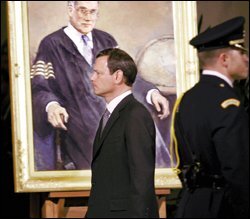
Justice Rehnquist, whose previous job had been as an assistant U.S. attorney general, faced questions at his 1971 confirmation hearings about his views on school desegregation. He was asked about a memo he had written about the Brown v. Board of Education of Topeka desegregation cases when he was a law clerk to Justice Robert H. Jackson in the 1952-53 court term. The memo laid out an argument for judicial deference to the will of the majority on school segregation.
As a nominee to the high court, Mr. Rehnquist maintained that the memo merely reflected Justice Jackson’s own views. Few historians accepted that explanation, but the memo did not derail the nomination.
When Justice Rehnquist joined the court nearly 34 years ago, desegregation cases were often on the docket. In 1973, the then-associate justice wrote a dissent in Keyes v. School District No. 1, Denver that lamented the extension of federal court oversight for desegregation to school systems that did not have de jure segregation.
“The court has taken a long leap in this area of constitutional law in equating the districtwide consequences of gerrymandering individual attendance zones in a district where separation of the races was never required by law with statutes or ordinances in other jurisdictions which did so require,” he wrote.
In 1979, when the court upheld a systemwide desegregation plan in the Columbus, Ohio, school district, Justice Rehnquist expressed concern about the removal of authority from local school officials.
“The school desegregation remedy imposed on the Columbus school system by this court’s affirmance of the court of appeals is as complete and dramatic a displacement of local authority by the federal judiciary as is possible in our federal system,” he said in his dissent in Columbus Board of Education v. Penick.
Local Control
By the late 1980s, the tide had begun to shift in the federal courts toward ending long-running desegregation orders.
In 1991, Chief Justice Rehnquist wrote the majority opinion in Board of Education of Oklahoma City v. Dowell, which eased the standard under which a school district could be found to have complied with such an order.
As was often the case with his opinions, the Dowell opinion was relatively short and to the point, devoid of rhetorical flourishes.
In 1995, the chief justice wrote the Supreme Court’s last majority opinion to date on school desegregation. In his opinion in Missouri v. Jenkins, which scaled back a costly and extensive desegregation remedy for the Kansas City, Mo., school system, he stressed that “local autonomy of school districts is a vital national tradition, and that a district court must strive to restore state and local authorities to the control of a school system operating in compliance with the Constitution.”
In 2003, the chief justice wrote important opinions in the cases from the University of Michigan that dealt with affirmative action in student admissions. In Grutter v. Bollinger, the court voted 5-4 to uphold the consideration of race in principle and to approve the system used by Michigan’s law school to achieve a “critical mass” of underrepresented minorities. Chief Justice Rehnquist wrote in the main dissent: “Stripped of its ‘critical mass’ veil, the law school’s program is revealed as a naked effort to achieve racial balancing.”
He wrote the majority opinion in the companion case, Gratz v. Bollinger, which struck down Michigan’s undergraduate-admissions system because it automatically awarded bonus points to certain minority applicants.
In writing about the intersection of religion and education, Justice Rehnquist dissented in 1973 when the court struck down a New York state program of tuition reimbursement for parents whose children attended religious schools, in Committee for Public Education and Religious Liberty v. Nyquist. Over the next decades, he would play a key role in several cases that essentially amounted to a reversal of that ruling.
‘True Private Choice’
In 1983, Justice Rehnquist wrote the majority opinion in Mueller v. Allen, which upheld a Minnesota program of state income-tax deductions for private school expenses, including those at religious schools. Ten years later, he wrote the majority opinion in an Arizona case that allowed the provision of a sign-language interpreter at public expense for a deaf student in a religious school.
That case, Zobrest v. Catalina Foothills School District, along with Mueller and another school choice case, Witters v. Washington Department of Services for the Blind, helped lay the foundation for the Supreme Court’s 2002 voucher decision in Zelman v. Simmons-Harris. In Zelman, the court upheld the state of Ohio’s private-school-voucher program for Cleveland students, which included the participation of religious schools.
“We believe that the program challenged here is a program of true private choice, consistent with Mueller, Witters, and Zobrest, and thus constitutional,” the chief justice said in the majority opinion.
Clint Bolick, the president and general counsel of the Alliance for School Choice, a Phoenix-based organization that pushes for school voucher programs nationally, noted that Justice O’Connor “was considered the shaky vote in Zelman.”
But the chief justice’s “careful artisanship was instrumental in forging” a majority in the voucher case, Mr. Bolick said before Chief Justice Rehnquist’s death. Mr. Bolick took part in the case as a lawyer representing Cleveland families who were using the vouchers.
The chief justice also had strong opinions when it came to religion in the public schools, as he demonstrated in a lengthy dissent in Wallace v. Jaffree, in which the court struck down on establishment-clause grounds an Alabama law that required a moment of silence at the start of the day in all public schools for “meditation or voluntary prayer.” In that 1985 case, Justice Rehnquist criticized Thomas Jefferson’s “wall of separation between church and state” as “a metaphor based on bad history, a metaphor which has proved useless as a guide to judging.”
In 1980, he dissented from the court’s summary decision to strike down a Kentucky law that required the posting of the Ten Commandments in public school classrooms.
The First Amendment’s prohibition against a government establishment of religion “does not require that the public sector be insulated from all things which may have a religious significance or origin,” said his opinion in Stone v. Graham.
In a mixed pair of 5-4 decisions in Ten Commandments cases handed down in June, Chief Justice Rehnquist voted both times to allow displays of the Decalogue on government property. Neither case involved schools, but school lawyers and administrators had watched the cases closely.
In McCreary County v. American Civil Liberties Union of Kentucky, he voted with a minority of justices who would have permitted framed displays of the commandments in two county courthouses. Writing for the winning side in the other case, Van Orden v. Perry, he said a 40-year-old monument depicting the commandments on the grounds of the Texas Capitol did not cross constitutional lines. But he noted that the monument “is a far more passive use of those texts than was in the case in Stone, where the text confronted elementary school students every day.” (“Court Offers Mixed Rulings on Commandments Displays,” July 13, 2005)
Last year, Chief Justice Rehnquist wrote an opinion saying that he would have decided on the merits a California atheist’s challenge to the phrase “under God” in the Pledge of Allegiance, and that he would have upheld the phrase. The court held in Elk Grove Unified School District v. Newdow that the man lacked proper standing to bring the case, and thus the justices did not decide the constitutional issues.
“Reciting the pledge, or listening to others recite it, is a patriotic exercise, not a religious one; participants promise fidelity to our flag and our nation, not to any particular God, faith, or church,” the chief justice said in his opinion.
Students With Disabilities
In another education-related case, Justice Rehnquist dissented in 1974 from the court’s opinion in Cleveland Board of Education v. LaFleur, which struck down two school districts’ mandatory maternity-leave rules for pregnant teachers. He said that the rules set timetables for mandatory leave that might be arbitrary in individual cases, but that the government often enacted rules such as mandatory retirement ages.
“If legislative bodies are to be permitted to draw a general line anywhere short of the delivery room, I can find no judicial standard of measurement which says the ones drawn here were invalid,” Justice Rehnquist wrote.
In 1982, he wrote the court’s opinion in its first interpretation of the Education for All Handicapped Children Act of 1975, the precursor to the Individuals with Disabilities Education Act.
In Board of Education of the Hendrick Hudson Central School District v. Rowley, Justice Rehnquist wrote for the court that the law does not require states “to maximize the potential of each handicapped child commensurate with the opportunity provided nonhandicapped children.”
He stressed that Congress did not intend the law to “displace the primacy of states in the field of education, but that states receive funds to assist them in extending their educational systems to the handicapped.”


