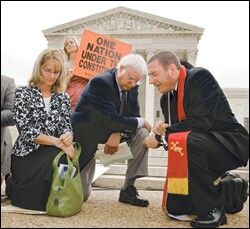
The U.S. Supreme Court’s recent split decisions in a pair of cases concerning displays of the Ten Commandments on government property did not fundamentally alter the legal landscape for public schools, but neither did they leave it untouched, legal observers say.
On the last day of their 2004-05 term last month, the justices held 5-4 that displays of the Decalogue in two county courthouses in Kentucky were aimed mainly at advancing religion and therefore violated the U.S. Constitution’s prohibition on government-established religion. In a companion case, they held by a different 5-4 lineup that a 40-year-old granite monument of the Ten Commandments on the grounds of the Texas state Capitol did not cross the constitutional line and can remain.
One effect of the June 27 rulings, which together yielded 10 separate opinions, was to leave in place the high court’s 1980 decision in Stone v. Graham, in which it struck down a Kentucky law requiring public schools to post copies of the Ten Commandments in every classroom.
Another was to underscore the case-by-case nature of the Supreme Court’s approach to deciding church-state controversies. Disappointing those who had hoped for greater clarity, a majority of the nine justices signaled that specific context weighs heavily in such cases, and that hard-and-fast lines should not be drawn.
See the related item,
In a friend-of-the-court brief in favor of no party in the Kentucky county-courthouse case, the National School Boards Association and several other education groups had asked the court to clarify for public schools just where to draw the line between unconstitutional government endorsement of religion, on the one hand, and impermissible hostility to religion on the other.
“If these cases gave the Supreme Court of the United States so much trouble, what do we expect school boards to do?” said Thomas Hutton, a staff lawyer for the Alexandria-based NSBA. “If there’s one lesson in this for everybody, it’s that the courts perhaps are not the place to work out these differences at an acceptable cost.”
School Cases Cited
Writing for the majority in McCreary County v. American Civil Liberties Union of Kentucky (Case No. 03-1693), Justice David H. Souter invoked a string of school-related Supreme Court cases as support for his view that government must remain neutral toward religion.
The courthouse displays originally featured framed copies of only the Ten Commandments. After the Kentucky ACLU sued, the displays were changed to include other historical documents. That sequence of actions, Justice Souter said, made clear that a religious purpose behind the displays was paramount.
“We are centuries away from the St. Bartholomew’s Day massacre and the treatment of heretics in early Massachusetts, but the divisiveness of religion in current public life is inescapable,” his opinion said.
He was joined by Justices John Paul Stevens, Sandra Day O’Connor, Ruth Bader Ginsburg, and Stephen G. Breyer.
In a concurring opinion in the McCreary case, Justice O’Connor cited West Virginia State Board of Education v. Barnette, in which the Supreme Court ruled in 1943 that public schools couldn’t compel students to recite the Pledge of Allegiance.
“It is true that many Americans find the commandments in accord with their personal beliefs,” Justice O’Connor wrote. “But we do not count heads before enforcing the First Amendment.”
Scalia Dissents
Justice Antonin Scalia argued in his dissent in the McCreary case that the Constitution in no way prohibits government from posting the Ten Commandments, and that the majority’s effort to parse county officials’ motives was misguided. He was joined by Chief Justice William H. Rehnquist and Justice Clarence Thomas, and in part by Justice Anthony M. Kennedy.
In the Texas case, Chief Justice Rehnquist said that even though the Ten Commandments display there was constitutional, the Stone v. Graham decision made it clear that there are “limits to the display of religious messages or symbols.”
That 25-year-old ruling reflects the high court’s particular vigilance in the K-12 context, the chief justice wrote in his plurality opinion announcing the judgment of the court. The Texas monument, he added, “is a far more passive use of those texts than was the case in Stone, where the text confronted elementary school students every day.”
Justices Scalia, Kennedy, and Thomas joined his opinion in Van Orden v. Perry (No. 03-1500).
Charles C. Haynes, a senior scholar at the Freedom Forum’s First Amendment Center in Arlington, Va., predicted that the Kentucky ruling on the commandments would be of greater significance to K-12 educators than the Texas case.
“The real question in the public school setting has been, is there a way around Stone v. Graham?” he said. “The effort has been to say, ‘Let’s find a way to put them up in classrooms as part of an historical display,’ and I think this Kentucky decision makes that effort much more difficult.”
Reviews Denied
One place such an effort was mounted was in Kentucky’s Harlan County, where the school district hung up single, framed copies of the commandments in classrooms in 1999. As in the courthouse cases, the district then twice modified the displays after being sued by the ACLU.
The Harlan County case had been consolidated with the courthouse cases in the U.S. Court of Appeals for the 6th Circuit, in Cincinnati, which ruled in favor of the ACLU in both challenges. The cases were then appealed separately to the Supreme Court.
After deferring action on Harlan County v. ACLU of Kentucky (No. 03-1698), the high court announced on June 28—the day after the McCreary and Van Orden rulings—that it would not take up that schools case for full review. Also on June 28, the court denied review of Adams County/Ohio Valley School Board v. Baker (No. 04-65) and Johnson v. Baker (No. 03-1661), appeals aimed at reinstating Ten Commandments monuments outside four high schools in Ohio.
The Adams County displays originally featured only stone replicas of the Ten Commandments tablets, but were then supplemented with small monuments with text from other historical documents, such as the Magna Carta, the Constitution, and the Declaration of Independence.
Unlike the displays in Kentucky and Ohio, the monument at the Texas Capitol was donated decades ago, in 1961, as part of a national push to combat juvenile delinquency by the Fraternal Order of Eagles. Its vintage was clearly a factor.
Justice Breyer, who provided the swing vote in the case, said in his concurring opinion that “the public visiting the Capitol grounds has considered the religious aspect of the tablets’ message as part of what is a broader moral and historical message reflective of a cultural heritage.”
The context in Texas differs in several other ways from that of the McCreary County case, he argued.
Justice Breyer noted in his concurring opinion that the Texas display “is not on the grounds of a public school, where, given the impressionability of the young, government must exercise particular care in separating church and state.”


