Speaking to more than 200 largely undecided voters packed into a technical- college dining room here on Halloween day, Howard Dean explained his strategy for winning the White House.
See Also... | |
| Read the accompanying table, “The Democratic Contenders on Education” | |
“Everybody else in the race thinks that if you’re a little like George Bush, then that’s the way to beat him,” he said. “Vote for the war in Iraq because we don’t want to be called soft on defense. You vote for some of the tax cuts because, Lord knows, we have to be for the middle class. You vote for No Child Left Behind. ...”

The former Vermont governor highlights his opposition to the federal education law in drawing contrasts between his campaign for the Democratic presidential nomination and those of other contenders. He promises to “dismantle” the bulk of the No Child Left Behind Act, one of President Bush’s most prized domestic-policy accomplishments.
“Anybody here from a school board?” Mr. Dean asked the audience. “School boards call it ‘No School Board Left Standing.’ ... Teachers call it ‘No Behind Left.’”
While the funding levels for the No Child Left Behind law have become routine target practice for the Democratic presidential candidates—they say that Mr. Bush and other Republicans won’t back adequate amounts of money—most of the candidates don’t criticize the law itself.
And little wonder. As Mr. Dean likes to point out, most in the crowded Democratic field voted for it. Of the nine candidates now in the race, the three senators and the two House members all cast “aye” votes when the No Child Left Behind Act won overwhelming, bipartisan majorities in Congress in late 2001.
Only one congressional delegation unanimously rejected it: the two senators and one representative from Mr. Dean’s adopted state.
Zero to Three
A New York City native who has gone from quixotic long shot to top-tier contender, as judged by opinion polls and fund- raising prowess, Mr. Dean, 54, loves to talk about Vermont, where he was the governor for 11 years.
|
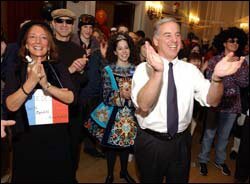
Democratic presidential candidate Howard Dean enjoys a skit parodying his stump speech at a Halloween party in Manchester, N.H. The former Vermont governor has been outspoken in his criticism of the bipartisan No Child Left Behind Act of 2001. |
Fresh from a red-eye flight out of Boise, Idaho, he spent Oct. 31 making his pitch to voters across southern New Hampshire, the state that on Jan. 27 will hold the first delegate- selecting presidential primary of the 2004 campaign. At every chance, the salt- and-pepper-haired candidate steered the conversation toward the state due west.
“The nice thing about being a governor is you can go on my Web site ... and look up what I’ve done,” he said during a morning forum on children’s issues at the University of New Hampshire at Durham. “I doubt very much that there’s another state in the country that does what we do for kids.”
He first assumed the helm in Vermont in 1991, when Gov. Richard Snelling, a Republican, died of a heart attack. Mr. Dean was the lieutenant governor at the time.
At the university forum, he touted a number of ways his state helps children. Virtually all Vermont children have health insurance, he pointed out. He trumpeted Success by Six, a state initiative that helps communities foster the well-being of young children and families, from an initial hospital visit at the time of childbirth (and a later home visit, if desired) to making available parenting classes, job training, and programs to keep dads interested in their children.
Vermont, through a combination of state and federal aid, also subsidizes child care for families earning up to $40,000 a year.
Those who know Mr. Dean, a former practicing physician, say that as governor he showed a keen appreciation for the interplay between education and social services, and children and their families.
“He understood how health, nutrition, and care for our children related to education,” said Raymond J. McNulty, a former state education commissioner and district superintendent in Vermont. Mr. McNulty said he recalls weekly Cabinet meetings at which the governor would try to make connections between the efforts of various state agencies.
Mr. Dean has shown a particular policy interest in the first years of life.
“We have the right-wing Republicans beating up on the public school system all the time because they don’t graduate kids who can read and write,” Mr. Dean said in Durham. “I’ve got news for them: Those kids go into the schools being unready to learn 15 years earlier.”
He has promised to ensure health care for all Americans, and to provide better support for high- quality child care and early-childhood education, modeled after Vermont’s system.
Pat Stevens, a 55-year-old independent voter from Stratham, N.H., who came to Portsmouth to hear the candidate, said she was impressed with “the way he emphasized, let’s get at children when they’re young,” she said. At the same time, she said, she wishes the former governor “hadn’t taken so many shots at Bush ... whether he liked him or not.”
Mr. Dean’s late-October campaign visit in New Hampshire came just before his controversial remarks appeared in an Iowa newspaper about seeking the votes of “guys with Confederate flags in their pickup trucks.” The comment dogged him last week, and on Nov. 5 he backed away by saying that he did not endorse the Confederate flag, but that the country needs “to engage in a serious discussion about race.”
‘Over the Top’
Not one to mince words, Mr. Dean is unsparing when it comes to the No Child Left Behind Act. At a late-afternoon campaign event with some 50 union members in Concord, N.H., he was asked about the law.
“No Child Left Behind is an unfunded mandate, and the way the president decided to make New Hampshire schools better was to make them more like Texas,” he declared.
The Bush administration has long argued that it has provided ample money to comply with the law and help states and districsts turn around low-performing schools, and it stresses that each state designs its own standards and tests.
“What I would do is dismantle No Child Left Behind,” Mr. Dean said. “There’s a couple of good pieces in it. We’ll keep those.”
In an interview with Education Week, he elaborated on his views.
“What I like is the disaggregation of student scores,” by racial, ethnic, and other key subgroups, he said, calling that provision an important “civil rights” issue. “What I hate is the unfunded mandates and the mindless adherence to 3rd-through-8th- [grade] testing. ...
“And the ‘average yearly progress’ is ridiculous,” he said, referring to the requirement that schools show adequate progress each year in raising achievement.
He added: “The way this administration has structured it, every public school in the country will be a failing school by 2013 unless there’s 100 percent compliance, which is, of course, ridiculous and impossible.”
The No Child Left Behind law calls on states to test all students in reading and mathematics each year in grades 3-8. Public schools must ensure that all students are proficient—as defined by each state—by the 2013-14 academic year, and meet gradual targets toward that goal. The law also demands improvement for subgroups, such as racial minorities. If a school does not make adequate progress for two or more years, it is supposed to get extra help, but progressively stronger sanctions also kick in.
Mr. Dean contended that the adequate-progress demands were designed “to put public schools out of business.”
“Trying to destroy the public school system? That is just absurd, absolutely not true, and he knows it,” countered David H. Winston, a Republican political strategist and the president of the Winston Group, a polling firm in Alexandria, Va. “I think Dean’s rhetoric is just beyond the pale and over the top.”
Mr. Winston, who has conducted opinion surveys about the federal law, said of its focus on testing and tough accountability: “This is an idea that, generally, the American public has embraced.”
“Does he have a better idea?” Mr. Winston said.
Mr. Dean is expected to roll out several detailed education initiatives in coming weeks. He has made clear his support for high standards and testing, but says he prefers technical assistance over federally mandated sanctions. And beyond his mantra about early education, he wants to promote greater parental involvement in education.
Larry J. Sabato, the director of the Center for Politics at the University of Virginia, suggests that attacking the bipartisan law poses some political risk.
“He’s clearly off in a corner on this,” Mr. Sabato said. “In much of the Democratic Party’s establishment, Dean is viewed as someone who is difficult to get along with, someone who is quarrelsome and unwilling to compromise. ... Opposition to No Child Left Behind would reinforce that.”
A Stand-Up Guy?
But Mr. Dean’s stance is popular among some educators.
Citing his criticisms of the federal law, the California Teachers Association endorsed Mr. Dean last month. Several current and former Vermont superintendents said they were enthusiastic about the candidate’s stance, too, as is the Vermont-NEA, whose board of directors unanimously approved a statement Nov. 1 in favor of his candidacy. That group also likes his opposition to school vouchers and his support for what is known as “full funding” of the main federal special education law.
But the Vermont affiliate of the National Education Association admits that, at times, it has parted company with Mr. Dean.
“The governor has always been a fiscal conservative,” said Angelo J. Dorta, the president of the state union. "[That] was kind of the centerpiece of what for us were at times some serious differences of opinion.”
That concern for balancing budgets helps to make him hard to pin down politically.
“I used to get along with Howard better than the liberal Democrats did,” recalled state Sen. Vincent Illuzzi, a self-described moderate Republican and longtime Vermont lawmaker.
As governor, Mr. Dean threw his weight behind a controversial plan, called Act 60, to radically overhaul school finance in Vermont. The measure, a response to a court mandate, has shifted money from affluent to poorer areas of the state to provide more equitable funding.
Besides his involvement in education as governor, Mr. Dean long ago saw schools from another perspective: He worked briefly as a student-teacher at a middle school.
As a result, Mr. Dean said in the interview, “I’m the only candidate running for president who knows what it’s like to stand for five hours without going to the bathroom.”


