Following their sudden and unsettling clash over school vouchers, New York City’s mayor and schools chief allayed fears last week that the nation’s largest school system would soon be shopping for a new chancellor.
The dispute began in January when Mayor Rudolph W. Giuliani proposed a publicly funded, Milwaukee-style voucher plan to help send poor children to private schools--an idea that Schools Chancellor Rudolph F. Crew unequivocally opposes.
Their differences did not flare up, however, until it became clear early this month that the mayor was actively trying to line up a majority on the city school board to back the plan. That prompted Mr. Crew to warn that if the mayor succeeded, the schools chief would have no choice but to resign.
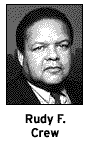
|
The “Two Rudys,” as New Yorkers call them, have forged a remarkably sturdy alliance since Mr. Crew’s arrival in October 1995. So observers were taken aback by the sparring in the news media following the chancellor’s ultimatum.
Yet the unexpected acrimony dissolved last week when the mayor and the chancellor emerged smiling from a private meeting to announce that their friendship remained intact and that they had agreed to disagree.
“The chancellor has one view of [the voucher issue], and I have another,” Mr. Giuliani said at the jovial March 8 news conference with Mr. Crew. “Neither one of us knows what the resolution of it will be in the future. We’ll figure that out.”
Echoes of Conflicts Past
Mr. Crew, for his part, did not disavow his threat to resign, but stressed that he had no desire to leave and was not looking for another job. He said the voucher dispute was “not a friendship-breaking deal,” and he joined with the mayor in pledging to continue talking about it one-to-one.
“This is all held in abeyance at this time,” the chancellor said. “The mayor holds on to his view. I hold on to mine.”
For some in New York’s education community, Mr. Crew’s squabble with City Hall evoked memories of his immediate predecessor, Ramon C. Cortines, who left after two years of nearly constant feuding with the Republican mayor.
That episode left Mr. Giuliani vulnerable to charges that he had destabilized the school system by forcing out a chancellor well-liked by many parents and educators. By contrast, the mayor has taken pains to underscore his support and respect for Mr. Crew despite disagreements over issues ranging from control of the school police to charter schools.
Mr. Crew has said he would need at least five years in his job to make a lasting difference in the 1.1 million-student system. Mr. Giuliani suggested last week that he did not want to see that tenure cut short. He called Mr. Crew “an exceptional chancellor” who has “brought an incredible amount of reform to the system.”
“He shouldn’t leave; he should stay,” the mayor said.
Anti-Voucher Campaign
But Mr. Giuliani did not rule out a renewed effort to win school board approval of his proposal to spend $12 million in public money over three years to help poor children in one of the city’s 32 subdistricts attend private schools, including religious ones. (“Giuliani Proposes a Voucher Program for New York,” Jan. 27, 1999.)
Nor did he endorse an alternative that Mr. Crew has suggested he would be able to live with: a voucher program run not through the school system but City Hall.
“I think this is something that is going to take a little while to play out,” observed William C. Thompson Jr., the president of the city school board and an ally of Mr. Crew’s.
To some voucher opponents in New York City, the debate over who would run such a program is essentially moot. They say the state constitution bars a voucher program that would include religious schools, and that state legislation would be needed even for one involving only secular private schools--arguments the mayor’s office disputes.
“It’s well and good for the mayor and chancellor to be discussing this issue, but the board of education cannot make that decision, and the mayor cannot make that decision,” said Assemblyman Steven Sanders, a Manhattan Democrat who chairs the education committee in the legislature’s lower house.
Meanwhile, the city’s affiliate of the American Federation of Teachers and the state chapter of the American Civil Liberties Union have vowed to challenge any voucher plan in court. And late last week, a coalition of education and labor advocacy groups, civic and parent organizations, and political and religious leaders launched an “Emergency Campaign Against Vouchers.”
Now that the immediate sense of crisis has eased, some analysts predicted the city and state should brace for a home-grown version of the nation’s hard-fought debate over vouchers.
“I think everyone’s going to step back and say, ‘We haven’t lost a chancellor, and we haven’t implemented vouchers, so let’s continue the discussion,’ ” said Robert Berne, New York University’s vice president for academic development and a longtime observer of the city schools.