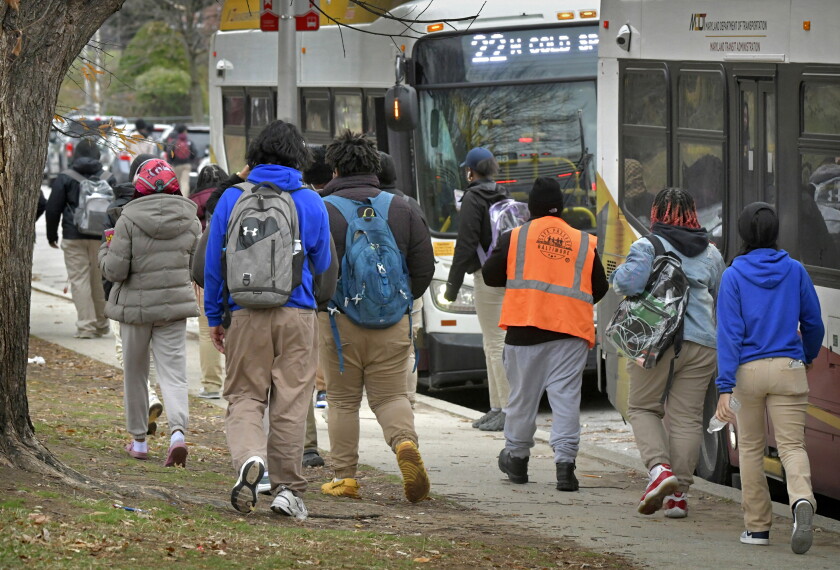
Lingering discontent over a wave of school closures and other education policies, along with the enduring influence of the local teachers’ union, has helped force Chicago Mayor Rahm Emanuel into a runoff to keep his job after he failed to garner a majority of the vote in the city’s mayoral election late last month.
Mr. Emanuel, who captured 55 percent of the vote in his first mayoral run in 2011, won 45 percent of the ballots cast on Feb. 24. He now goes head-to-head against Jesus “Chuy” Garcia, a former alderman and a Cook County commissioner whose spirited campaign was heavily backed by the Chicago Teachers Union. Mr. Garcia got 34 percent of the vote.
City voters also strongly favored establishing an elected board of education for the city’s schools, a nonbinding outcome, but one that is sure to embolden opponents of the mayor’s power to appoint the panel.
The runoff is scheduled for April 7.
Mr. Garcia was handpicked by Chicago Teachers Union President Karen Lewis to run against Mr. Emanuel. Ms. Lewis, who led the city’s seven-day teachers strike in 2012, had planned to challenge Mr. Emanuel, but she was forced to step aside last fall for health reasons. So she recruited Mr. Garcia to run instead, ensuring that education would remain front and center in the mayoral race.
Timothy Knowles, the director of the Urban Education Institute at the University of Chicago, said Mr. Emanuel’s re-election challenges stemmed from tough decisions he made—including the school closures and budget cuts—during a difficult fiscal climate in the city and the state. “School closures, the strike, a reform-minded mayor who was willing to push hard on a system that had not worked for decades, all conspired to create detractors for the current mayor,” Mr. Knowles said. “And then add to that Karen Lewis, and her ‘anointing’ of Garcia as her choice in the 11th hour, I think all of those forces conspired to make education a part of the race in ways that you don’t always see at the city level.”
Strong Hispanic Support
In his campaign, Mr. Garcia called for an end to additional school closings, a moratorium on new charter schools, a reduction in class sizes, and more school nurses, counselors, and social workers. He also called for reducing the number of standardized tests students are required to take. Barbara Byrd Bennett, the chief executive officer of the 396,000-student Chicago school system, has placed a moratorium on school closures and is scaling back testing in the schools.
Mr. Garcia characterized his good showing in the contest as a victory for all city residents. He drew strong support from minority communities, and beat Mr. Emanuel in 15 of the city’s 50 wards, including 11 of the 12 that are heavily Hispanic.
Chicago is home to the nation’s third-largest school district, and authority over the school system rests in the mayor’s office. The ballot question asking whether the city’s school board should be elected directly by voters passed overwhelmingly, but such a move would require a change in state law.
In addition to the teachers’ strike—the first in the city in 25 years—Mr. Emanuel oversaw the closing of nearly 50 underperforming and underenrolled schools that were located primarily in minority neighborhoods. Mr. Emanuel has been criticized by some city residents and public education advocates for the expansion of charter, privately run, and selective- enrollment schools.
But Mr. Emanuel has also received credit for improvements in the city’s schools during his tenure, and he has strenuously defended his education record. Graduation, attendance, and college enrollment rates have all increased during his first term. He has also lengthened the school day, expanded full-day kindergarten, and committed to providing free prekindergarten to all low-income 4-year-olds by the 2015-16 school year. Mr. Emanuel plans to add more STEM teachers and triple the number of certified graduates in science, technology, engineering, and mathematics by 2018. In interviews, Mr. Emanuel was at pains to convey the difficult decision he made to close the schools.
“I did not want to be the mayor who says kids should have a better school and relegate them to underenrolled, underperforming schools because it was easier for me and harder for them the rest of their lives,” he told The New York Times.
Ripples Beyond Chicago?
Whether the teachers’ union influence on the city’s mayoral election will reverberate beyond Chicago—or even extend to the city’s April’s runoff—is yet to be seen, Mr. Knowles said. A host of factors contributed to Mr. Emanuel’s poor showing, including the number of candidates in the race, which effectively split the vote five ways, and the low turnout, which the Chicago Board of Election said may register around 34 percent.
“Today, at the moment, it’s easy to say this might ripple across the nation, but I think we have to wait and see, and we’ll have a much clearer picture of that in April,” said Mr. Knowles, who added that he would be surprised if Mr. Emanuel did not prevail over Mr. Garcia in the runoff.
The mayoral runoff will be the first since the city moved to nonpartisan elections 16 years ago, according to The New York Times. In about a third of the city council races, no candidate received more than 50 percent of the votes, and those candidates—some of them teachers and others backed by the teachers’ union—will also take part in the April runoff.
Pauline Lipman, a professor of educational policy studies and the director of the Collaborative for Equity and Justice in Education at the University of Illinois, Chicago, said that the mayoral and aldermanic runoffs and the overwhelming approval of the nonbinding school board question all demonstrated that Mr. Emanuel and the majority of city residents have fundamentally different philosophies about the future of education in the city.
It’s a divide Mr. Emanuel could not overcome even with a campaign war chest of more than $13 million, the advantage of incumbency, and endorsement from high-powered friends such as his former boss, President Barack Obama, who visited Chicago to provide a last-minute boost, according to Ms. Lipman.
“We’re seeing a growing education movement in Chicago that’s flexing its political muscle,” Ms. Lipman said, along with the “growing power of parents, allied with the Chicago Teachers Union, in supporting an alternative to Mayor Emanuel.”
The other mayoral candidates were Willie Wilson, a businessman, who finished with 10.6 percent of the vote; Bob Fioretti, a former alderman, with 7.4 percent; and William “Dock” Walls with 2.8 percent. Ms. Lipman believes that if Mr. Garcia taps into those candidates’ supporters to form a coalition of white progressives, blacks, and Latinos, Mr. Garcia could defeat Mr. Emanuel next month.