Battles between different philosophical camps in education are nothing new.
Whether it’s knowledge vs. skills, memorization vs. project-based learning, small schools vs. comprehensive ones, the debates in education are often framed as a choice between “either-ors.”
From John Dewey to Chester E. Finn Jr., countless education researchers have documented the fallacies in these dichotomies and the dangers of being too beholden to an "-ism,” as Dewey wrote.
Many educators sense the folly as well. They know that at different times and in different circumstances, different approaches are best for students.
Despite this understanding, teachers are often handcuffed in their ability to steer their way toward a pragmatic middle ground. With limited blocks of time in a public school day and a set curriculum to work their way through, as well as the need to serve many students, each with unique learning needs, teachers must make trade-offs. More of one thing means less of another.

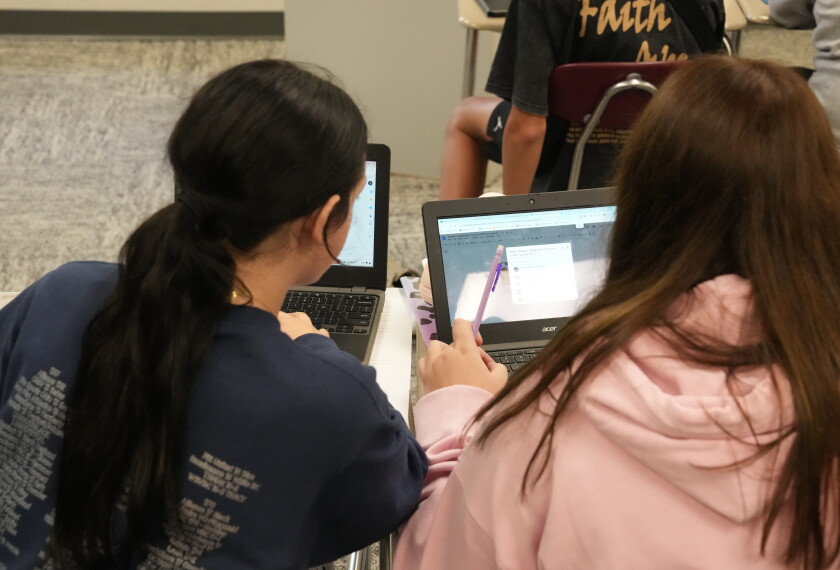
Blended learning—the mix of online and in-school learning—represents a way to break away from the trade-offs mentality, as Harvard Business School professor Clayton Christensen explains in the foreword to our new book, Blended: Using Disruptive Innovation to Improve Schools. (Christensen is also the co-founder, with Michael B. Horn, of the Christensen Institute, where both of us work.)
Done right, blended learning breaks through the barriers of the use of time, place, path to understanding, and pace to allow each student to work according to his or her particular needs—whether that be in a group or alone, on practice problems or projects, online or offline. It preserves the benefits of the old and provides new benefits—personalization, access and equity, and cost control.
The question is how educators can capture these benefits. Blended learning is not inherently good or bad. It is a pathway to student-centered learning at scale to allow each child to achieve his or her fullest potential, but it is not a guaranteed success.
More generally, too many schools have crammed computers into their classrooms over the years—spending many billions of dollars, with little to show for it. It is not unusual to see a district adopt educational technology only to see costs rise and student achievement decline.
So, how to proceed? The first rule is simple, even if it is counterintuitive. Do not start with the technology.
Instead, schools should follow a tried-and-true design process to innovate successfully. The first step is to pick a rallying cry by identifying the problem to solve or the goal to achieve. Some problems relate to serving mainstream students in core subjects, while others arise because of gaps at the margins—where schools cannot offer a particular course, for example. Both areas are worthy of innovation. In either case, though, the problem or goal must not be about technology—such as trying to solve a “lack of devices"—and lead to a deployment of technology for technology’s sake.
Blended learning is not inherently good or bad. It is a pathway to student-centered learning at scale."
With the problem or goal identified, it is important to state it in a “SMART” way—specific, measurable, assignable, realistic, and time-related—such that an organization will unambiguously know what success is and if it has been realized.
One common mistake is failing to bring the right people to the table to lead the effort. The result is that teachers are either stuck with tasks beyond their reach or too much bureaucratic oversight. Schools must match the right type of team and the right people to the scope of the problem.
The Milpitas, Calif., school district, for example, has created coordinating teams to support teachers innovating within their classrooms, and brought together heavyweight schoolwide design teams to rethink the very structure of some of their schools.
With the rallying cry in place and the right team organized, it is time to design. The starting point is to look at school from the viewpoint of students to understand what they are trying to accomplish in their lives and thus what motivates them. When leaders get the design right from their pupils’ perspective, such that young people feel that school aligns perfectly with the things that matter to them, students arrive in class eager to learn.
This is not to say that educators should not instill certain core knowledge, skills, and dispositions in students, but that to accomplish these objectives seamlessly, schools should be intrinsically motivating. This means not only understanding what students are trying to accomplish, but also understanding the experiences they need to get those jobs done, and then assembling the right resources and integrating them in the right way to deliver those experiences.
We know that teachers are a crucial part of the student experience. But to gain teachers’ buy-in, schools must work for teachers as well, which is why designing the teacher experience is the next step. Teachers have personal jobs to do in their lives, and the magic happens when schools offer experiences that are fulfilling for both students and teachers. Ensuring that teachers have opportunities to achieve, receive recognition, exercise responsibility, and advance and grow in their careers is critical. To provide teachers these motivators, institutions using blended learning are experimenting with extending the reach of great teachers, assigning teachers specialized responsibilities, employing team-teaching, awarding micro-credentials for achievement, and granting teachers increased authority.
The next step is the one where technology and devices finally enter the equation. The objective is to design the virtual and physical setup to align with the desired student and teacher experiences.
Some of the important questions that schools should ask when selecting content and software are: Should we build our own? Should we use one or multiple outside providers? Or should we adopt a facilitated-network solution—a platform that integrates modular content from a variety of sources? Considering devices—what type and how many—to match the software and student and teacher experiences is equally important.
Finally, teams should think through the physical environment in which students learn. Will the traditional egg-crate factory-model school design enable students and teachers to be successful? Or is a more modular environment that enables increased customization desirable? Increasing numbers of blended-learning programs are embracing the latter.
From here, it’s time to put the vision into action. That means taking the choices from these different steps and piecing together a coherent instructional model.
After a team finishes designing, its work is still not done. Execution matters.
Schools must create the right culture. Blended learning accelerates a good culture and makes it great, but it will also accelerate a bad culture and make it terrible. Schools should also implement their designs with humility and acknowledge that it is unlikely that they will get the design right on the first try. Taking a discovery-driven approach to help school leaders identify and mitigate risks as they kick off a blended-learning program—and iterate accordingly—will help avoid costly mistakes both for students and a school’s limited budget.
Blended learning is no panacea. It’s a scalable strategy that can break the trade-offs inherent in the traditional school design to allow teachers to reach students in ways never before possible. But for it to work, school leaders must not start with blended learning or technology for its own sake, but instead undertake a careful design process to unlock its potential.