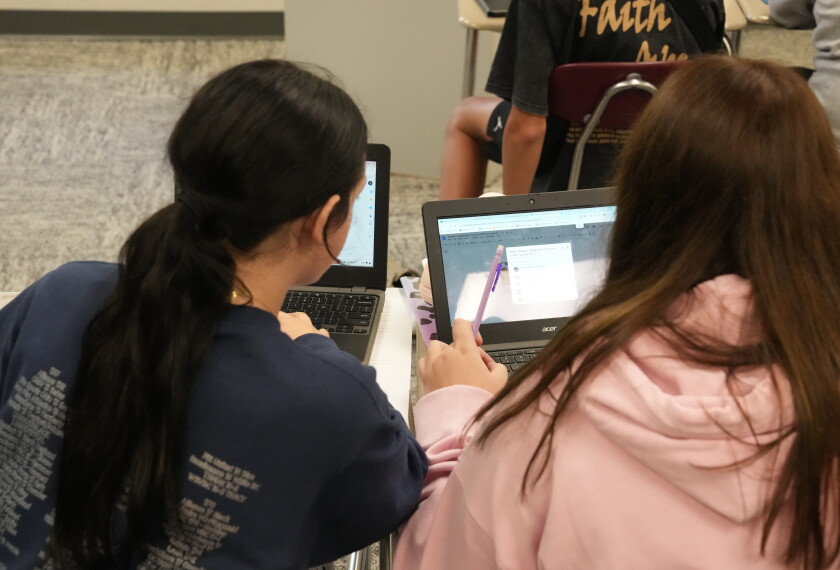
Peter Sanchioni likes to joke that he has five years to prove the 1-to-1 laptop program his district recently put in place is a resounding success. Either that, or he’s out of a job.
Sanchioni is the superintendent of the Natick public school system, a solidly middle-class district of about 5,000 students in Massachusetts. He first started looking into 1-to-1 programs, in which each student is paired with a school-issued laptop or tablet computer, a few years back.
At the time, the district was home to an antiquated high school that was barely equipped to provide Internet access to its teachers, let alone to stream content simultaneously on thousands of devices. But when the construction of Natick’s new high school came in significantly under budget, the school board voted to spend the extra money on 1,500 MacBook laptops—first for the 8th grade class, then for the entire high school during the program’s second year of implementation, at a total cost of $1.8 million.
“So many kids were going home and doing their homework on their laptops, and then in school, we’d hand them an old textbook and a piece of paper and a pencil to take some notes on,” says Sanchioni. “We had to change that.”
For the Natick schools, like hundreds of other districts around the country, the goal behind the digital conversion was simple: increase academic achievement. Despite the difficulty of investing in a costly program at a time when many districts are also facing tighter budgets, a growing number of districts like Natick are beating the odds by adopting cost-effective 1-to-1 programs—and seeing results.
“The bottom line, at least in the areas of writing and [English/language arts], is that laptop programs have a benefit, and they result in measurable student improvement,” says Mark Warschauer, an education professor and associate dean of the education school at the University of California, Irvine. He recently completed an analysis of more than 50 studies that examined the effectiveness of school laptop initiatives.
While many districts have yet to take the 1-to-1 plunge, Warschauer was hard-pressed to think of a single district that wasn’t piloting something, somewhere.
“It’s largely been a cost issue,” he says, noting that “laptops started to take a big dive in price ... around the same time the country went into a major recession, making the investment in 1-to-1 computing still beyond the reach of many districts. Warschauer recently was the author of Learning in the Cloud: How (and Why) to Transform Schools With Digital Media, which includes several chapters on 1-to-1 computing.
Investigating What works
Costs aside, Sanchioni saw a need to shake things up in his district.
While a review of Natick’s SAT and Advanced Placement scores, the percentage of students on its honor roll, and the dropout rate didn’t reveal any major achievement problems, Sanchioni recalls seeing a certain “flatness to everything.”
At first, he began by investigating a handful of districts that had already started 1-to-1 initiatives, and he even ventured across the country to Cupertino, Calif., to tour the Apple Inc. headquarters to learn more about how the company was working with districts putting 1-to-1 computing initiatives in place.
Despite the best of intentions, he soon discovered that districts commonly fall short during the implementation stage by mistakenly believing that simply buying the hardware is enough.
Sanchioni vowed to make it a four-year vision—first issuing the $900 MacBooks to his teachers and administrators. During professional development, he trained the middle school and high school teachers on best practices before finally unleashing the laptops on the 8th grade. Last fall, the program expanded to include grades 9-12.
While Sanchioni cautions that it’s still too early to assess the program’s ultimate success, the district has already seen an increase in the number of students who made the honor roll, with an increasing number of Natick’s 8th graders receiving A’s and B’s. Qualitatively, teachers are reporting their students are more engaged and excited about being in school, with attendance up and discipline problems down.
Still, many experts caution against equating the use of laptops with higher rates of student achievement.
“Can you show me the report that shows the pencil or the overhead projector increased test scores?” says Jill Hobson, the director of instructional technology for the 39,000-student Forsyth County schools, an upper-middle-class district in Georgia.
“It isn’t the device that creates an improvement in achievement,” says Hobson. “It’s the changes in instructional strategies that make improvements.”
Rather than issue laptops or other devices to students, the Forsyth County district opted for another, increasingly popular alternative. Three years ago, the district instituted a “bring your own technology” (or BYOT) program, also known as “bring your own device” (or BYOD).
Each day, more than 11,000 student-owned devices—from laptops to tablets to smartphones—connect to the district’s wireless network.
The BYOT initiative is attracting national attention: By the end of this school year, about 900 visitors will have cycled through the district in hopes of replicating its program.
According to Hobson, administrators observed that when every student in a classroom used an identical device, the teacher often kept teaching the same way that he or she had before the technology was available.
But, she says, “the exciting thing about BYOT is that it’s pretty near impossible to teach the way you have always been teaching. It forces conversations about differentiation and the personalization of learning.”
Whether a district opts for a BYOT approach or an initiative that uses school-issued devices, Damian Bebell, an assistant research professor at Boston College’s Lynch School of Education, cautions that there’s nothing magical about technology suddenly landing on student desks that causes test scores to go up.
iPads in Kindergarten
Since the late 1990s, when school districts began spending more heavily on computers and other technology, Bebell has studied the outcomes of such initiatives. Through his work, he has helped schools document the evolution of teaching and learning into the 21st century.
In addition to measuring impact, much of his research has underscored the importance of combining traditional indicators of success—teacher quality, professional development, and effective leadership, for example—with the use of technology. Technology alone will not have a measurable impact, he says.
During the 2011-12 school year, Mike Muir, the multiple-pathways leader who executes districtwide projects for the Auburn school system in Maine, approached Bebell with the promise of a compelling experiment: What would happen if you gave every kindergartner in an entire school district an iPad? The 3,600-student district wanted to see whether, by providing early access to such technology, they’d see a spike in early literacy scores as a result.
As part of the experiment with the district’s 16 kindergarten classrooms, half received randomly assigned iPads at the start of the 2011-12 school year. The remaining classes received them 12 weeks later, allowing for a perfect randomized controlled trial.
According to Muir, the pupils with the first cycle of iPads outperformed their non-iPad peers on all 12 district literacy measurements.
The instructional strategies for the two cohorts were not much different. Muir believes that part of the success was due to the fact that the students using the iPads received immediate feedback and more time was available for independent work.
“The district was able to use that information, making it a point of pride in the community,” says Bebell. “It’s given this district a new breath of life.”
Because of its success, the district recently footed the bill to expand the iPad program to 1st grade this past fall and to 2nd grade in September 2013.
“It’s really exciting to see kindergarten kids walk up to adults and explain what they’re doing. We have classrooms that would knock your socks off,” says Muir, who has hosted visitors from all over the state and the world who hoped to see how they might replicate the Auburn program.
“Just last week, we had a group visiting from Japan, Sweden, Finland, Denmark, and Australia,” Muir says. “And we’re grabbing a ton of data all along the way.”