
Whether it’s the right to strike, a flush membership, or an attentive legislature, the factors that build the political strength and reputation of a state’s teachers’ unions are multiple and interwoven, concludes a long-awaited analysis.
Released last week by the Washington-based Thomas B. Fordham Institute and the New York City-based advocacy group Education Reform Now, the report ranks states’ unions into five tiers, from strongest to weakest, based on an analysis of 37 criteria in five areas. Hawaii’s statewide union—now teetering on the edge of a strike—was deemed the strongest and Arizona’s the weakest.
A few of the report’s findings seem obvious: Mandatory bargaining laws and fuller coffers appear to help unions strengthen their hands. But for the most part, the study unearths few cut-and-dried patterns across the states.
“Let us admit that its conclusions are more nuanced, even equivocal, than we’re accustomed to,” Fordham officials write in the report’s foreword.
The source of the report raised some concerns among unions. The right-leaning Fordham group and Education Reform Now, the nonprofit 501(c)3 wing of Democrats for Education Reform, a political action committee, have both tussled with teachers’ unions in the past. And union officials criticized the analysis on several fronts, including that such officials were not given a chance to review the findings before publication.
“It appears the report is deeply flawed and misleading,” Randi Weingarten, the president of the American Federation of Teachers, said in a statement. “It seems to omit many factors, including poverty.”
How to Use
Others felt that the report’s impact would best be gauged in terms of the uses others would make of it.
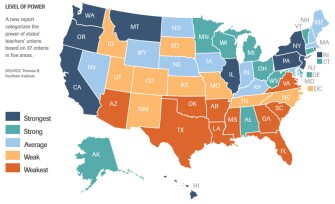
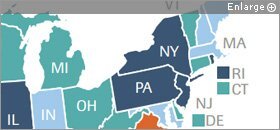
A new report categorizes the power of states’ teachers’ unions based on 37 criteria in five areas.
SOURCE: Thomas B. Fordham Institute
The findings could, on the one hand, be used as a road map to weaken unions, or alternatively as a resource by those who believe strong unions play an important role in setting and improving education policy, said Jonathan S. Gyurko, a New York City-based education consultant who provided input into the study’s design.
“There is a dearth of research in this area. If this report prompts more research and more reaction, good,” said Mr. Gyurko, who has previously worked both for Ms. Weingarten and for the New York City education department. “If it exacerbates antagonistic relationships and impedes thoughtful dialogue about new policies, it’s been a disservice.”
Nuanced Factors
As interest in pay schedules and benefits has grown, scholars have often struggled to come up with good proxies for union strength beyond membership density and bargaining status. The report tries to analyze that question through a number of lenses.
“People don’t want to take this on because it’s messy, and it’s complicated, and it’s really hard to do,” said Amber Winkler, the Fordham Institute’s vice president for research. “We tried to look at what we thought most reasonable people would use as a measure of union strength.”
Individuals who provided input into the project design included: Mike Antonucci, an independent watchdog and critic of teachers’ unions; Dan Goldhaber, a well-known researcher at the University of Washington, in Bothell, who has studied pay schedules; and Katharine O. Strunk, an assistant professor of education policy at the University of Southern California, in Los Angeles, who has used empirical methods to examine the imprint of teachers’ unions on policy.
Each state’s unions were ranked on findings in five areas:
• Financial resources and membership numbers;
• Involvement in politics, including share of financial contributions to candidates and political parties;
• Scope of collective bargaining, including the right to “agency fees"—paid by nonmembers who benefit from union services—and the legality of strikes;
• Degree of alignment between the unions’ traditional positions on teacher workplace rules and charter schools, and state policies governing those areas; and
• Perceived influence, based on a survey of “key stakeholders” within each state.
After testing various ways of weighting the findings in each of the areas, the report’s authors decided to count them equally. Each was worth 20 percent, with subcomponents making up an equal share of that particular component’s overall score. In states with both National Education Association and AFT affiliates, the authors examined both unions, combining their resources.
The analysis does not address the hot-button topic of whether unionization affects student achievement. Generally, scholars say it is difficult to establish cause-and-effect relationships between unionization and outcomes, and the Fordham report’s findings are descriptive rather than causal.
“It’s a good first attempt to put together a lot of data on state-level teachers’ unions and associations that just doesn’t exist in one place,” Ms. Strunk of USC said. “It provides a data source for others to use. I don’t think the report claims to do much more than that.”
Among the findings, the study notes that state factors, such as the scope of bargaining, play a large role in determining whether the unions’ imprint is felt on education policy. Illinois’ mandatory-bargaining law, coupled with a broad scope of bargaining, for instance, allows teacher evaluation to become a major splinter issue in contract negotiations in Chicago, the report says.
But that pattern isn’t universal: Alabama’s NEA affiliate was deemed to be one of the 20 strongest unions, even though bargaining is not required in the state, nor is the union permitted to charge agency fees.
The report also postulates that, in some states, the relative weakness of the teachers’ unions might be because laws there are already largely favorable to teachers. Mississippi’s laws on charters and teacher work rules generally align with its union’s positions, even though it is not among the bigger or wealthier NEA affiliates, the report points out.
Though the project is probably the most detailed analysis ever conducted on the relative strength of teachers’ unions, Mr. Gyurko wondered whether it missed the opportunity to highlight a potentially more relevant comparison.
“The study and method tell us less about the strength of the union as compared to other stakeholders within the same state,” such as education advocacy groups or a robust charter school lobby, he said. “That’s the comparison—the balance of power—that is actually interesting when it comes time to making new state policies or advocating for change.”


