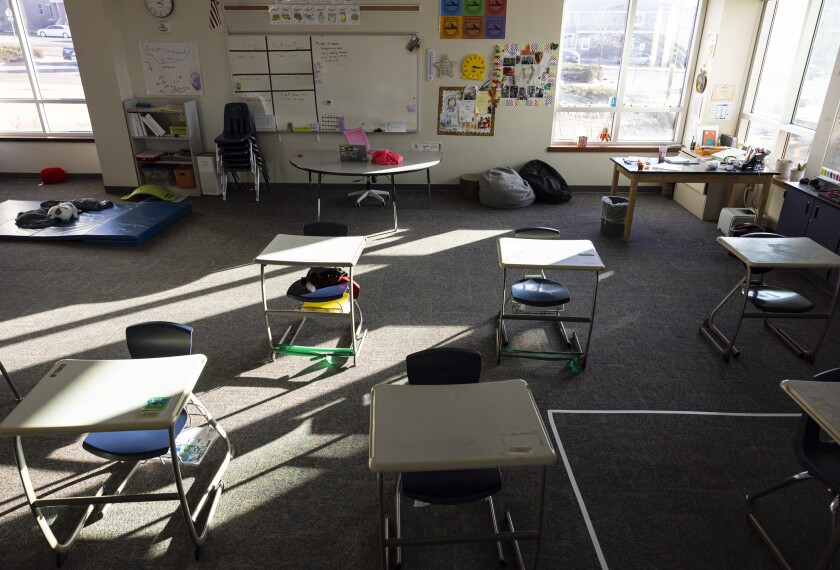
While many think of chronic absenteeism as a secondary school problem, research is beginning to suggest that the start of elementary school is the critical time to prevent truancy—particularly as those programs become more academic.
“Early attendance is essential; This is where you really want to work on them,” said Kim Nauer, the education project director at the Center for New York City Affairs, which studies attendance issues. “By the time you get to 5th or 6th grade, you can really get a cascade effect that you can’t recover from. How much money do we spend in a school system on all of this recuperative stuff in high school—getting the kid back and reengaged—as opposed to making sure the kids don’t slip off in elementary school?”
Yet statistics show that rates of absenteeism in kindergarten and 1st grade can rival those in high school. An average of one in 10 students younger than grade 3 nationwide is considered chronically absent, defined as missing 10 percent or more of school. That’s about 18 days in a normal 180-day year, according to the San Francisco-based Attendance Counts and the Baltimore-based Annie E. Casey Foundation and others.
In all grades, the lower the family income, the higher the absenteeism rates.

Source: National Center for Children in Poverty
According to the Casey foundation, which has stepped up its focus on attendance in recent years, the problem is particularly acute among students from low-income families. The foundation reports that, in 2009, more than one in five poor kindergartners was chronically absent, compared to only 8 percent of young students living above the poverty line. Among homeless students, absenteeism can be even more common.
Reducing absenteeism is important, experts said, because studies link it to an increased likelihood of poor academic performance, disengagement from school and behavior problems. Moreover, research by the National Center for Children in Poverty shows that the same risk factors that make students more likely to become chronically absent, such as poverty-related mobility or an unstable home life, only serve to intensify the problems caused by missing school.
Ms. Nauer, whose report on early absenteeism prompted New York City Mayor Michael Bloomberg to launch attendance-turnaround pilots at 25 schools this year, said educators there were surprised to learn that 10 of the 25 pilot sites are elementary schools.
“It’s so much a part of the average experience of the schools that we don’t notice it,” Ms. Nauer said. Teachers would “have about five or six kids gone on any given day, and they realized how absolutely disruptive that was, but they hadn’t really been thinking about it. Nobody even realized the little guys were missing so much school.”
Not a Priority
Hedy N. Chang, an early-absenteeism researcher and the director of Attendance Counts, said high kindergarten absences are the norm nationwide, but tend to get less attention from educators and policymakers than secondary school truancy.

Preschool and kindergarten absenteeism may be more prevalent, Ms. Chang said, because in many states kindergarten attendance is not mandatory and because parents and community members may not understand how early-learning curriculum has changed in recent years.
“Kindergarten as an academic resource is a relatively new experience,” Ms. Chang said. “Parents may think of their own experience, but kindergartners today are learning to read.”
Yet missing school early, when students are learning the most basic skills, can hamstring students in later grades and contribute to poor attendance throughout their academic careers.
The National Center for Children in Poverty found in 2008 that on average, students who missed 10 percent or more of school in kindergarten scored significantly lower in reading, math and general knowledge tests at the end of 1st grade than did students who missed 3 percent or fewer days. Moreover, the researchers found chronic absenteeism in kindergarten predicted continuing absences in later grades. A study released this year by the Baltimore Education Research Consortium showed that high school dropouts show steadily increasing chronic absenteeism for years before they actually leave school.
Family Interventions
Educators agree that improving attendance in the early grades requires a different approach than secondary school truancy interventions, because, as Ms. Chang put it, “Most 5-, 6-, 7-year-olds, they’re not home playing hooky.”
Since 2008, when the first attendance data by the Center for New York City Affairs suggested more than 90,000 of the city’s elementary school students miss more than a month of school, the Children’s Aid Society of New York has conducted school-by-school risk assessments and intervention plans to improve attendance at the 22 community-model schools with which it works.
“It’s so easy to jump to a conclusion about why a child or a group of children are absent—‘Oh, it’s the parents or it’s the students’—but we have found in our research that it’s really important to do some digging and find out what is going on,” said Katherine Eckstein, the public policy director for the Children’s Aid Society.
For example, Children’s Aid attendance monitors found young children’s absences could trigger a ripple effect in families. If younger siblings had to stay home with a flu, asthma, or other ailment, frequently older siblings missed school, too, in order to watch them while the parents worked. In the Bronx, P.S. 61 Francisco Oller School created child care and health partnerships in which staff members interview the families of students who are absent frequently. In exchange for parents ensuring all their children get to school every day on time, an outreach coordinator will arrange and escort children to doctors’ appointments at the nearby Bronx Family Center clinic, or provide school-based in- and after-school care, according to Octavia Ford, P.S.61 site coordinator. The school is working now to provide mental health and social service screenings for students anxious about coming to school.
Ms. Eckstein said her group has found that in neighborhoods with high asthma rates, schools with on-campus health centers have higher attendance than schools without those services.
“Children and families have relationships with the schools, obviously, but they also may have relationships with the Boys and Girls Club across the street or the health clinic, and you need to leverage all of those relationships,” she said.
Similarly, Providence, R.I., schools found that more than 16 percent of urban students in kindergarten through grade 3 missed 18 days of school or more. After extensive interviews with parents, administrators determined that parents’ overnight work schedules contributed heavily to the problem, as returning parents fell asleep before bringing their children to school.
In response, Robert L. Bailey, IV Elementary School created an early morning child care starting at 7 a.m., to allow parents to drop off students at the end of their shift.
This sort of parent education and family support can not only help parents and young students develop better attendance habits, but can also get disconnected families more involved in school generally, according to M. Jane Sundius, the director of education and youth development at the Open Society Institute in Baltimore, which studies absenteeism. “Even parents who don’t feel they can add much to their child’s education, if they are lauded for getting their kids to school each day … there’s so much possibility there,” Ms. Sundius said.