One of the joys, and challenges, of covering educational technology is that the landscape is forever shifting as digital advancements carve new twists and turns.
The latest shift in the landscape is the growing use of portable technology tools for learning. Mobile devices such as smartphones and iPods, still seen as nuisances or contraband by many schools, are now viewed by an increasing number of teachers and administrators as cost-effective tools to build and sustain 1-to-1 computing programs.
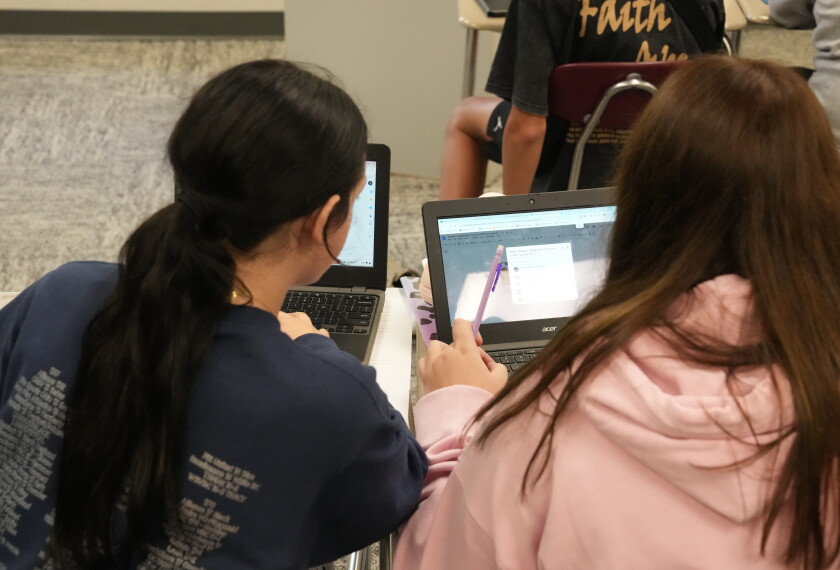
At the same time, more schools and districts are handing out laptops or netbooks to students to use in school and at home, a mobile-learning commitment that mirrors what is happening in higher education and the professional world. Other schools are concluding that they need to take advantage of the ubiquitous presence of technology by having parents supply laptop computers for their children, even if that requires working through some difficult issues about equality of access for students whose parents cannot afford those purchases. That trend is likely to continue as cash-strapped schools look for creative ways to start and maintain 1-to-1 computing programs. (“Building on a Decade of 1-to-1 Lessons.”)
From the perspective of many educators, mobile devices have the potential to transform teaching and learning by engaging students more deeply in lessons and promoting anytime, anywhere learning. The problem is that there is no real proof of the impact of mobile devices on learning, at least not the kind of large-scale empirical data that might persuade district, state, and federal decisionmakers that the investment needed to equip classrooms and train teachers would pay off in higher student achievement.
Yet researchers and educators who are already convinced of the benefits of mobile learning say that a rising number of studies here and abroad, as well as increasing anecdotal evidence from the K-12 field, are helping to strengthen the case for embedding mobile devices into classroom learning. (“Mobilizing the Research.”)
“The problem that we’ve got on [mobile computing] is that all the research is promising, but it’s also based on very small samples,” says Thomas Greaves, the president of the Greaves Group, an educational technology consulting firm based in Encinitas, Calif. “It’s really too early to tell definitively yet. It’s really hard until we get large-scale results to know what difference [mobile computing devices] are making.”
Lack of research is not the only challenge that could complicate the growth and effectiveness of mobile computing in schools.
The cost of a successful mobile-technology initiative goes far beyond just the cost of the devices. In fact, the greatest expenses often come from the resources needed to support the technologies. (“Adding Up Mobile Costs.”)
“The biggest cost that we’ve seen is really around policy,” says David Metcalf, the senior researcher and director of the Mixed Emerging Technology Integration Lab at the University of Central Florida’s Institute for Simulation and Training. “The amount of time that it takes to get this integrated into the curriculum and to train teachers—that takes time, and time translates into money somewhere, and a lot of people forget about that.”
Even in higher education, where the use of mobile devices for learning has taken off at a much faster rate than in K-12 schools, colleges and universities that have already implemented mobile-learning initiatives find it hard to tally the cost, says George Saltsman, the director of technology for the Adams Center for Teaching and Learning at Abilene Christian University, in Texas. Abilene Christian gave out iPhones and iPod touches to each of its incoming freshmen, starting in 2008. (“Full Speed Ahead in Higher Ed.”)
Some good news in the short run is that precollegiate schools may find money to support mobile learning through the American Recovery and Reinvestment Act, the 2009 federal economic-stimulus law. That is how Brent Myers, the superintendent of the 1,015-student Jim Ned Consolidated Independent School District, in Tuscola, Texas, managed to supply each of the students at the local high school with iPod touches, which cost from $200 to $400 each. The district also used federal stimulus money to beef up its wireless network to support the devices.
Still, once the money is secured, other challenges remain, and one of the most daunting ones is figuring out how to develop high-quality instructional content for mobile devices. (“Configuring Content.”)
As more educators have started to move beyond the simple mobile applications for education, such as multiple-choice quizzes, flashcards, and polling, they are learning that adapting existing lessons to the miniature viewing area of a cellphone or personal digital assistant does not always work. As a result, many educators and administrators are using basic academic applications for the short term as they work on more-sophisticated lessons, or wait for additional products to come to market.
“Right now, we’re just focusing on what’s easy, what can be developed quickly, because it’s going to take a lot of trial and error to figure out what is the best practice for doing this,” says Joy Smith, the chief development officer for the Florida Virtual School, the largest state-sponsored online school.
Others echo Smith’s perspective. They say mobile computing is moving forward, but its power to bring about change across K-12 education is far from being fully tapped.
“The important thing to understand with mobile devices in general, especially for education purposes, is it’s still in a state of infancy,” says Nabeel Ahmad, a professor at Teachers College, Columbia University, and a learning technologist for IBM. “We’re just scratching the surface.”