
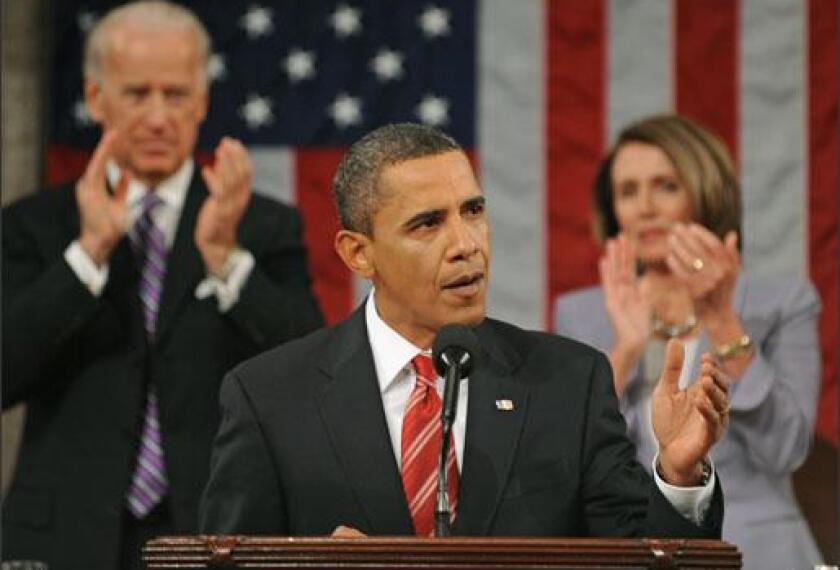
Despite a pledge to hold down spending on most domestic programs, President Barack Obama tonight called for greater investment in public schools in his State of the Union address as part of a push to renew the Elementary and Secondary Education Act.
The president’s fiscal year 2011 budget, slated to be released Monday, will seek a 6.2 percent increase to the U.S. Department of Education’s budget, including up to $4 billion more for K-12 education. The department’s discretionary budget for fiscal 2010 is roughly $63.7 billion.
A large piece of the increase, $1.35 billion, would be aimed at extending beyond this year the $4 billion in economic-stimulus program Race to the Top grants and opening up the competition—now limited to states—to school districts. The president highlighted the Race to the Top saying it had “broken through the stalemate between left and right,” and pledged to expand the reform priorities of that competition—among them turning around failing schools and increasing the supply of effective teachers—to all 50 states.
“The idea here is simple,” he said. “Instead of rewarding failure, we only reward success. Instead of funding the status quo, we only invest in reform—reform that raises student achievement, inspires students to excel in math and science, and turns around failing schools that steal the future of too many young Americans, from rural communities to inner cities.”
The president is also taking the unusual step of making $1 billion of the increased education funds contingent on renewal of the ESEA, whose current version is the No Child Left Behind Act of 2002.
“It’s very unusual to have a budget that is contingent upon legislative action,” U.S. Secretary of Education Arne Duncan acknowledged Wednesday in a conference call with reporters in advance of the speech. “But the president is so deeply committed to education, and there are further reforms we hope to accelerate with this money.”
Consolidating Programs
The $3 billion increase for K-12 not contingent on the ESEA reauthorization would include hikes for programs ranging from “teacher quality to student safety,” Secretary Duncan said. But the budget would also consolidate 38 Education Department programs into 11. And it would propose eliminating six additional programs.
The administration intends to provide details in next week’s budget on just which programs would be affected.
The increase for education is expected to be just one of a few bright spots in an otherwise austere budget proposal. Earlier this week, the White House said that it would call for freezing top-line spending levels for discretionary programs for the next three years.
Mr. Duncan emphasized that education is one issue on which the president expects he can find common ground with Republicans. The secretary said he has spoken with education committee leaders in both the House and Senate, on both sides of the aisle, as well as Democratic and Republican governors and mayors.
“This is one area where we share values and policy ideas,” Mr. Duncan said. “While there will always be some disagreements, there is much more that we have in common. Everyone wants to see education improve. Everyone understands we need to get better.”
Democrats, who control both chambers of Congress, recently lost their 60-vote “super majority” in Congress, when a Republican, Sen.-elect Scott Brown, claimed the seat long held by the late Sen. Edward M. Kennedy in Massachusetts, a Democratic stronghold.
Education organizations were heartened by the president’s pledge to spend more on public schools.
“We are delighted that despite the freeze on domestic [spending], education will be spared this year,” said Mary Kusler, the assistant director of policy and advocacy for the American Association of School Administrators in Arlington, Va.
And she said districts would like Congress to pass an ESEA reauthorization “sooner rather than later,” given “the worsening fiscal picture.” Districts, she said, need relief from the “arbitrary” requirements of the NCLB law, such as that they hold back 20 percent of Title I funds for programs such as school choice and supplemental education services such as tutoring.
But it will be important to watch how the administration structures the proposal to make a $1 billion funding increase contingent on the passage of ESEA reauthorization, said Charles Barone, the director of federal legislation for Democrats for Education Reform, a political action committee based in New York City.
If policymakers use the $1 billion as an incentive for passing a strong bill that builds on the education redesign principles advanced in the American Recovery and Reinvestment Act, which provided up to $100 billion for education, that will be a positive step, he said
But it could also create a somewhat “difficult dynamic,” added Mr. Barone, a former aide to Democrats on the House and Education Labor Committee. Members of Congress could be caught between wanting to deliver money for education to their states through a bill that might no be as strong “and trying to make sure that there’s education reform in your state.”
The proposal “makes the point of illustrating the seriousness” of passing a bill this year, but Congress ultimately crafts the education spending bills, said Andrew J. Rotherham, a co-founder of Education Sector, a think tank in Washington. Lawmakers may not go along with the idea of holding some money back, he said.
President Obama also called on Congress to pass legislation that would make sweeping changes to the student loan program and redirect money from the projected savings to building new school facilities and bolstering community colleges, early-childhood-education programs, and Pell Grants, which help low-income students pay for college.
The House of Representatives approved the proposal in September on a vote of 253-171. But the Senate has yet to introduce similar legislation.
The House bill—which is based largely on a proposal put forward by the president in his fiscal year 2010 budget request—would scrap the Federal Family Education Loan Program, under which the government subsidizes private lenders to make federal loans. Instead, all loans would originate with the direct-lending program, in which students borrow right from the U.S. Treasury.
The change would save about $87 billion over 10 years, according to the nonpartisan Congressional Budget Office.
A portion of that savings, $9 billion over 10 years, would be used to create a competitive-grant program to help states boost the quality of their early-childhood programs, serving children from birth through age 5. The measure also includes more than $4 billion to help school districts revamp school facilities, including making them more environmentally efficient. And the bill would provide grants to help improve community colleges, including remedial education and dual-enrollment programs.
In his speech, the president also urged the Senate to follow the House in passing a bill that will “revitalize our community colleges, which are a career pathway to the children of so many working families.”
Staff writer Lesli A. Maxwell contributed to this article.


