
Corrected: An earlier version of this story gave the incorrect year for Anthony S. Bryk’s departure from the Consortium on Chicago School Research. He left in 2003.
Offering a counter-narrative to the school improvement prescriptions that dominate national education debates, a new book based on 15 years of data on public elementary schools in Chicago identifies five tried-and-true ingredients that work, in combination with one another, to spur success in urban schools.
The authors liken their “essential supports” to a recipe for baking a cake: Without the right ingredients, the whole enterprise just falls flat.
“A material weakness in any one ingredient means that a school is very unlikely to improve,” said Anthony S. Bryk, the lead author of Organizing Schools for Improvement: Lessons From Chicago, which was published this month by the University of Chicago Press. “Often what happens in school reform is that we pick just one strand out, and very often that becomes the silver bullet.”
The book is a capstone effort for the Consortium on Chicago School Research, which was founded 20 years ago at the University of Chicago by Mr. Bryk and others to undertake independent research on that city’s 409,000-student school system.
Besides Mr. Bryk, who left the consortium in 2003 to lead the Carnegie Foundation for the Advancement of Teaching, in Stanford, Calif., the book’s authors are Penny Bender Sebring and Elaine Allensworth, the consortium’s interim co-executive directors; Stuart Luppescu, its chief psychometrician; and John Q. Easton, the consortium’s former director and now the director of the Institute of Education Sciences at the U.S. Department of Education.
Based on a series of studies drawn from the database that the consortium has built up over the years, the five ingredients are:
• Strong leadership, in the sense that principals are “strategic, focused on instruction, and inclusive of others in their work”;
• A welcoming attitude toward parents, and formation of connections with the community;
• Development of professional capacity, which refers to the quality of the teaching staff, teachers’ belief that schools can change, and participation in good professional development and collaborative work;
• A learning climate that is safe, welcoming, stimulating, and nurturing to all students; and
• Strong instructional guidance and materials.
‘Counter-Narrative’
“We’ve known leadership was a major driver since at least the 1970s, and a lot of the roots of the theory in the book come from the ‘effective schools’ movement,” said Joseph McDonald, a professor of teaching and learning at New York University who has followed the project. “What’s new and exciting here are the subtleties with which the supports are described and the astonishing evidence that’s been collected.”
The likelihood of substantial improvements varied depending on whether schools were rated weak or strong in five key areas.
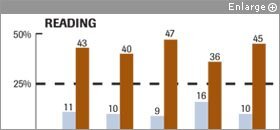
Source: Organizing Schools for Improvement: Lessons From Chicago
“There’s nothing like this in any other book about school reform or improvement,” he said.
The focus on long-known reform ingredients, Mr. McDonald and others also pointed out, runs counter to parts of the Education Department’s school improvement agenda, which advocates charter schools, policies for basing teachers’ pay at least partly on their students’ learning gains, more innovation, and replacing principals at failing schools with new leaders, among other ideas.
“This is a counter-narrative to a lot of the policy debates you hear now,” said Ms. Sebring.
The study began by focusing on the period from 1990 to 1996, a time when the Chicago school system was enmeshed in a districtwide effort to move decisionmaking power to schools. Drawing on parent and teacher surveys, data on student attendance and achievement, and a wealth of other statistics from the consortium’s trove, the researchers compared close to 100 schools that improved the most on standardized reading and math tests and in attendance over those years with another 100 schools that did the worst.
Chicago has 482 elementary schools, which serve students in grades K-8.
Decentralization Not Failure
“We made a conscious decision to remove magnet schools and gifted schools,” said Ms. Sebring. “This was all about neighborhood schools that did not have any advantage of selective enrollment.”
The researchers used value-added measures throughout the study to focus more squarely on the gains students made from year to year in their classrooms, rather than their overall achievement levels.
The consortium’s first finding was that, overall, school decentralization efforts in Chicago had led to improvements for schools—in some more than others—despite the widespread perception that the reform strategy had failed.
The study also found that, while each of the five ingredients for success could be linked to improvement on its own, they were more effective in tandem with other essential supports. Schools that were rated strong in all five areas were at least 10 times more likely than schools with strengths in just one or two areas to achieve substantial gains in reading and math.
Likewise, a weakness in one area exacerbated other weaknesses. For instance, 33 percent of schools with weak teacher educational backgrounds and 30 percent of schools with weak professional communities stagnated, compared with 47 percent of the schools lacking on both measures.
The researchers also replicated the study with data from 1997 to 2005, after the school system had come under mayoral control and was led first by Paul G. Vallas and then by Arne Duncan, who is now the U.S. secretary of education.
Rather than spurring improvement from the bottom up, the district during that period imposed a number of top-down, highly structured improvement initiatives. Despite the change in strategy at the district level, the study found, the same indicators emerged as key ingredients for success.
In the course of the study, the researchers also noticed that schools with similar profiles in their percentages of students poor enough to qualify for federally subsidized meals or students’ race and ethnicity could have markedly different outcomes: One school would stagnate, while its demographic “twin” would make progress.
To get a more fine-grained look at what made the difference, the researchers incorporated data from city social-service agencies, crime statistics, U.S. Census figures, and data on the city’s neighborhoods compiled from another University of Chicago study.
‘Truly Disadvantaged’
Based on that analysis, the researchers identified 46 schools as “truly disadvantaged.” Those schools were in neighborhoods where families were most likely to live in public housing, crime rates were highest, residents were least likely to attend church, and the percentages of children who were abused, neglected, and homeless were highest. In other words, they lacked what other researchers have variously termed “social capital” and “collective efficacy.” Improvement was unlikely to occur in those schools, the study found.
“When the density of problems walking through the front door is so palpable everyday,” Mr. Bryk said, “it virtually consumes all your time and energy and detracts from efforts to improve teaching and learning.”
A small percentage of those schools did manage to boost achievement and attendance, Ms. Sebring added, but all the schools in that far smaller group were “exceptionally strong” in their essential supports.
What tough-to-improve schools may need, the researchers said, is an integrated set of community, school, and related social-service programs akin to the Harlem Children’s Zone, a New York City initiative that combines charter schools with wraparound services for poor children.
“It’s going to take a pretty bold effort to turn those schools around,” Ms. Sebring said, “but it can be done, and it should be done.”
The Chicago school district, for its part, began embracing the consortium’s essential supports as an improvement strategy three to four years ago, according to Barbara J. Eason-Watkins, the district’s chief education officer. The supports provide a template for improvement plans that schools are required to complete every two years and that feed into the district’s overall strategy.
“Schools that adopted the model and the five fundamentals have improved, and some are part of our ‘autonomous’ area based on their success,” she wrote in an e-mail, referring to a program that gives high-performing schools more decisionmaking authority.


