
Includes updates and/or revisions.
In choosing Arne Duncan as his nominee for U.S. secretary of education, President-elect Barack Obama signaled today that his administration intends to take what both men see as a pragmatic, nonideological approach to improving the nation’s schools.
During a press conference announcing the Chicago school system’s chief executive as his choice, the president-elect praised Mr. Duncan’s willingness to support controversial policies, such as shutting down low-performing neighborhood schools and expanding charter schools.
“For years, we have talked our education problems to death in Washington, but failed to act, stuck in the same tired debates that have stymied our progress and left schools and parents to fend for themselves,” Mr. Obama said at Dodge Renaissance Academy in Chicago. “Democrat versus Republican; vouchers versus the status quo; more money versus more reform—all along failing to acknowledge that both sides have good ideas and good intentions.”
As a practitioner working “on the ground,” Mr. Duncan has been able to emphasize taking practical steps to improve student achievement, Mr. Obama said.
“When faced with tough decisions, Arne doesn’t blink,” the president-elect said. “He’s not beholden to any one ideology—and he doesn’t hesitate for one minute to do what needs to be done.”
Mr. Obama said his administration would consider often-debated policies, including performance pay for teachers, if they helped to advance student progress. But he emphasized that such policies would be crafted with considerable input from educators.
During his seven years as the leader of the 408,000-student Chicago system, Mr. Duncan has aggressively pushed for more charter schools and new ways to recruit and prepare teachers. He closed down and reopened some schools.
Speaking after being introduced today by Mr. Obama and Vice President-elect Joseph R. Biden Jr., Mr. Duncan emphasized his hands-on experience as both a district leader and a tutor of disadvantaged children.
“While there are no simple answers, I know from experience that when you focus on basics like reading and math, when you embrace innovative new approaches to learning, and when you create a professional climate that attracts great teachers, you can make a difference for children,” he said.
Mr. Duncan, 44, grew up on the South Side of Chicago and has worked closely with disadvantaged students throughout his life. During his childhood, he was an active participant in an after-school tutoring program founded by his mother. While playing professional basketball in Australia in the late 1980s and early 1990s, he also worked with underprivileged youths.
When Mr. Duncan returned home in 1992, he led the Ariel Education Initiative, running programs and starting a school aimed at helping poor children. In 1998, he joined the Chicago Public Schools, working for then-CEO Paul G. Vallas. Mayor Richard M. Daley tapped Mr. Duncan to lead the school system in 2001.
Questions on ‘Renaissance’ Plan
Linda Darling-Hammond, a Stanford University education professor and the leader of the education policy team for the Obama transition, praised Mr. Duncan as a “very thoughtful and collaborative reformer” who “is deeply steeped in urban education.”
Ms. Darling-Hammond, who herself was frequently mentioned as a serious candidate for secretary, said Mr. Duncan has been able to bring disparate groups together to support his policies.
Michael Johnston, the principal of the Mesa Expeditionary School for the Arts in Thornton, Colo., and an adviser to Mr. Obama’s campaign, said Mr. Duncan’s collegial style meshes with the president-elect’s.
“Arne fits the Obama way of doing business,” Mr. Johnston said. “That’s a real vision for reform and the ability to build coalitions to get it done.”
Chicago activists also praise Mr. Duncan’s collegial approach, but some have expressed concerns about some of the policies he has endorsed.
Michael Klonsky, a longtime Chicago activist and the director of the Small Schools Workshop, which has helped get small schools off the ground in Chicago and elsewhere, said, “I don’t think of Arne as an ideologue. He’s a pragmatist at heart and a democrat.”
Mr. Klonsky praised Mr. Duncan’s support for small schools in the city. But he also said he has been concerned that as part of the work of growing the small schools concept there, Mr. Duncan has helped fuel a trend toward using private companies to manage schools.
Mr. Klonsky said he has also been troubled that Mr. Duncan and Mayor Daley have eliminated local school councils at some schools, making it harder for parents and others to influence and access the goings-on at their schools.
Julie Woestehoff, the executive director of Parents United for Responsible Education, a Chicago advocacy group, criticized Mr. Duncan’s high-profile Renaissance 2010 initiative, which closed underperforming schools for a year before reopening them with new staff members. Ms. Woestehoff said that approach proved harmful to poor children because their schooling was disrupted as they changed schools.
“We are very concerned that there is radical experimentation going on with schools under his watch,” Ms. Woestehoff said. “Renaissance 2010 has had a negative impact on many of the most vulnerable children in our system.”
But the Rev. Michael Pfleger, the pastor at St. Sabina Roman Catholic Church on Chicago’s South Side, which runs a small private school and hopes to start a charter school, praised the turnaround effort.
“Arne has been a tremendous educational leader and reform person who has a tremendous vision and thinks out of the box, which I think is necessary,” Father Pfleger said. “He was supportive of the charter concept. He wasn’t just saying, ‘Oh, charter schools are the answer.’ He’s also held charters accountable.”
Mr. Duncan has won the respect of the teachers’ unions in Chicago and across Illinois.
“While we have not always agreed with the Board of Education policies that Mr. Duncan has been given to carry out, we have been fortunate in convincing him that … collaborative initiatives by labor and management are positive means to solving the challenges of public education,” said a statement by Marilyn Stewart, the president of the Chicago Teachers Union.
Jo Anderson, the executive director of the Illinois Education Association, said in a statement: “In our experience, Arne Duncan is committed to working with others, including the unions, to promote excellence and equity in public education.” The IEA is an affiliate of the 3.2 million-member National Education Association.
Front-runner Gets the Job
Mr. Duncan’s profile and his relationship as a basketball partner with the president-elect led to speculation that the Harvard-educated school leader would be a natural pick to be Mr. Obama’s secretary of education.
But sources said the president-elect did not decide on Mr. Duncan until yesterday.
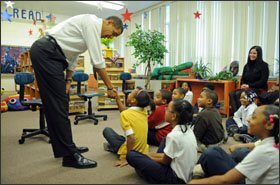
Mr. Obama and his transition team also seriously considered offering the post to Michael Bennet, the superintendent of the 74,000-student Denver Public Schools, and Jonathan H. Schnur, the founder of New Leaders for New Schools, a key adviser to Mr. Obama’s campaign, and the leader of the transition team’s review of management at the Education Department. The principal and several other leaders at the Dodge Renaissance Academy were trained by Mr. Schnur’s group.
All three of the final candidates would have been able to bridge the differences between Democrats over role of schools in improving student achievement, the source said.
Immediately after Mr. Obama claimed the Democratic presidential nomination in June, two groups released separate manifestos offering different approaches to improving schools. (“2 New Coalitions Seek Influence on Campaigns,” June 18, 2008.)
The “Broader, Bolder Approach” called for increasing children’s access to health care and other social services as a way to improve their ability to learn. Its leaders included Ms. Darling-Hammond of Stanford, who in addition to her transition role was a prominent campaign adviser to Mr. Obama on education, and several veterans of President Bill Clinton’s administration.
The second statement, released by the Education Equality Project, calls for aggressive accountability, expansion of charter schools, and other school-based efforts to improve student learning. Although its leaders endorse health care and other social services, it believes that concentrating on improving schools could result in significant gains in student achievement.
The group is led by New York City schools Chancellor Joel I. Klein, who was also considered to be a possible Obama pick for education secretary, and the Rev. Al Sharpton, a civil rights activist.
Mr. Duncan was the only original co-signer of both statements. While Mr. Obama didn’t sign either statement, a campaign aide said in a statement that he supported the content of both of them.
On No Child Left Behind
Mr. Duncan’s experience in expanding the number of charter schools in Chicago and creating additional ways of recruiting new teachers reflect two important ingredients of Mr. Obama’s campaign platform.
His stance on the federal No Child Left Behind Act also reflects Mr. Obama’s. At a congressional hearing in July, Mr. Duncan was one of several urban leaders who endorsed the NCLB law’s emphasis on holding schools accountable for student performance. (“City Leaders Back Stronger Accountability,” July 30, 2008.)
Although the NEA is one of the biggest critics of the law’s accountability rules, the union says it welcomes Mr. Duncan’s support for doubling funding for the law over the next five years, NEA President Dennis Van Roekel said in the union’s statement supporting Mr. Duncan’s nomination.
The NCLB law is overdue for reauthorization. Mr. Obama has said he supports the law’s goal of improving student achievement, especially among minorities. But he has proposed improving the quality of tests used to make accountability decisions and significantly increasing funding for the law.
Mr. Duncan would be the second urban school leader to serve as U.S. secretary of education. Rod Paige, who was Houston’s superintendent of schools at the time, was selected by President George W. Bush to be his education secretary in 2000 and served through the president’s first term.
Two key Democrats on education issues in Congress, Rep. George Miller of California and Sen. Edward M. Kennedy of Massachusetts, who head up their respective chambers’ education committees, released statements praising the pick.
In a statement, Sen. Kennedy said Mr. Duncan “has been a pragmatic and effective leader of Chicago’s schools.”
Craig Orfield, a spokesman for Sen. Michael B. Enzi, the top Republican on the Senate Health, Education, Labor, and Pensions Committee, said the senator “looks forward to reviewing Mr. Duncan’s credentials and wants to discuss the unique challenges that rural and frontier schools face.”
The Senate must confirm Mr. Duncan’s nomination before he can take office. Noncontroversial nominations often are approved on Inauguration Day to provide a smooth transition for the new president and his team.



