Law & Courts

Military Recruitment Ignites an Arizona Rhetorical Firefight

By Katie Ash — September 10, 2007 1 min read
  • Save to favorites
  • Print

Exercising his own First Amendment rights, Arizona state schools Superintendent Tom Horne recently criticized opponents of military recruitment for targeting students with their message— and heard howls of protest in return.

During the first weeks of school in August, members of several activist groups— including the Arizona Advocacy Network Foundation, the Arizona Counter Recruitment Coalition, and Parents Against Violence in Education—stood outside Phoenix-area high schools to distribute preaddressed, postage-paid postcards that would require military recruiters to take students off their contact lists.

The No Child Left Behind Act requires schools that receive federal funding to provide contact information for each student to the U.S. armed forces. Parents can choose to keep their children’s names off the list.

Recruiters’ outreach to high school students has been controversial. Earlier this year, the U.S. Department of Defense, responding to a lawsuit, clarified what kind of information could be collected and how students could remove their names from the database. (“Defense Dept. Settles Suit on Student-Recruiting Database,” Jan. 17, 2007.)

Mr. Horne, however, isn’t keen on activists walking high school students through that process. “To have adults teaching students to be hostile to the military institutions that defend our freedom is educationally dysfunctional,” the state chief said in a statement. “I urge these adults to look in the mirror and decide to do something constructive for education, rather than destructive.”

But his comments earned a tart response from activists.

“Most families had no idea this provision was included in the No Child Left Behind Act, and when they found out, they were appalled,” said Linda Brown, the executive director of the Arizona Advocacy Network Foundation of Phoenix.“We will continue to inform students and parents of their right to privacy.”

She said the superintendent distorted the groups’ message. “We have to respect young people’s abilities and intelligence,” she said. “If they’re given all the information, [they can] make choices that are in accordance with their values.”

Related Tags:

A version of this article appeared in the September 12, 2007 edition of Education Week

Events

Budget & Finance Webinar Creative Approaches to K-12 Budget Realities
What are districts prioritizing in 2026? New survey data reveals emerging K-12 budgeting trends.
This content is provided by our sponsor. It is not written by and does not necessarily reflect the views of Education Week's editorial staff.
Sponsor
College & Workforce Readiness Webinar
From Coursework to Careers: Expanding Work-Based Learning and Industry Credentials in CTE
Expand work-based learning and industry credentials in CTE to connect classroom learning with real careers and prepare students for future success.
Content provided by Project Lead The Way
College & Workforce Readiness Webinar Data-Driven and District-Ready: What EdWeek Research Tells Us About the CTE Market
Discover how to sharpen your positioning in a fast-moving market of CTE with actionable strategies grounded in EdWeek Research Center data.

EdWeek Top School Jobs

Teacher Jobs
Search over ten thousand teaching jobs nationwide — elementary, middle, high school and more.
View Jobs
Principal Jobs
Find hundreds of jobs for principals, assistant principals, and other school leadership roles.
View Jobs
Administrator Jobs
Over a thousand district-level jobs: superintendents, directors, more.
View Jobs
Support Staff Jobs
Search thousands of jobs, from paraprofessionals to counselors and more.
View Jobs

Read Next

Law & Courts Birthright Citizenship Case Raises Stakes for Schools and Undocumented Students
Educators are paying close attention to the case on Trump's birthright citizenship order.
10 min read
President Donald Trump signs an executive order on birthright citizenship in the Oval Office of the White House in Washington, Jan. 20, 2025.
President Donald Trump signs an executive order on birthright citizenship in the Oval Office of the White House on Jan. 20, 2025. The order, now before the U.S. Supreme Court, seeks to limit citizenship for some children born in the United States to immigrant parents without permanent legal status.
Evan Vucci/AP
Law & Courts Appeals Court Revives Lawsuit Over 1st Grader’s Black Lives Matter Drawing
A court revived a 1st grader 's claim she was punished for giving a drawing to a Black classmate.
4 min read
Seen is the drawing made by Viejo Elementary School first-grader B.B. that was entered into evidence. B.B. gave the drawing to her classmate, M.C., who is African American. M.C. thanked B.B.
Pictured is a drawing by a 1st grader in California and given to a Black classmate that is at the center of a First Amendment legal challenge over the student's alleged punishment.
U.S. Court of Appeals for the 9th Circuit
Law & Courts Supreme Court’s Gender Identity Ruling Leaves Schools Seeking Clarity
Advocates say they would welcome more from the Supreme Court on gender-notification policies.
7 min read
The Supreme Court is photographed, Friday, Feb. 27, 2026, in Washington.
The Supreme Court is photographed, Friday, Feb. 27, 2026, in Washington. The high court recently ruled that California policies that sometimes limit or discourage schools from disclosing information to parents about children’s gender transitions and expressions at school likely violate parents’ constitutional rights
Rahmat Gul/AP
Law & Courts Supreme Court Backs Parents in School Gender Disclosure Fight
The Supreme Court restored an injunction blocking California policies on student gender transitions
8 min read
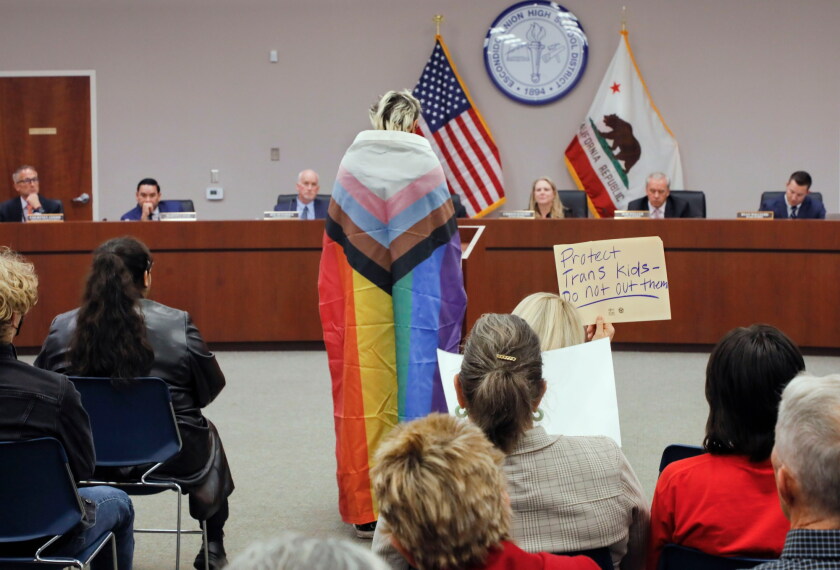
Teacher’s aide Amelia Mester, wrapped in a Pride flag, urges Escondido Union High School District not to have employees notify parents if they believe a student may be transgender in November 2025. A policy on the issue in the city’s elementary school district is the subject of a federal class-action lawsuit in which a judge just sided against the district.
Teacher’s aide Amelia Mester, wrapped in a Pride flag, urges Escondido Union High School District not to have employees notify parents if they believe a student may be transgender at a meeting in November 2025. Two parents and two teachers from the district sued in 2023, challenging California state guidance concerning student gender transitions and parental notification. The U.S. Supreme Court has now reinstated a lower-court decision overturning those state policies.
Charlie Neuman for The San Diego Union-Tribune/TNS