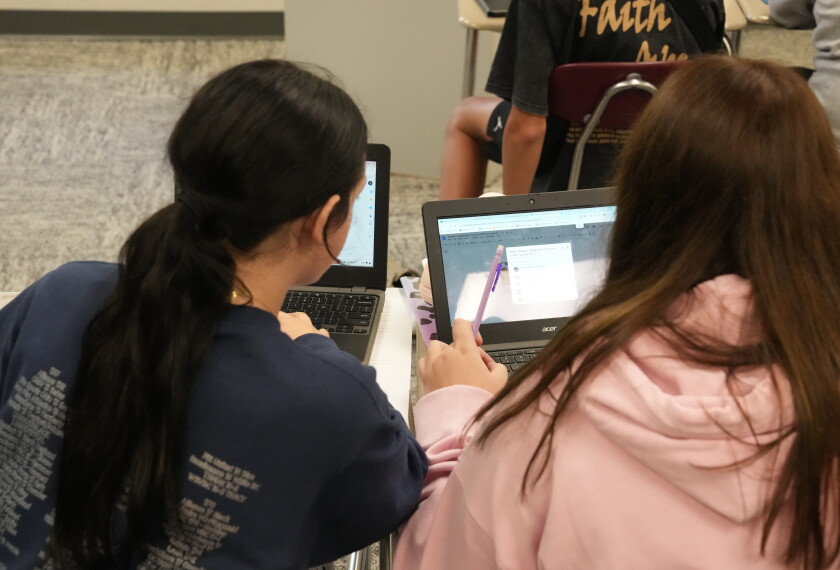
Putting personal computers into the hands of students is an idea whose time has come. All of the more than 34,000 middle school students and teachers in Maine are given a laptop to use during the academic year, with wireless connections to the Internet provided in each school, and the state is interested in expanding its program to high schools. More than 20,000 Henrico County, Va., students in grades 6-12 use personal computers on loan from the district, just the way textbooks are. Interest in this innovation is growing quickly, and Massachusetts, Michigan, New Hampshire, New Mexico, Vermont, Texas, and hundreds of individual schools and districts across the United States are making investments in so-called one-to-one computing.
Many of the likely benefits are barely visible now, let alone well documented by high-quality research. We will have to rely on human judgment to make decisions about investing in it.
Why are policymakers interested in one-to-one computing? One reason is economic competitiveness. Here’s how former Gov. Angus S. King Jr. of Maine, who started his state’s laptop program, put it: “For more than 100 years, Maine has always been in the bottom third of states—in prosperity, income, education, and opportunity for our kids. In my 30 years of working on Maine economic issues, no idea has had as much potential for leapfrogging the other states and putting Maine in a position of national leadership as this one—giving our students portable, Internet-ready computers as a basic tool for learning.”
Equity concerns are another reason for policymakers’ interest. Mark A. Edwards, who was the superintendent when Henrico County began its laptop program, was concerned about the inequitable distribution of computers and access to information among student haves and have-nots. Thousands of students in the county who did not have easy access to computers, the World Wide Web, and a wealth of digital resources now have such access. And because students can take the computers home, homework assignments can take advantage of them.
Improving teaching and learning, increasing student achievement, and preparing students for the future are other reasons cited in support of implementing one-to-one computing. Teachers in both Maine and Henrico County, sites of the largest one-to-one computing programs in the country, are strongly in favor of them, as are school administrators, parents, and the students themselves. This has been documented in multiple surveys and studies by a number of different organizations. These reports, and others looking at different one-to-one sites, suggest that students are more engaged in school, demonstrate greater independence and more self-directed learning, and show improvement in a variety of skills, such as writing. There also are unique benefits for students with disabilities, and as a result, special education teachers are especially enthusiastic.
Of course, not everyone is a supporter. Critics point to the price tag. Both Maine and Henrico County, however, have lower-than-average financial resources, and both have continued their programs for years, long beyond the administrations that began them. Critics also claim that many teachers are not yet ready to integrate computers into instruction, and it is true that one lesson learned about one-to-one computing is how important it is to prepare teachers and provide them with high-quality resources and professional development. But the same is true of any serious instructional innovation.

Evidence of student achievement gains at one-to-one sites, as measured by test scores, is still weak. But many earlier studies, and meta-analyses of studies, have documented the benefits of using computers. Moreover, the U.S. Department of Education currently is sponsoring a large, randomized experimental study of some discrete educational software products, such as those for instruction in beginning reading and middle school mathematics, and the results of that study will answer questions about certain benefits that computers may offer.
As an education researcher, I am interested in good research about computers in schools. I co-direct a project seeking to connect researchers who study one-to-one computing so that we can share findings and avoid reinventing the wheel. But a seldom- discussed facet of the debate about “scientifically based research” is that many education innovations, by virtue of their being new, are not likely to have much of a research base. There’s still a debate, for example, about what the research says about charter schools. Indeed, when that idea was first introduced in federal legislation there was practically no research available.
We should not expect more of research than is reasonable. In the context of one-to-one computing, we should realize that many of the likely benefits are barely visible now, let alone well documented by high-quality research.
Suppose, for example, textbooks stored on a disk or a USB drive could replace the contents of students’ heavy, bulky backpacks. Students could mark up and interact with electronic texts without damaging them. And their backpacks would weigh far less. A few schools and companies are beginning to experiment along these lines. Such electronic instructional materials could incorporate animated examples, movies, interactive tests, and links to historical documents on the Web. They also could provide the opportunity to learn and listen to a foreign language, as well as the capacity to use scientific probes and sensors to improve instruction.
Examples of these and other opportunities can be found in schools today, but few of them have been sufficiently developed or in place long enough to lead to scientifically based research documenting their benefits. Moreover, there is no well-accepted methodology that would allow us to add up a disparate set of benefits across school subjects and apply a hypothetical cost-benefit formula to tell us whether these benefits are worth their cost. We will simply have to rely on human judgment to make decisions about investing in one-to-one computing. Good research can help inform those judgments, however, and I’m all for that. In fact, as new one-to-one initiatives begin, more money ought to be invested in research about them.
Educator ought to be asking how computers will be used to support the most important functions of schools. No school can afford to start an expensive and challenging program that is at odds with its core mission.
Improved school-home connections constitute another important benefit of one-to-one computing programs. Virginia’s Henrico County, for example, licenses K12Planet, a Web site that provides administrators, teachers, parents, and students access to a variety of information, such as students’ homework assignments and grades. Many teachers and parents are enthusiastic about this innovation.
Large numbers of school systems also are getting serious about data-driven decisionmaking. The availability of useful data about students will increase as computers become ubiquitous, and many states, such as Oregon and Virginia, are experimenting with online or computer-based testing as well.
The picture is not all rosy. Teachers have to learn to manage a complex set of devices, which takes up precious time, and they also must minimize the potential disruptions caused by students’ use of the computers in inappropriate ways. There are systemic ways to help teachers contend with such issues, including the avoidance of “jukebox” software and the creation of codes of conduct for students and parents to sign. Another problem arises if teachers rely on the computers for classroom instruction but find that some students have not brought their computer to class. This is a problem not entirely different from students’ forgetting textbooks or other materials. Computer batteries also are not as good as we’d like, so ways must be found to charge them at school. No instructional innovation is without its difficulties, and one-to-one computing is not an exception.
Still, these are manageable problems. The most serious criticism leveled at one-to-one computing programs is that they are add-ons distracting people from what is important in schools. The research literature provides some examples, such as sites where teachers complain that insufficient effort has been made to provide them with high-quality digital resources for instruction. Teachers should not be left on their own to find or develop these materials, classroom by classroom, and resource by resource. Fortunately, such examples seem to be the exception and not the rule. And guides are beginning to be made available to help schools implement one-to-one computing effectively. One, for example, has been published by the Northeast and the Islands Regional Technology in Education Consortium.
Places that adopt one-to-one computing ought to be asking how computers will be used to support the most important functions of schools, because no school can afford to start an expensive and challenging program that is at odds with its core mission. But that is not what is being reported at the nation’s two largest sites of one-to-one computing. To the contrary, there is evidence there that one-to-one programs are helping schools achieve more.
One thing is certain: The price of technology will continue to drop. Hand-held computers, graphing calculators, and laptops are becoming more sophisticated, cheaper, and smaller. At the Massachusetts Institute of Technology, one visionary has unveiled a $100 laptop for students in developing nations.
We may not be able to predict what the common electronic devices used in schools will look like in five or 10 years. But it is no longer a question of whether every student in our schools will have a powerful computing device to use. The question is when. Will we be prepared to make good use of these devices?