Corrected: The Victor Central district spokeswoman’s name was misspelled in this story; the correct spelling is Kara M. Conners. Also, it was a junior high school principal in the Victor Central district who raised $500 by raffling off a coveted school parking space.
Last week, Kevin L. O’Rourke was sitting atop a pile of discarded school desks in an old machine shed in Minnesota. By this week, those 2,000 desks were slated to be in classrooms in Plaquemines Parish, La., where the school district’s own furniture was washed away by Hurricane Katrina.
Mr. O’Rourke heads Magnus West, an Inver Grove Heights, Minn., nonprofit organization that usually collects old school desks and textbooks and routes them to developing countries. This time, he’s sending a care package to Gulf Coast schools, and a fleet hired by the Department of Transportation is trucking it there.
The link between Mr. O’Rourke and the Plaquemines Parish district is one of 530 such connections made so far through a special Web site of the federal Department of Education called Hurricane Help for Schools. The site acts as a matchmaker for donors who want to help hurricane-affected schools or those that have taken in students displaced by Katrina or Rita.
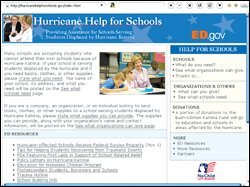
It’s an altruistic effort for the Education Department, but it also ventures into uncharted territory for the federal government, which has traditionally allowed nonprofit and private organizations to lead relief efforts for those in need in times of crisis or disaster.
“It looks like they’re cutting out the middle person,” said Daniel Borochoff, the president of the American Institute of Philanthropy, a charity watchdog group in Chicago. “For the federal government to be doing that is unusual.”
While schools continue to wait for Congress to pass direct federal hurricane aid for them, the Education Department’s hurricane-relief Web site, hurricanehelpforschools.gov, has attracted donors providing everything from textbooks and backpacks full of school supplies, to educational software and cash. The donations range from the small to the massive both in cost and in size.
For example, 6-year-old Sam Thornhill of Midlothian, Va., asked his birthday-party guests in October to bring gifts to donate and his family sent the art supplies, notebooks, and a train set to a Prichard, Ala., child-development center. Fifty-two school buses were donated by the Appomattox County, Va., school district to several public and private schools in Mississippi, department officials said.
Those connections were all made through the Web site, said Kristine Cohn, who is Secretary of Education Margaret Spellings’ regional representative for Indiana, Ohio, Michigan, Wisconsin, and Minnesota, and who is leading the team working on the relief effort.
“There’s no major science to this,” Ms. Cohn said. “We review the information the donors give and then try to get the materials to the schools that need them the most.”
Now that the structure of the site is in place, department officials say they plan to use it for future disasters as well.
Passing the Hat
While linking needy schools and benefactors may not be rocket science, the Education Department’s direct role as the intermediary between the sides is new terrain for the federal government, said Arthur C. Brooks, an associate professor of public administration at Syracuse University in Syracuse, N.Y., who studies philanthropy.
Earlier this fall, in response to Hurricane Katrina, the White House raised the ire of many in the charity world by suggesting specific relief groups for donations, said.
“Picking winners in the nonprofit world is really controversial,” he said.
Though he cautioned that typically government involvement in philanthropy slows the process, because “government is big and blunt and nonprofits are little and facile,” in this case the Education Department isn’t providing the relief, only brokering it, Mr. Brooks said.
Though some nonprofits may complain that the department’s effort could sap the relief they’ve been seeking to channel to the Gulf Coast since Katrina struck in late August, Mr. Borochoff of the American Institute of Philanthropy said, he sees the department’s efforts as a positive step.
“These are turbulent times, fast-changing times, and there’s a need for creative ways of helping,” he said. “Government tends to be very stodgy and slow to react, but this is something that is an exception.”
Ms. Cohn said that more than 500 matches have been made through the Education Department’s site, but she acknowledged that not all of them have turned out successfully. Sometimes after a school contacts a donor, the item the donor was willing to give has already been given to someone else, she said.
And some of the most important matches have taken a lot of work. One of the biggest problems early on with the Web site was that the hardest-hit school districts didn’t have access to it to post their needs, Ms. Cohn said. They were barely reachable by telephone. So Ms. Cohn and her staff had to track them down.
That’s what happened in the case of Plaquemines Parish schools which had 5,200 students before Hurricane Katrina and now has about 3,000 students, said Superintendent James C. Hoyle. The department contacted him to find out his district’s needs, which were—and still are—overwhelming. The district had six of nine schools wiped out and is now operating four, including one in rented office space. The district needs some 4,000 desks, Mr. Hoyle said, so this week’s donation is essential.
“When you’re down here, your biggest fear is that the rest of the United States is going to forget just how tragic this event has been,” he said. “It’s refreshing to know there are people out there who still remember.”
Those who log on to the Web site, either directly or through the department’s main site at www.ed.gov, can view lists of needs from schools as well as items that donors are willing to provide. There’s also an easy electronic form donors and schools can use to submit their own information.
Ms. Cohn said the biggest successes have been matches that turned into ongoing relationships. For example, the Victor Central district in Victor, N.Y., has adopted the Pass Christian, Miss., district.
Victor Central spokeswoman Kara M. Connors said the effort to help the Mississippi district has permeated every grade of the 3,700-student district near Rochester. Pupils are collecting coins to donate; a high school principal raised $500 by raffling off a coveted school parking space; and this week students are “Passing the Hat for Pass Christian”—decorating hats and seeking donations. So far, the district has sent about $5,000 to the 2,000-student Pass Christian district, she said.
“I see so much giving and generosity and dedication here to kids that are just like our kids, but they’ve experienced something we can’t fathom,” she said. “People want to help.”


